
Samsung 18-Day Strike Countdown: Panic Buying Risks Sparking Surge in Memory Prices

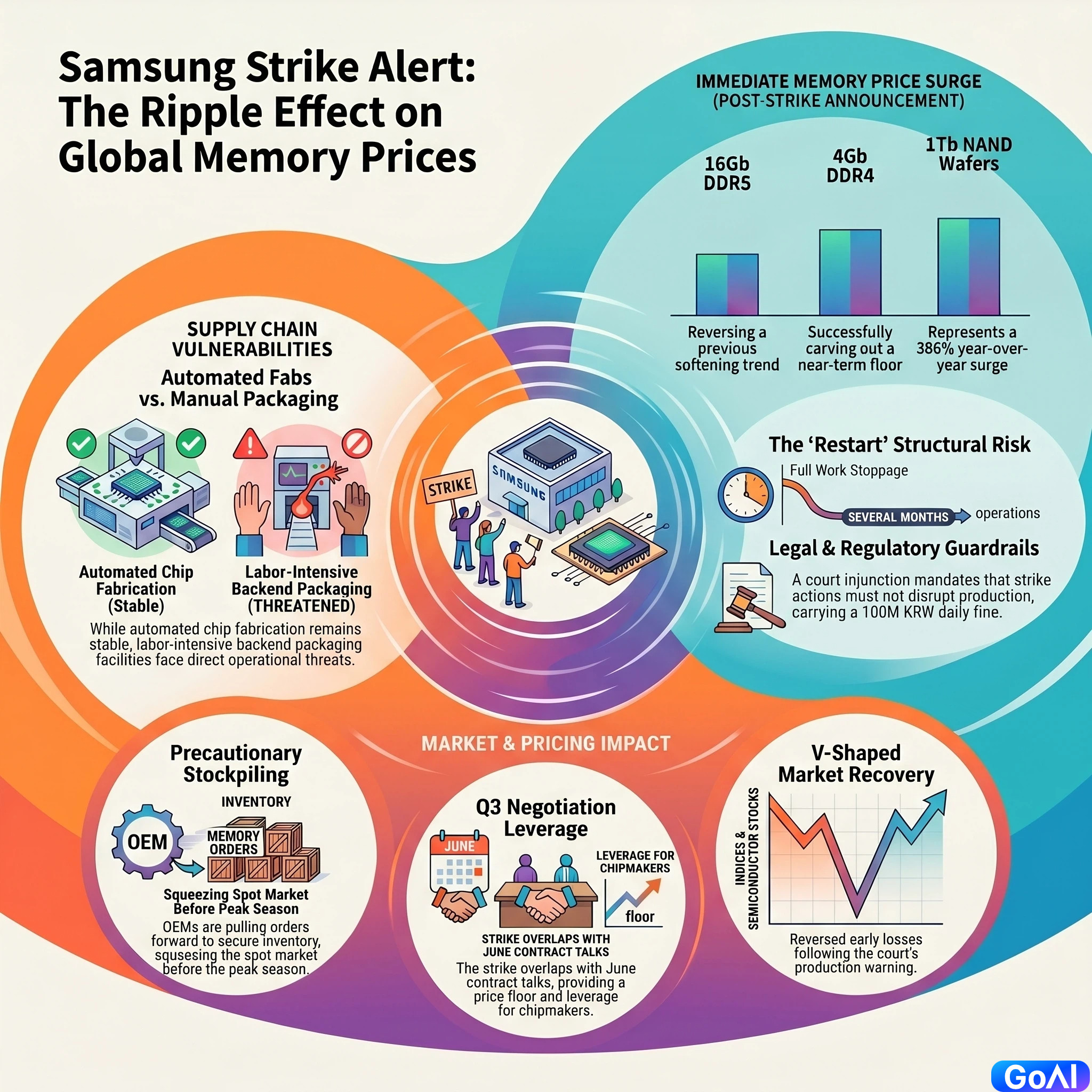
As the world's largest supplier of DRAM and NAND flash, Samsung Electronics is facing an escalating labor crisis that introduces fresh upside risks to memory chip pricing.
With the union planning an 18-day strike starting May 21, analysts warn the threat could trigger panic buying by OEMs and tech giants, driving up memory valuations just as crucial third-quarter contract price negotiations open.
On May 18, a South Korean court granted part of Samsung Electronics’ injunction request, ruling that any union strike action must not disrupt production.
Non-compliance with the court order carries a daily fine of approximately 100 million KRW.
Concurrently, Samsung management and union representatives entered a new round of government-mediated wage talks, with the union maintaining its core demand for a special bonus equivalent to 15% of the company's operating profit.
South Korean President Lee Jae-myung urged both sides to pool their wisdom, abandon unilateral demands, and seek cooperation.
The regulatory and legal developments triggered sharp volatility in domestic capital markets.
The benchmark KOSPI and KOSPI 200 indices plunged over 4% in early trading, only to stage a dramatic V-shaped recovery following the court’s warning order.
Heavyweight semiconductor stocks, including Samsung Electronics and SK Hynix, similarly reversed losses. The local turbulence also rippled through global investor sentiment toward broader technology equities.
According to a Bank of America Global Research report released on May 16, while the actual physical impact of a Samsung strike on global memory supply may remain relatively contained, precautionary stockpiling could act as a more immediate catalyst for higher prices.
Notably, DRAM and NAND spot prices have already staged a modest rebound this week, reversing a brief period of softening.
Limited Impact on Fabs, but Backend Packaging Remains Vulnerable
The planned 18-day walkout from May 21 to June 7 hinges on whether negotiations over the 15% operating profit bonus reach a stalemate.
Crucially, the timeline overlaps heavily with the negotiation window for Q3 memory contract prices—typically finalized in June—making the market hyper-sensitive to any threat of disruption.
BofA Securities suggests that because Samsung’s memory fabs operate on highly automated systems with minimal cleanroom personnel requirements, a complete shutdown is highly unlikely.
Consequently, the theoretical supply disruption from an 18-day strike should remain manageable.
However, labor-intensive backend packaging facilities face a more direct operational threat.
The report also cautioned that if a full work stoppage were to occur, it typically takes fabs at least several months to resume normal operations—a structural risk that cannot be ignored when assessing potential supply-side shocks.
Preemptive Stockpiling Flips Spot Price Trends
BofA Securities expects the primary transmission channel to memory pricing will be demand-side precautionary purchasing.
The firm notes that OEMs and major tech companies are likely to pull forward their procurement of Samsung memory chips to secure inventory ahead of the traditional September–October peak season, which will inevitably squeeze the spot market.
This seasonal sensitivity is amplified at the contract level. Because Q3 memory contract prices are hammered out in June, the strike creates immediate pricing leverage for chipmakers.
BofA Securities anticipates this friction will provide a solid floor for near-term contract pricing.
Preliminary pricing signals have already emerged. Data from DRAMeXchange shows that DRAM and NAND spot prices have stabilized and turned upward this week, breaking a softening trend seen throughout April and early May:
- 16Gb DDR5: Rose 2% over the week to $40.7.
- 4Gb DDR4: Post a 5% weekly gain.
- 1Tb NAND Wafers: Inched up 1% for the week, bringing its year-over-year surge to a staggering 386%.
BofA Securities highlighted that while DDR5 prices pushed further into positive territory this week, previously declining DDR4 and NAND categories have also successfully carved out a near-term floor.