
Nvidia Earnings Ahead: Three Key Questions Facing Jensen Huang

Artificial intelligence powerhouse Nvidia is scheduled to report its fiscal first-quarter results after the closing bell this Wednesday.
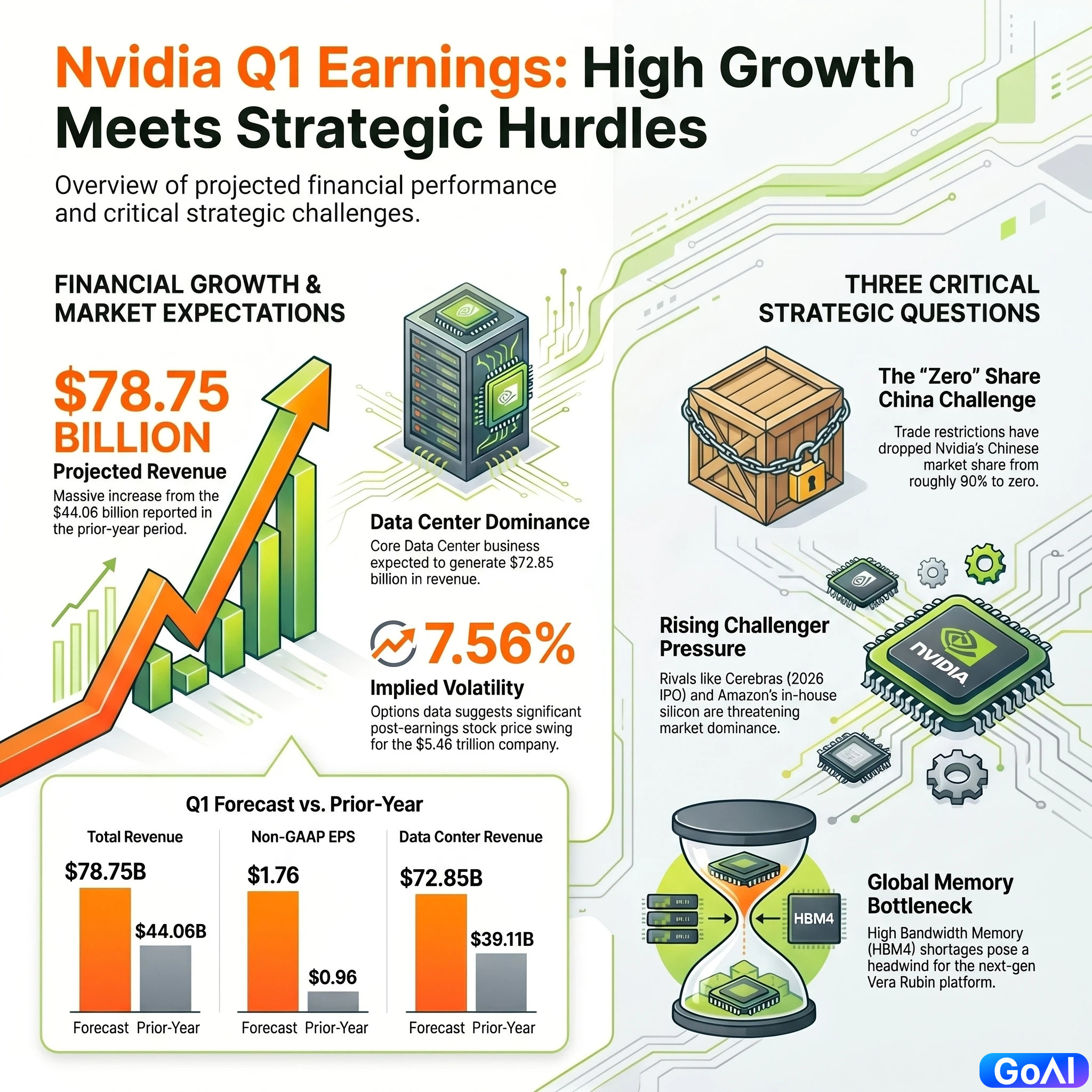
In what shapes up as the most anticipated event of the current earnings season, options data implies a potential 7.56% post-earnings stock price swing.
For a behemoth sporting a $5.46 trillion market capitalization, this level of volatility is poised to ripple across both Wall Street and global markets.
Beyond the headline financial metrics, global investors will be listening closely to the commentary from CEO Jensen Huang and other top executives regarding the broader trajectory of the semiconductor and AI landscapes.
The AI Darling Poised for Another Strong Showing
Nvidia has consistently beaten market expectations over the past two years, and the first quarter is expected to follow a similar template. Wall Street broadly anticipates another "beat-and-raise" print.
According to Bloomberg consensus estimates:
- Revenue: Projected at $78.75 billion, a massive jump from the $44.06 billion reported in the prior-year period.
- Non-GAAP EPS: Expected to hit $1.76, up from $0.96 a year ago.
The company's core Data Center business is expected to generate the lion's share of revenue, with forecasts hitting $72.85 billion (up from $39.11 billion in Q1 last year).
Within this segment, computation revenue is projected at $60.53 billion, while networking is expected to chip in $12.45 billion. Conversely, the gaming division is forecast to drop 3.26% year-over-year to $3.64 billion.
Reflecting this optimism, major investment banks have rushed to raise their price targets: Bank of America bumped its target to $320, Wells Fargo raised its outlook to $315, and UBS lifted its target to $275.
However, beyond the headline numbers, Wall Street analysts will focus heavily on how management addresses three critical structural questions during the conference call.
1. The Outlook for the Chinese Market
This earnings release comes on the heels of Jensen Huang’s recent high-profile visit to China alongside U.S. President Donald Trump. Consequently, Nvidia’s future sales pipeline in China will be a central focal point for analysts.
On April 30, Huang noted in an interview that trade restrictions had effectively erased Nvidia’s commercial footprint in the country.
"Nvidia used to command roughly a 90% market share globally," Huang stated. "But today in China, our market share has dropped to zero." Investors will expect direct commentary on how Nvidia plans to navigate geopolitical constraints moving forward.
2. Navigating Intensifying Competition
Nvidia also faces a rapidly crowding AI hardware landscape.
Last Thursday, AI chip challenger Cerebras Systems (CBRS) executed the largest IPO of 2026 so far, raising $5.55 billion.
The stock surged as much as 108% intraday before closing up 68% on its trading debut. Cerebras markets an alternative AI processor that it claims offers vastly superior compute speeds.
Concurrently, competitive pressure is mounting from AMD, which is scheduled to roll out a rival rack-scale server platform later this year. Furthermore, cloud hyperscalers are increasingly commercializing their proprietary silicon.
Amazon recently announced that its in-house chip business has reached a $20 billion annualized revenue run rate, expanding at a triple-digit percentage pace annually.
The company noted that AWS secured an agreement with OpenAI to provide 2 gigawatts of capacity on its Trainium chips, while Anthropic has committed to utilizing up to 5 gigawatts of current and future Trainium hardware.
Google has similarly inked a multi-generation, multi-gigawatt partnership with Anthropic focused on its Tensor Processing Units (TPUs).
3. Mitigating Global Memory Shortages
The global supply of advanced memory chips remains tightly constrained, a bottleneck that worsened during the first quarter.
This poses a major headwind for Nvidia given the immense High Bandwidth Memory (HBM4) requirements of its next-generation Vera Rubin platform.
Nvidia’s latest processors require up to 288GB of HBM per chip, with next-gen architectures relying on complex 16-layer stacking that will further drain global supply.
In the previous earnings call, CFO Colette Kress acknowledged memory constraints, confirming that the upcoming GeForce RTX 50-series graphics cards could face tight supply.
While Jensen Huang previously characterized the tight supply chain as a positive signal—arguing it encourages clients to prioritize top-tier architectures.
He also noted that Nvidia has moved aggressively to secure long-term capacity across memory suppliers, foundries, and advanced packaging facilities.
Wall Street will look for granular updates on how these supply agreements will safeguard the production ramp of the Rubin generation.