
Japanese NAND Giant Locked at Limit-Up as Wall Street Strategists Race to Double Price Targets

Following a blowout quarterly report that shattered market expectations, Wall Street institutions have rushed to aggressively double their price targets for Japanese memory manufacturer Kioxia Holdings.
As context, Kioxia released its latest financial results after Friday's closing bell.
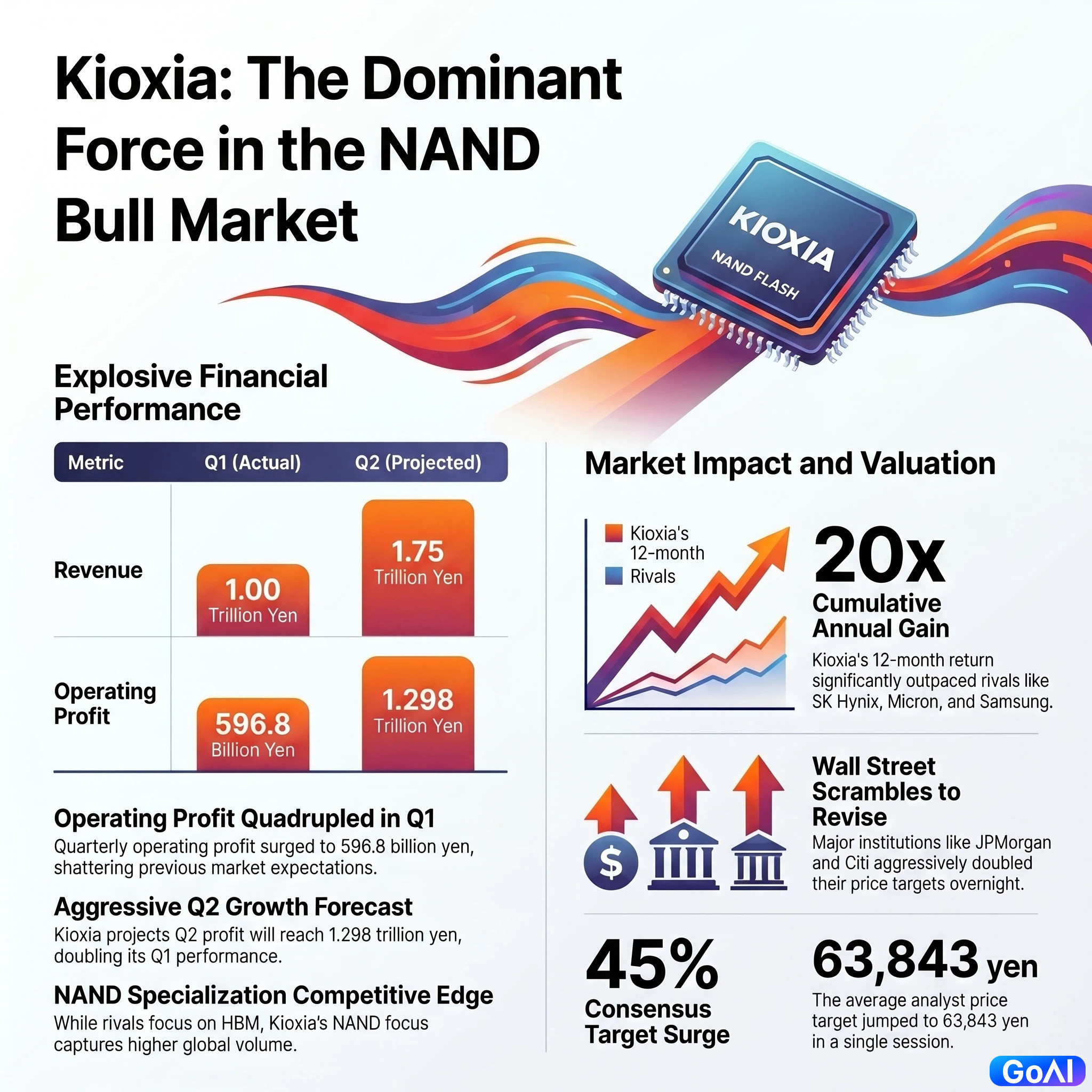
For the January–March quarter, the company recorded revenue of 1 trillion yen, with operating profit surging to 596.8 billion yen—more than quadrupling its fourth-quarter performance.
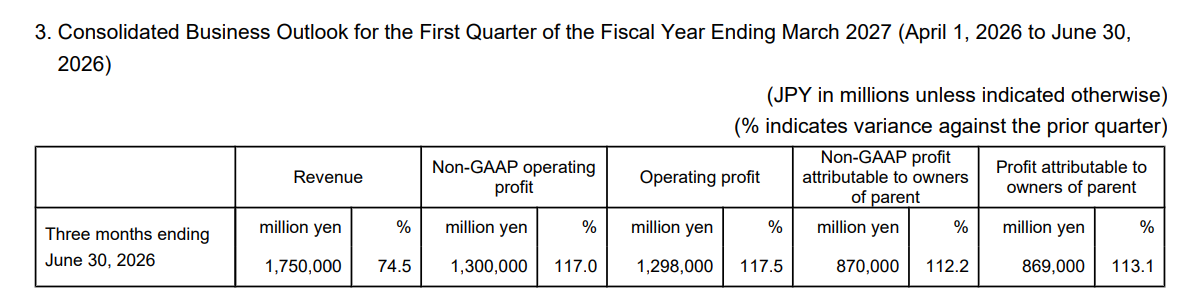
Building on this momentum, the company issued a highly ambitious forecast for the April–June quarter, projecting revenue of 1.75 trillion yen and an operating profit of 1.298 trillion yen, effectively doubling its Q1 bottom-line performance.
Similar to SK Hynix, Kioxia also officially announced plans to launch an American Depositary Receipt (ADR) program in the U.S.
Wall Street Scrambles to Revise Valuations
Confronted with an earnings report that beat expectations across the board, sell-side analysts immediately instituted major upward revisions to the NAND giant's price targets:
- JPMorgan: Raised from 38,000 yen to 80,000 yen
- Citi Global Markets (Japan): Raised from 31,000 yen to 73,000 yen
- Mitsubishi UFJ Morgan Stanley Securities: Raised from 33,000 yen to 70,000 yen
- Nomura Securities: Lifted its target from 51,000 yen to 68,000 yen
- BNP Paribas: Boosted its outlook from 40,800 yen to 66,660 yen
Following these revisions, Kioxia’s consensus analyst price target jumped to 63,843 yen on Monday, a spectacular 45% surge from the previous session's average of 44,000 yen.
This represents the sharpest post-earnings analyst divergence recorded among all Nikkei 225 constituents this season.
While Kioxia did not provide full-year guidance, Kazuyoshi Saito, Senior Analyst at Iwai Cosmo Securities, noted that given expectations that supply-demand dynamics will remain tight past July, an annual operating profit baseline of 5 trillion yen is a realistic starting point for the year.
NAND Specialization Yields Competitive Edge
Spun off from Toshiba in 2018, Kioxia has maintained a strict strategic focus on NAND flash production.
While its South Korean rivals produce similar hardware, their current infrastructure is heavily diverted toward the high-margin High Bandwidth Memory (HBM) track, allowing Kioxia to capture a disproportionate share of global NAND volume.
The company stated that NAND spot prices more than doubled in the first quarter and are projected to trend higher through the remainder of the year due to persistent supply constraints.
Management is currently negotiating long-term supply agreements with several hyperscale data center clients looking to secure capacity for 2027 and 2028.
Furthermore, Kioxia Chief Financial Officer Yoshihiko Kawamura revealed that the company plans to detail enhanced shareholder return initiatives next month, with cash dividends currently under active consideration.
Trading Paused in "Special Quote" Condition
During Monday’s trading session, Kioxia shares were frozen all day in a "Special Quote" condition.
A mechanism utilized by the Tokyo Stock Exchange (TSE) to pause continuous trading and allow only limit orders when a severe imbalance between buy and sell orders occurs.
Closing data showed that only 82,000 shares changed hands on Monday, booking a maximum permissible 15.75% daily gain to finish at the upper limit.
This volume sits far below Kioxia's typical daily liquidity of 30 million to 50 million shares.
Because the stock crossed the 50,000 yen threshold on Monday, its daily price limit band will widen to 10,000 yen on Tuesday.
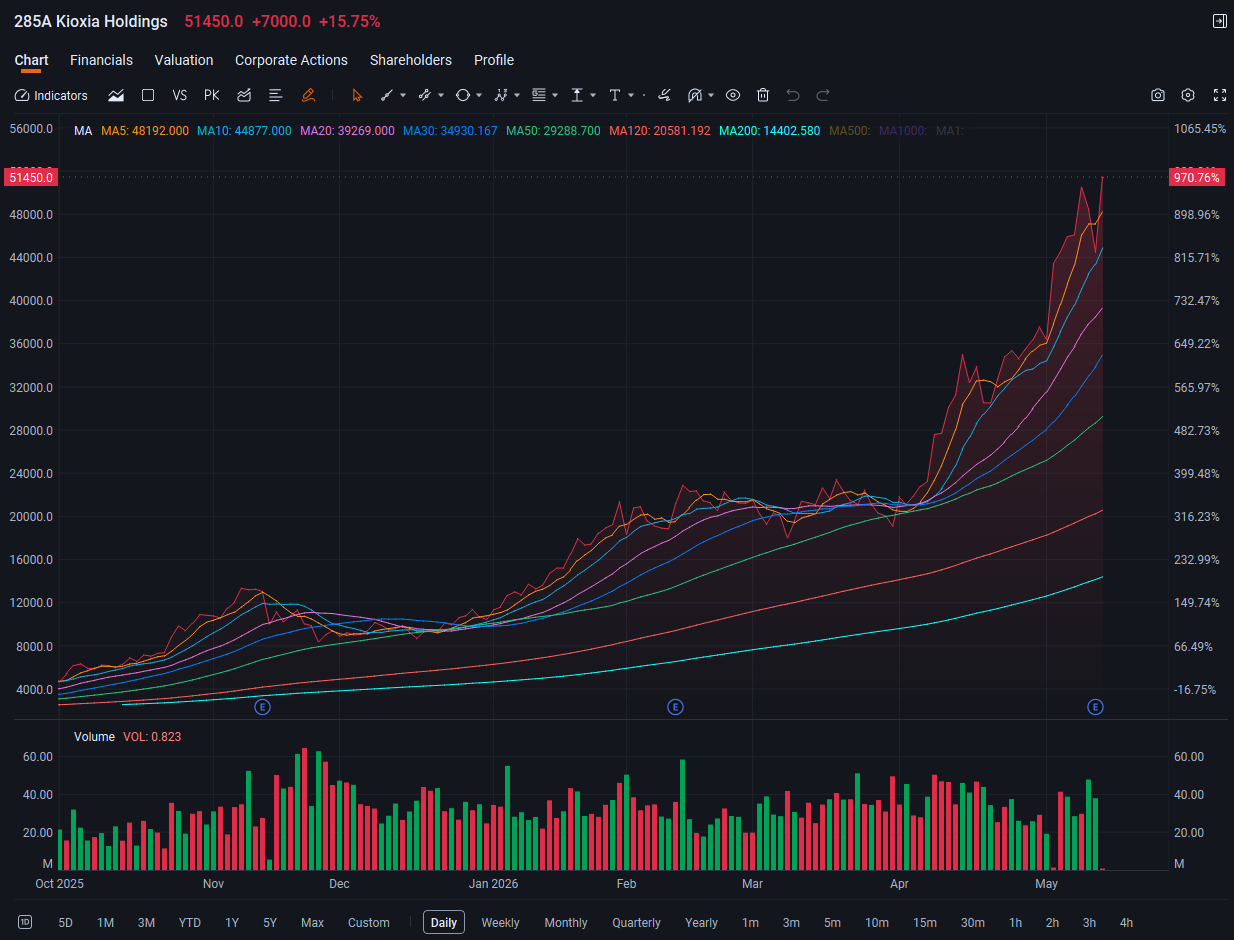
Over the past 12 months, Kioxia’s cumulative gain has exceeded 20-fold, comfortably outstripping the roughly 8-fold returns achieved by SK Hynix and Micron Technology, and the 4-fold increase at Samsung Electronics.
Within the current secular memory upcycle, Kioxia's performance trails only its pure-play NAND peer, SanDisk, which has surged over 30-fold.
With the surging share price pushing the entry threshold for a standard minimum trading lot (100 shares) to 5 million yen, Kioxia confirmed last Friday that it is reviewing measures to lower the investment barrier for retail investors, in alignment with TSE guidelines.