
SpaceX IPO Looms: Why Tesla Shareholders Are Panicking

For years, retail investors looking to back Elon Musk’s grand vision had only one realistic avenue: buying shares of Tesla Inc. That paradigm is about to shift, introducing a major risk factor for Tesla shareholders.
SpaceX is reportedly on track to file its highly anticipated initial public offering (IPO) prospectus as early as this Wednesday, with plans to debut on the Nasdaq exchange by June 12.
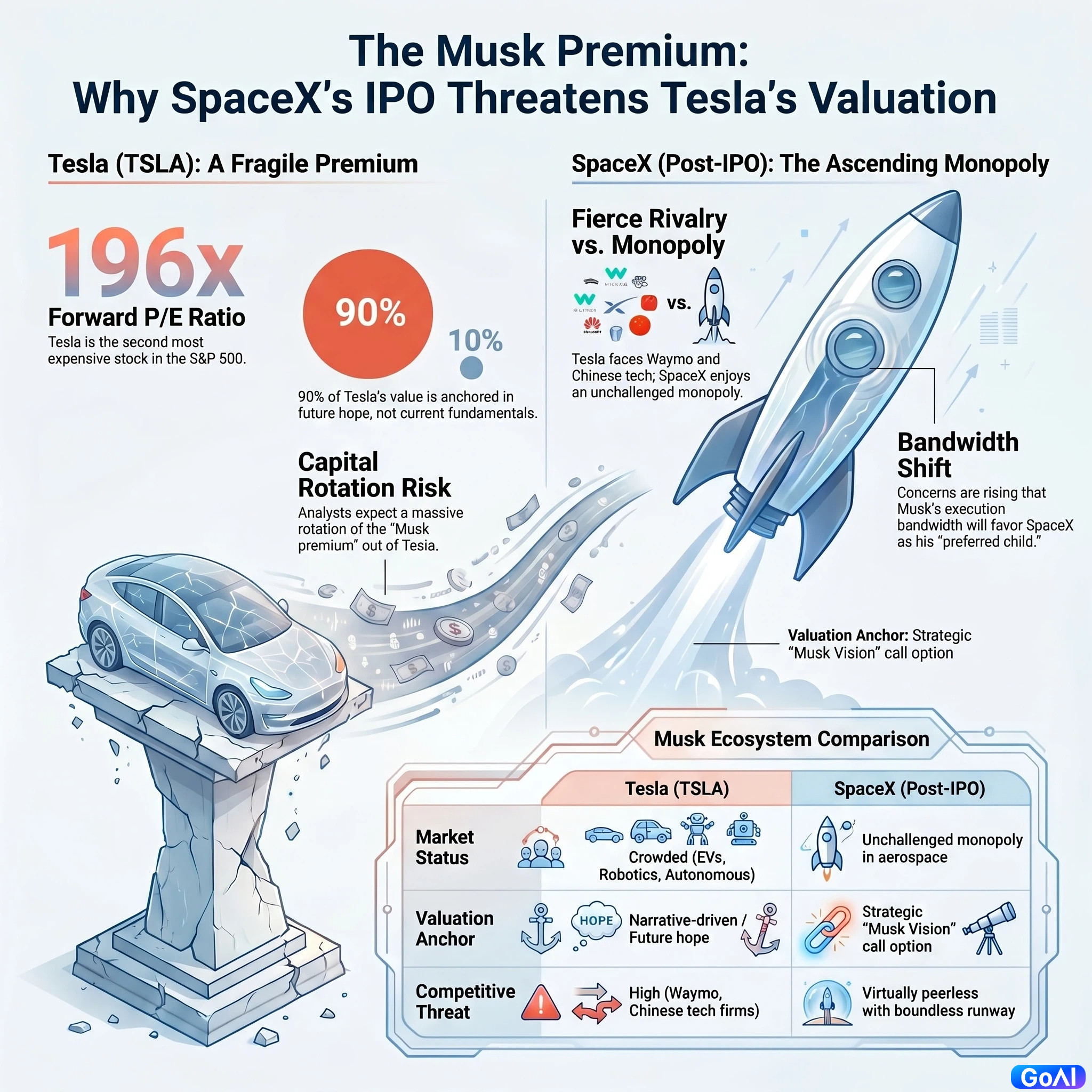
Wall Street professionals warn that capital and investor attention tied to the "Musk premium" will inevitably rotate out of Tesla and into the billionaire's shiny new public vehicle.
"This is definitely a headwind for Tesla," said Joe Gilbert, portfolio manager at Integrity Asset Management. "
We believe Musk’s attention and execution bandwidth will skew heavily toward SpaceX moving forward.
While he has tried to prove he can manage multiple empires simultaneously in the past, SpaceX feels like his preferred child this time around—and Tesla's interests could be compromised."
Is Tesla Being Eclipsed by its Sibling?
For a vast contingent of Tesla investors, traditional financial metrics have never been the primary driver of the stock price. Instead, buying Tesla equity has long been a proxy bet on Musk's overarching ambitions.
Despite mounting friction in its core automotive sales segment, Tesla’s stock price still managed a staggering 265% run between early 2023 and the end of 2025.
Even with an 8.8% year-to-date pullback, Tesla still commands a forward 12-month price-to-earnings (P/E) ratio of roughly 196x, making it the second most expensive stock in the S&P 500.
This premium valuation relies entirely on a "confidence vote" in Musk’s ability to successfully pivot Tesla from a pure-play EV manufacturer into a dominant autonomous driving and robotics powerhouse.
However, Tesla faces fierce structural competition on both frontiers.
In autonomous driving, it is chasing Alphabet's fully operational Waymo; in robotics, a legion of tech companies—particularly Chinese tech firms—are already aggressively scaling humanoid assistants.
Conversely, SpaceX enjoys a virtually unchallenged monopoly in commercial aerospace, backed by a seemingly boundless growth runway.
"We expect SpaceX to command a massive valuation at its debut because it effectively operates without peers," Gilbert noted, going as far as to predict that SpaceX’s market capitalization could eventually overtake Tesla’s.
"Any Musk-affiliated company has a 'Musk Vision' call option embedded into its valuation, and right now, SpaceX looks like the cleaner bet."
Dave Mazza, CEO of Roundhill Financial, offered a slightly more balanced view:
"Tesla and SpaceX are entirely different businesses, and investors who buy into the Musk ecosystem will likely want exposure to both. That said, SpaceX is the shiny new toy, and we fully expect a portion of capital to rotate out of Tesla to catch the initial wave of momentum."
A Slow-Moving Hit to Tesla's Valuation
Nicholas Colas, co-founder of DataTrek Research, suggests the capital flight might take about three months to clearly manifest in Tesla’s share price. Institutional reallocation takes time, and early post-IPO price action can often be choppy.
Colas highlighted that while typical corporations derive their market value from a roughly 50/50 split between current fundamentals and future growth potential, Tesla is an outlier because it trades heavily on Musk’s narratives rather than actual financial performance.
"In my coverage of Tesla, the ratio between future value and current value has always trended closer to 90/10," Colas explained. "The vast majority of the company's valuation is anchored in future hope, not present reality."
Ultimately, Colas believes that if Tesla and SpaceX remain separate publicly traded entities rather than merging.
The capital dynamics will structural favor SpaceX over the long term, given that the aerospace giant commands "a much clearer and more defensive competitive advantage in its core business."