
Tonight’s Highlights: Google I/O Keynote Tonight; U.S. Markets Consolidate Ahead of Nvidia Earnings

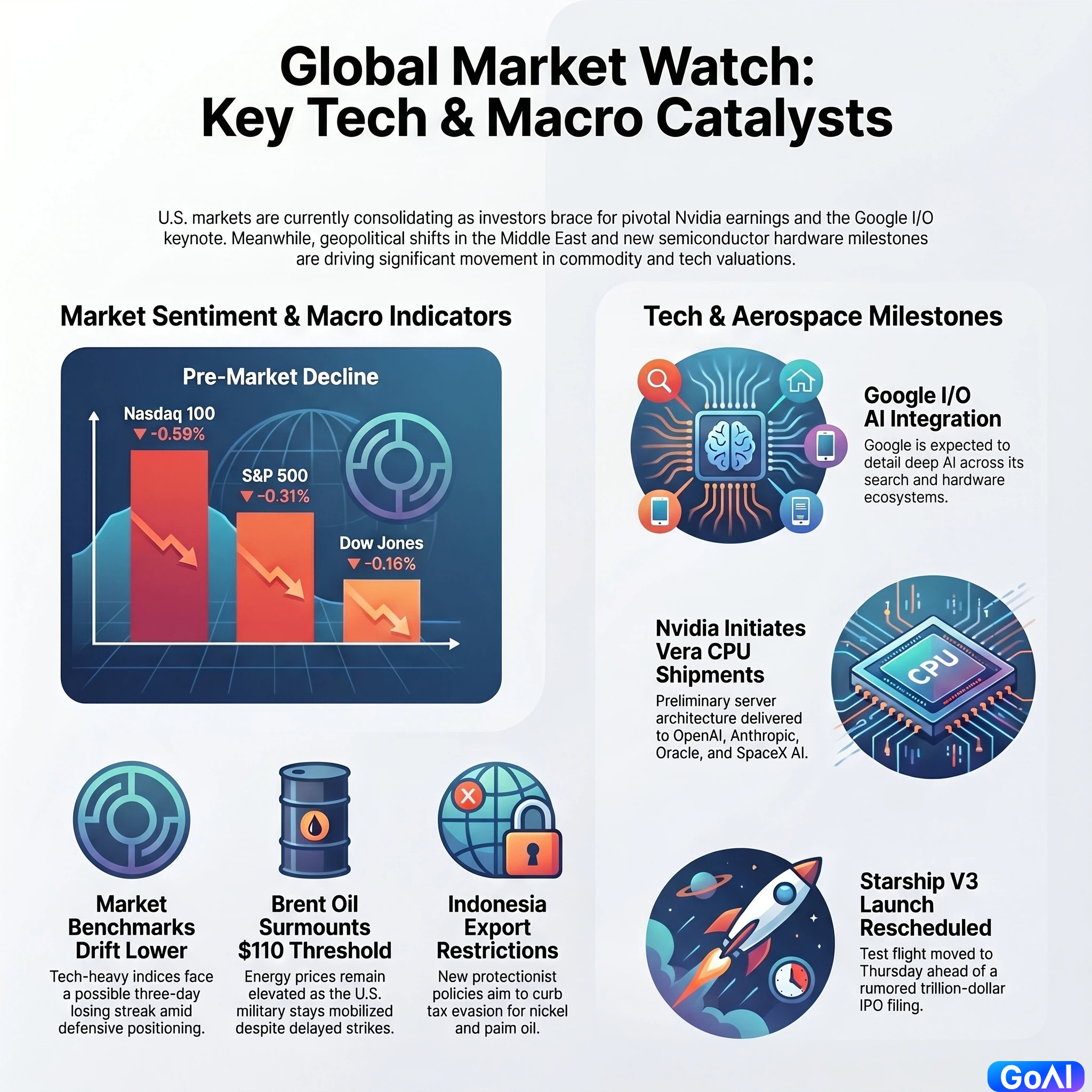
U.S. equity futures drifted lower ahead of Tuesday's opening bell as a persistent consolidation across large-cap technology shares continued to weigh on broad benchmarks.
At the time of writing, tech-heavy Nasdaq 100 futures slipped 0.59%, while S&P 500 futures fell 0.31%, and Dow Jones Industrial Average futures edged down 0.16%.
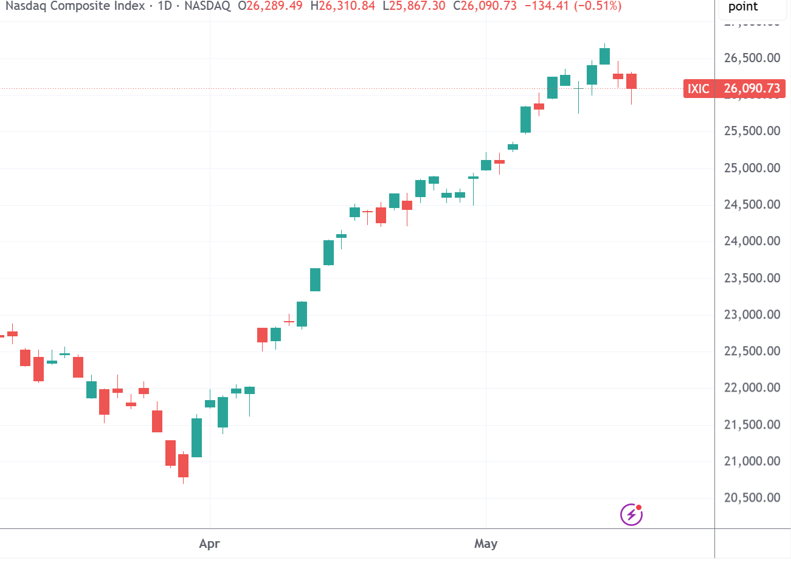
A negative close tonight would mark the first three-day losing streak for both the S&P 500 and the Nasdaq Composite since their respective market bottoms in March.
Semiconductor names remained under clear pressure, a trend analysts largely attribute to defensive positioning ahead of Nvidia's blockbuster earnings release tomorrow after the close.
Memory and storage providers, including Micron, Seagate, and SanDisk, all ticked lower pre-market.
Concurrently, news that Alphabet is forming a specialized, TPU-driven cloud computing joint venture with Blackstone sparked a sell-off in emerging GPU-cloud challengers. Both CoreWeave and Nebius dropped nearly 4% in early trading.
The primary macro headline tonight centers on Google’s annual developer conference, with the main Google I/O keynote scheduled to kick off.
Following the template established last year, Google is widely expected to utilize the prolonged presentation to detail deep AI integrations across search, hardware, and its broader software ecosystem.
Separately, SpaceX’s 12th Starship test flight—marking the maiden voyage of the upgraded V3 architecture—has been pushed back for a second time this week.
The launch window is now rescheduled for Thursday, local U.S. time. Given that SpaceX is heavily rumored to file a trillion-dollar public listing prospectus as early as tomorrow, the implications of this flight hardware execution stretch far beyond scientific milestone tracking.
In commodities, global oil benchmark Brent crude climbed back above the $110 per barrel threshold.
Over the weekend, U.S. President Donald Trump posted on social media that, at the request of Gulf allies, he instructed forces to hold off on planned strikes against Iran scheduled for Tuesday, May 19.
However, the President emphasized that the U.S. military remains fully mobilized to execute a large-scale offensive should negotiations fail.
"Investors are desperate for a resolution to the Middle East conflict, as it would theoretically cool energy prices, silence hawkish monetary policy rhetoric, and shift the narrative back to growth,"
noted Dan Coatsworth, Investment Analyst at AJ Bell. "With the geopolitical risk profile still active, markets are choosing to err on the side of caution."
Elsewhere, London nickel and palm oil futures pushed higher on reports that Indonesia is prepping tighter export restrictions on key commodities, including coal and palm oil.
The protectionist policy aims to curb tax evasion and anchor the local currency, potentially through a newly established state export management entity.
Sources close to the matter indicate the regulatory framework could be signed into law as early as this Wednesday.
Corporate News
Nvidia Commences Vera CPU Shipments: Nvidia officially announced Tuesday morning that it has initiated preliminary deliveries of its first Vera CPU systems to Anthropic, OpenAI, Oracle, and SpaceX AI.
Ian Buck, Vice President of Hyperscale and HPC at Nvidia, hand-delivered the initial server architecture.
According to the filing, Elon Musk personally received the hardware at the SpaceX AI facility, engaging in a highly technical Q&A session with Buck covering compute cores, memory geometry, and thermal dynamics.
Musk later posted a pun on social media, describing the hardware as "Vera nice."
Intel Reportedly Pushes PC OEMs to 18A Node: Reports emerging Tuesday suggest personal computer manufacturers are navigating a difficult operational bottleneck as AI infrastructure demands consume mature-node CPU capacity.
OEMs are reportedly being backed into a corner: either migrate to Intel’s leading-edge, significantly higher-cost 18A process nodes or risk severe supply shortages as allocations shift away from legacy architecture.
ASML Confirms High-NA EUV Production Timeline: ASML Chief Executive Christophe Fouquet stated Tuesday that the first commercial chips manufactured using the company’s cutting-edge High-NA EUV lithography systems will debut within months.
The executive's timeline arrives just weeks after foundry giant TSMC publicly questioned the near-term economic viability of the machinery, noting that High-NA systems—which command price tags up to $400 million per unit—remain heavily cost-prohibitive.