
Foreign Flight, Retail Frenzy: Wall Street Warns of Escalating Risks in South Korean Equities

Driven by the secular global artificial intelligence boom, international capital clustered heavily into Northeast Asia earlier this year, establishing South Korea as the world’s top-performing equity market.
From the turn of the year through early May, the benchmark KOSPI index notched a spectacular rally of over 80%, eclipsing its entire 2025 return of 75.63%.
However, the tide shifted violently over the past week. Following a precipitous 9% three-day drop ending Tuesday, the KOSPI extended its decline into Wednesday’s session, skidding over 3% in early trading.
As volatile price action triggers trading halts on local exchanges, a stark divergence has emerged: institutional foreign capital is executing a massive retreat, while local retail investors, gripped by intense market euphoria, rush to buy the dip.
Strategists at Goldman Sachs and Citigroup are now sounding the alarm, warning that underlying risk parameters for South Korean equities are flashing red.
The Double-Edged Sword of Tech Concentration
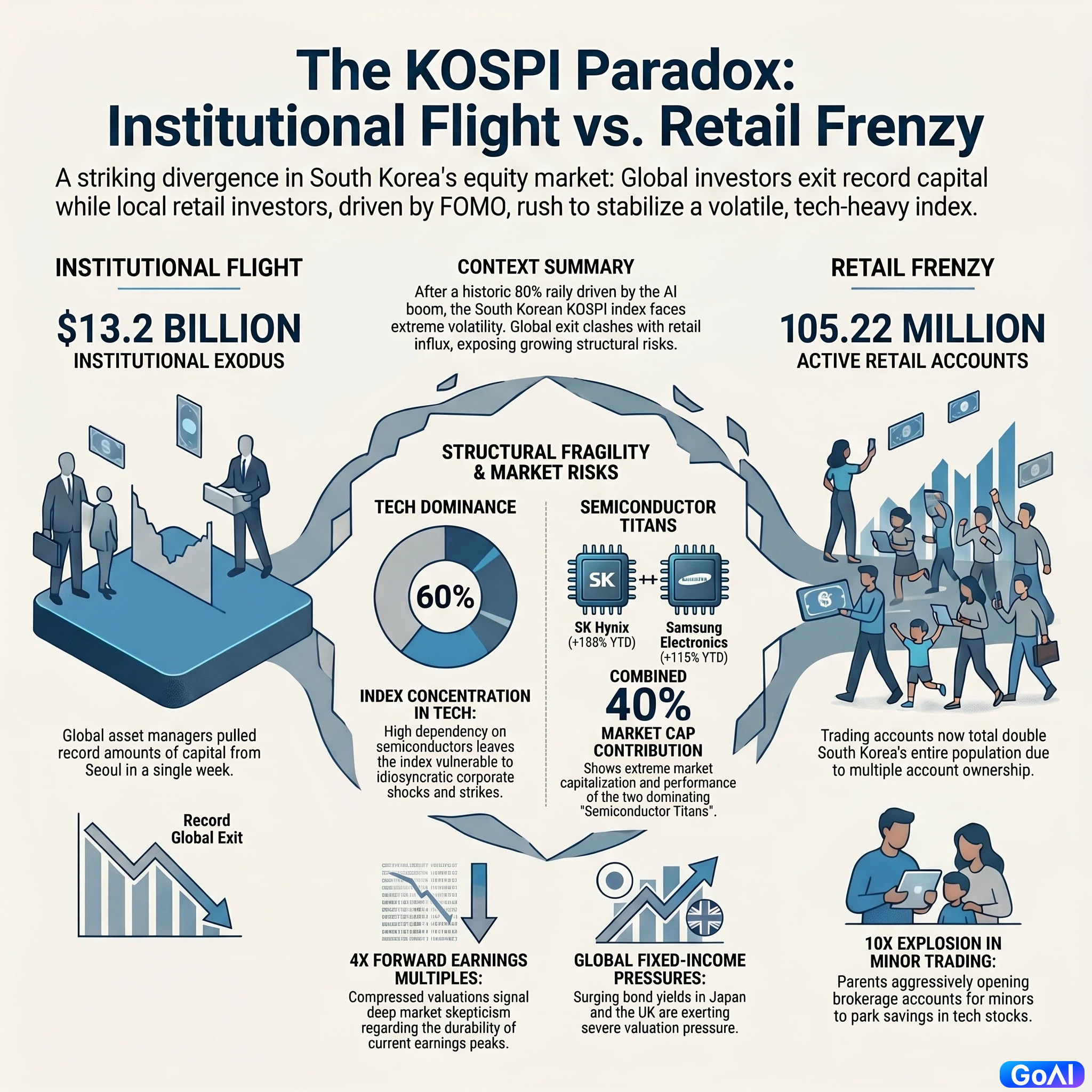
Tim Moe, Chief Asia-Pacific Equity Strategist and Co-Head of Asia Macro Research at Goldman Sachs, pointed out that the KOSPI’s historic bull run was fundamentally anchored in the "immense alpha" generated by its technology sector, which commands a staggering 60% weighting in the headline index.
The market's meteoric ascent was almost exclusively engineered by its dual semiconductor titans. Year-to-date, Samsung Electronics has surged over 115% while SK Hynix has jumped more than 155%.
Together, these two memory giants account for over 40% of South Korea’s total equity market capitalization.
This extreme concentration leaves the entire index vulnerable to idiosyncratic corporate shocks.
The fragile dependency became clear last week when a severe breakdown in labor negotiations—culminating in a union threat to launch an 18-day strike this Thursday—sparked a sharp sell-off in Samsung shares, dragging down the broader market.
Even if labor frictions ease, Goldman Sachs warns that cyclical clouds are gathering over the semiconductor trade.
Moe noted that Samsung and SK Hynix are currently trading at compressed multiples of five to six times forward consensus earnings for this year, and roughly four times projected earnings for next year.
"This severely compressed valuation structure indicates that the market harbors deep skepticism regarding the durability of this current earnings peak," Moe noted.
Concurrently, Citigroup strategists have dialed back their bullish stance on the region, explicitly warning that South Korean equities have reached a state of technical overbuying that outpaces even Wall Street.
"While macroeconomic liquidity indicators imply we remain far from a forced tightening of local financial conditions—suggesting a full-blown secular bear market is not yet our baseline scenario—the KOSPI is technically far more overbought than the S&P 500,"
Citi noted. "Prudence dictates that market participants should harvest profits on at least half of their existing exposure."
Foreign Outflows Met by an Unprecedented Retail Wave
The structural rotation of institutional capital out of Seoul has reached historic proportions. According to Goldman Sachs, global asset managers pulled a net $17 billion from emerging Asian equities (excluding China) last week, marking the second-largest weekly capital flight on record.
South Korea bore the brunt of this exodus, enduring a massive $13.2 billion institutional divestment. The sudden liquidity drain pushed local market volatility to near-historic thresholds on Monday, forcing the Korea Exchange (KRX) to temporarily deploy programmatic circuit breakers to stabilize order books.
Yet, as foreign funds exit, local retail investors are stepping in with unbridled optimism. Retail accounts have emerged as the primary marginal buyers of Korean equities this year, weaponizing high levels of margin debt and leveraged ETFs to build exposure.
While Citi notes this retail bid does not guaranteed the death of the bull market, it fundamentally alters the quality of market structure and heightens drawdown risks.
Data from the Korea Financial Investment Association underscores the sheer scale of domestic equity participation.
As of May 4, 2026, the number of active retail brokerage accounts soared to a record 105.22 million—roughly double South Korea’s entire population of 51 million, pointing to a proliferation of multiple trading accounts per individual.
Driven by acute fear-of-missing-out (FOMO) following the early-year rally, this speculative retail culture is rapidly trickling down to the next generation.
Parents are aggressively opening brokerage accounts for minors to park family savings in technology stocks. According to Toss Securities, the volume of new minor trading accounts opened during the first quarter exploded nearly tenfold compared to the same period last year.
Global Fixed-Income Breakouts Compound Local Pressures
Adding to the equity market's headwinds is a sharp, structural shift in global fixed income.
Citigroup highlighted a technical "back-end breakout" in global sovereign bond yields, with Japanese Government Bonds (JGBs) and UK Gilts surging to multidecade highs as the geopolitical logjam in Iran stokes fears of a structural oil shock.
There is an acute concern that this global yield spike, paired with a persistent geopolitical risk premium, will begin to exert severe valuation pressure on Asia's top-performing, high-duration equity sectors.
Despite these near-term structural pressures, neither Citigroup nor Goldman Sachs believes the absolute structural ceiling for South Korean equities has been breached.
Goldman estimates that local retail buyers absorbed a massive $14.1 billion in equity volume last week alone, providing a highly resilient domestic cushion.
Meanwhile, Citi maintained that while it has closed out half of its tactical Korean long positions to lock in gains, it is not completely exiting the market.
The bank expects the KOSPI to receive a powerful liquidity buffer in the immediate term, as passive investment vehicles reallocate capital to the region ahead of the upcoming semi-annual MSCI Index rebalancing.