
Wall Street Reconstructs Nvidia: Runway Stretches Beyond GPU as AI Capex Remains in Early Innings

Against a backdrop of heightened anticipation across Silicon Valley and Wall Street, artificial intelligence bellwether Nvidia Corp. delivered another definitive beat-and-raise performance after Wednesday's closing bell.
The semiconductor giant's print was anchored by unrelenting demand for its core AI infrastructure and next-generation Blackwell platforms.
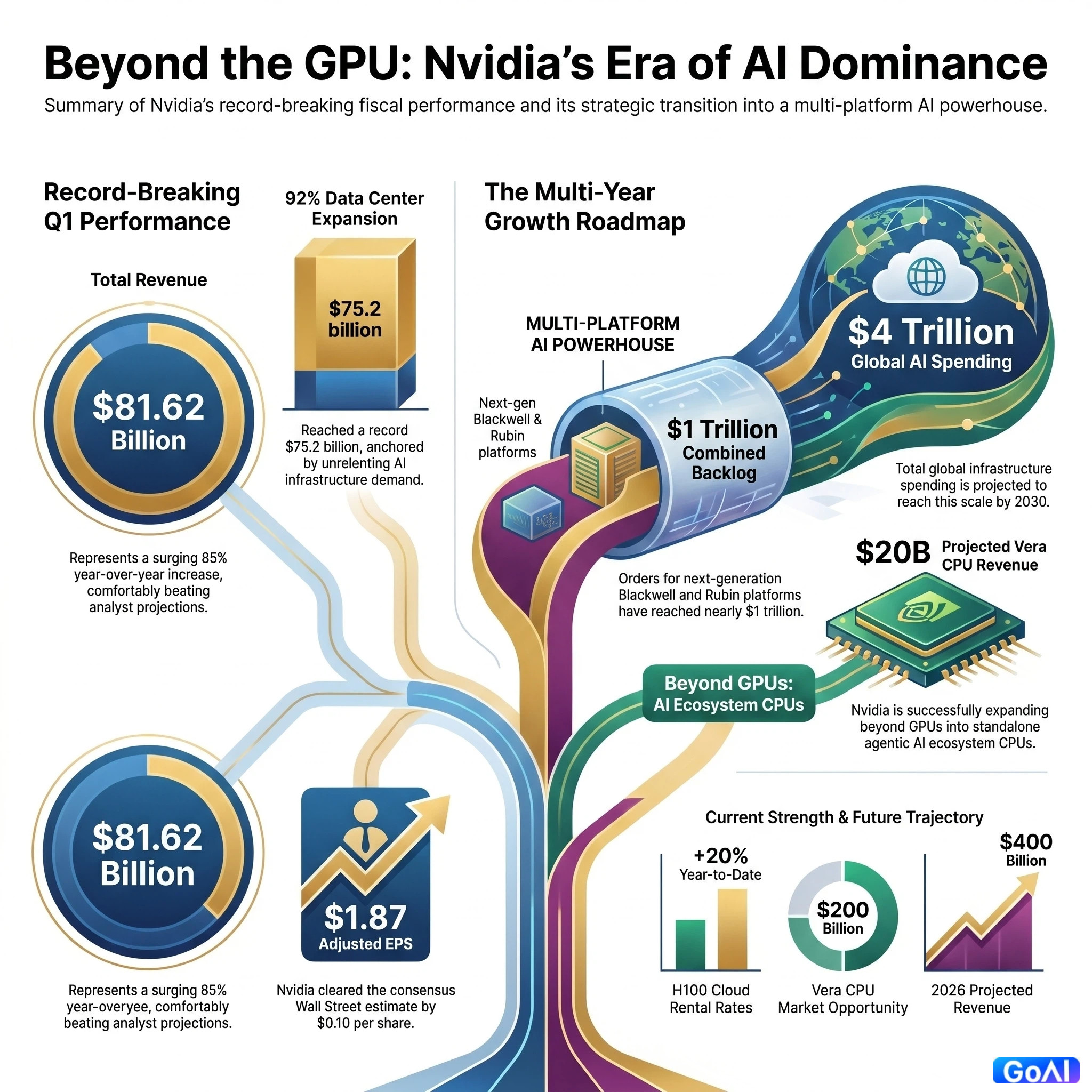
Nvidia reported adjusted earnings per share (EPS) of $1.87 for its fiscal first quarter, clearing the consensus Wall Street estimate by $0.10.
Top-line revenue surged 85% year-over-year to $81.62 billion, comfortably ahead of the $78.8 billion projected by analysts.
The company's critical Data Center segment clocked a record-breaking $75.2 billion in revenue, representing a massive 92% annualized expansion.
Looking ahead, management guided fiscal second-quarter revenue to approximately $91.0 billion, handily outperforming the $87.0 billion consensus target compiled by analysts.
Despite the stellar headline execution and robust forward-looking guidance, Nvidia shares dipped over 3% in post-market trading before trimming losses to sit down 1.2%.
Market observers attributed the soft reaction to heavily front-loaded expectations going into the print.
Furthermore, a gross margin figure that merely matched rather than exceeded the street's elevated whisper numbers prompted some tactical caution among short-term traders.
Even so, Wall Street consensus remains heavily tilted toward the bulls, with an average 12-month price target of $281.97, implying a compelling 26% upside runway from its current trading level of $223.47.
Daniel Ives, Managing Director and Senior Equity Research Analyst at Wedbush, dismissed the brief post-market soft patch, describing the release as another flawless report card from Nvidia founder Jensen Huang.Ives noted that the financial disclosures offer institutional allocators enhanced visibility into the company's product pipeline, commercial backlogs, and multi-year AI roadmaps.
Ives asserted that the market continues to systematically underestimate Nvidia's growth trajectory over the next few years. This is particularly true as enterprise clients, sovereign nations, and hyperscale cloud providers ramp up capital commitments to generative AI infrastructure.
The long-standing technology bull projects that absolute global AI infrastructure spending will scale to between $3 trillion and $4 trillion by 2030.
Ives highlighted that rental rates for Nvidia’s H100 architecture on cloud platforms have climbed roughly 20% year-to-date, while legacy A100 pricing rose 15%.
This structural pricing power effectively dampens fears of near-term depreciation friction or a cooling demand curve among top-tier cloud operators.
Crucially, Ives noted that Nvidia's growth runway has evolved past a pure GPU narrative. During the earnings call, management detailed an aggressive CPU expansion tailored for autonomous, agentic AI ecosystems.
Nvidia projects that its standalone Vera CPU systems will generate roughly $20 billion in revenue this year alone.
Ives believes the broader addressable CPU market caught directly in AI infrastructure could ultimately represent a massive $200 billion structural opportunity.
Furthermore, Wedbush highlights that Nvidia's combined Blackwell and Rubin backlogs have scaled to near $1 trillion.
Volume shipments of the next-generation Vera Rubin architecture are on track to commence in the second half of this year.
Ives warned that due to an extensive queue of enterprise and hyperscale customers looking to lock in allocations, the Rubin platform will likely face structural supply constraints throughout its entire lifecycle.
Following the release, Goldman Sachs maintained its Conviction Buy rating on Nvidia with a 12-month price target of $250.
The firm highlighted that management's aggressive stance on capital allocation provides a strong technical cushion for the equity. This includes an additional $80 billion share repurchase authorization paired with a dividend hike, reinforcing a defensive floor for the valuation.
Gene Munster, Managing Partner at Deepwater Asset Management, emphasized that Nvidia's metrics demonstrate that despite the massive scale already achieved, the secular AI spending cycle remains in its early innings.
Munster noted that management's explicit commentary regarding strategically secured inventory and foundry capacity proves that underlying demand continues to dictate the company's operational velocity.
He forecasts that Nvidia's calendar year 2026 revenue could approach $400 billion, a staggering trajectory compared to the roughly $27 billion reported in 2022.
However, Munster offered a structural caveat: as Nvidia's absolute scale inflates, institutional investors will naturally begin modeling a forward growth deceleration.
This shift in terminal growth assumptions could make it increasingly difficult for the stock to deliver outsized, multi-bagger returns moving forward.
Daniel Newman, CEO of The Futurum Group, suggested that Nvidia’s multi-trillion-dollar market capitalization structurally prevents the explosive, short-term percentage gains commonly seen in small-cap AI plays.
Newman noted that while the underlying business fundamentals are bulletproof, the sheer laws of large numbers limit the stock's ability to double overnight.
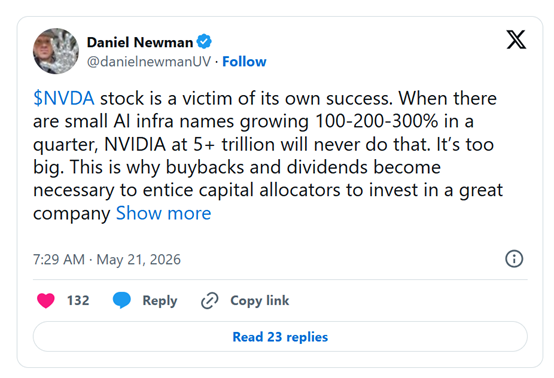
Writing on X, Newman emphasized that "the AI macroeconomic show will continue," pointing out that Nvidia's forward guidance cleared even the highest internal whisper numbers.
Prominent market commentator Jim Cramer urged market participants to look past the volatile, knee-jerk price action in the immediate post-market window.
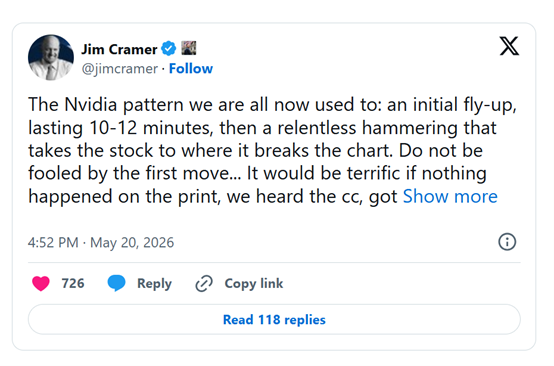
Cramer posted on X that we have seen this programmatic trading pattern play out with Nvidia time and again: an initial headline spike, followed by algorithmic selling pressure and short-term fade operations.
In a subsequent commentary, Cramer noted that even as tech giants like Amazon and Alphabet funnel billions into proprietary, in-house ASIC infrastructure, Nvidia's commercial GPUs continue to vastly outperform the competition in long-term asset value retention and architectural defensibility.