
APAC Market Wrap - May 21

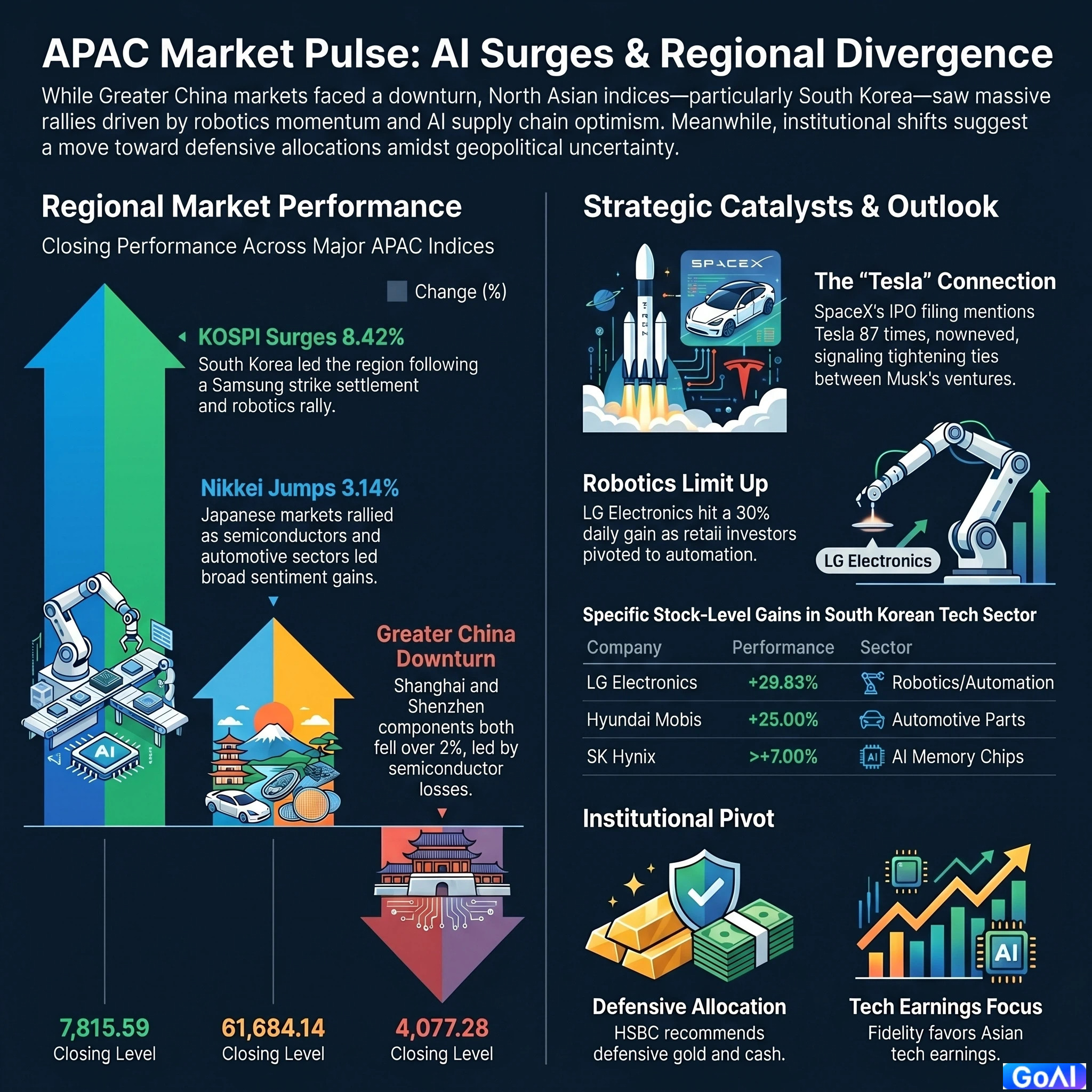
Chinese Mainland Equity Markets: The Shanghai Composite component dropped 2.04% to close at 4,077.28, while the Shenzhen Component fell 2.07% to 15,247.27.
The ChiNext Index slid 2.35% to 3,829.78. Sector-wise, banking, intelligent driving, and auto parts bucked the trend to post gains, while semiconductors, telecom equipment, power equipment, lithium batteries, and photovoltaics led the losses.
Hong Kong Equity Market: Hong Kong stocks closed broadly lower. The Hang Seng Index fell 1.03% to 25,386.52, the Hang Seng Tech Index dropped 2.15% to 4,768.90, and the Hang Seng China Enterprises Index slipped 1.51% to 8,475.32.
Large-cap tech names suffered broad losses: Tencent fell 3.56%, Bilibili slid 7.46%, and Kuaishou dropped 5.66%. Oil, commercial aerospace, and optical communications also weakened, leaving only local property and select financial stocks to offer modest defensive support.
Japanese Equity Market: The Nikkei 225 jumped 3.14% to finish at 61,684.14. Sector performance showed semiconductors, automotive, and precision manufacturing leading the rally.
Power, gas, and retail posted modest gains as broader market sentiment turned warm.
South Korean Equity Market: The KOSPI surged 8.42% to close at 7,815.59. At the sector level, semiconductors, memory chips, and automakers rallied sharply, with Samsung Electronics up over 5% and SK Hynix gaining over 7%.
Healthcare and biotech also advanced, reinforcing a pervasive market-wide rally.
Australian Equity Market: The S&P/ASX 200 Index closed up 1.47% at 8,621.70. Materials, mining, financials, and industrials led the gains, while energy and utilities saw mild pullbacks.
Singapore Equity Market: The Straits Times Index ticked up 0.02% to close at 5,045.71. Local banks and industrials edged higher, while telecoms and real estate weakened amidst a volatile, consolidating market.
Malaysian Equity Market: The FTSE Bursa Malaysia KLCI dropped 0.54% to 1,708.36. Tech and semiconductor shares bucked the downward trend, but weakness in banking, plantations, and energy dragged the broader market lower.
Key Events
Data Centers, Pet Food, and Instant Noodles: Capital Bets on Asian AI and New Consumer Trends
Against the backdrop of a relentless global AI boom, hedge funds are boosting exposure to the AI supply chain and Gen Z consumer assets.
From data centers and printed circuit boards (PCBs) to pet food and instant noodles, hard tech and new consumption emerged as the hottest themes at this year’s Sohn Investment Conference in Hong Kong.
At Wednesday's summit, a substantial number of hedge fund managers and chief investment officers laid out their current investment strategies.
A 2027 Merger? Wall Street Speculation Reignited as SpaceX Prospectus Cites Tesla 87 Times
Musk’s space and AI venture, SpaceX, officially filed its Form S-1 registration statement with the SEC on Wednesday, drawing closer to an epic IPO that sent shockwaves through Wall Street and Silicon Valley.
Investors are combing through the prospectus for key data points to value the rocket maker. Notably, the ties between SpaceX and Tesla are growing tighter: the word "Tesla" appears 87 times in the document—a striking frequency considering "Musk" appears only 174 times.
Samsung Strike Settled as Robotics Momentum Takes Center Stage; South Korea's LG Electronics Hits 30% Limit Up
With the Samsung strike taking a dramatic eleventh-hour turn, South Korean equities—boasting world-leading upward momentum—rebounded sharply on Thursday. The KOSPI surged over 8% to close at 7,815.59, just a stone's throw away from its previous high of 8,000.
Retail investors, known for driving thematic plays, pivoted to robotics companies on the thesis that automation demand will expand.
LG Electronics closed up 29.83%, hitting the 30% daily limit. Hyundai Motor (parent of Boston Dynamics) and Kia both rose over 12%, while parts maker Hyundai Mobis jumped over 25% and Samsung Electro-Mechanics gained over 13%.
Top Coffee Producers Set for Record Exports; Industry Warns of Sharp Price Correction
Global coffee shipments are poised to surge in the new crop year, threatening to severely depress international prices, though El Niño patterns could disrupt planting schedules and stoke volatility. Carlos Santana, head of ECOM’s Brazilian arm EISA, noted that Brazil will export a record volume of coffee in the crop year starting July due to bumper yields.
With the market currently backwardated (spot prices trading above futures), growers are incentivized to sell quickly. Green coffee exports from Brazil are projected to reach roughly 50 million 60-kg bags, up from the previous record of 46.3 million bags in 2024.
Institutional Perspectives
HSBC Private Banking: Downgrades Emerging Asia, Recommends Defensive Allocation Against Oil and Geopolitical Shocks
Citing escalating Middle East geopolitical conflicts, high oil prices, and Fed policy uncertainty, HSBC Private Banking has downgraded emerging Asian equities and significantly cut its exposure to India. It advises investors to increase allocations to gold, cash, and hedge funds.
However, it remains constructive on the long-term prospects of China (A-shares and Hong Kong), Singapore, South Korea, and Japan, noting that Asia houses an abundance of AI and tech leaders with distinct growth and valuation advantages in semiconductors and e-commerce.
Fidelity International: Asian Tech Earnings Growth Outpaces Global Peers; Memory Chips and Cloud Computing Lead the Way
Fidelity International highlights that earnings growth in Asian tech is significantly outpacing other global markets, with semiconductor supply chains in South Korea and Taiwan, alongside China's cloud computing and data center sectors, reaching a demand inflection point.
Data shows net inflows into non-China emerging Asian equities reached a two-year high of $13 billion in April, with capital concentrating in AI memory chips, HBM, and data centers. Amid a global tech cycle recovery, the firm views Asian tech stocks as core holdings combining valuation appeal with earnings elasticity.
BofA Securities: APAC Markets Shift from Tech Monopoly to Balanced Recovery; Domestic Demand and Utilities Poised to Catch Up
BofA Securities strategists state that the Asia-Pacific economic recovery is broadening from tech to non-tech sectors in 2026, opening up catch-up opportunities for previously depressed consumer, industrial, and utility plays.
The firm favors domestic-demand targets with "defensive + growth" traits—such as premium consumer leaders, high-dividend utilities, and industrial manufacturers benefiting from rebounding corporate capex.
It notes, however, that APAC consumption remains fragmented, with high-end and mass markets outperforming the mid-market, and lower-tier cities outperforming top-tier hubs.