
Will a Trio of Epic IPOs Trigger a Massive Capital Reshuffle in U.S. Equities?

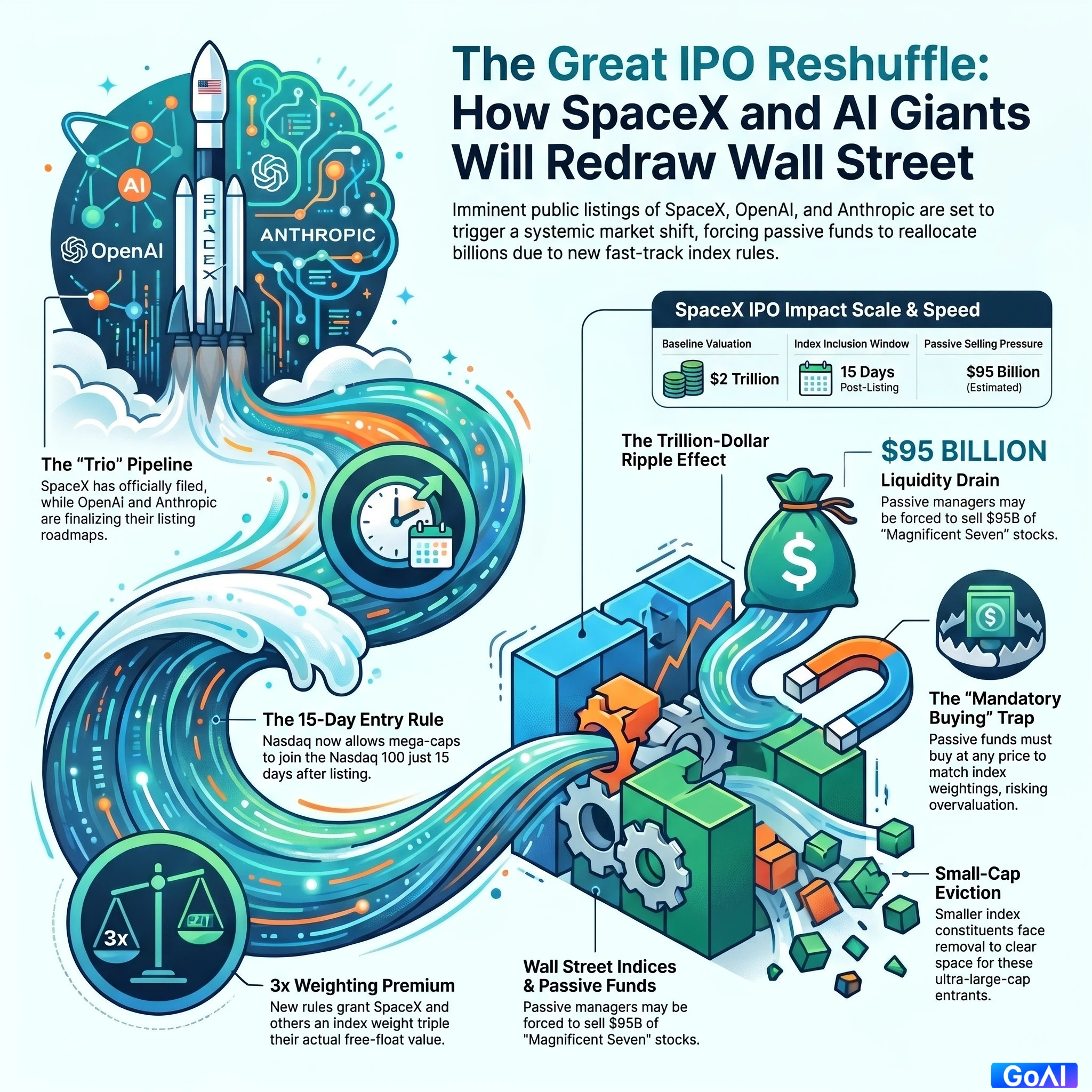
The upcoming blockbuster market debuts of SpaceX, Anthropic, and OpenAI are expected to trigger an unprecedented wave of buying and selling across U.S. equity markets.
New "fast-track inclusion" rules are set to usher these mega-caps directly into Wall Street's benchmark indices.
New rules implemented by Nasdaq this month mean that billions of dollars in passive capital will automatically flow into these three companies shortly after they list.
While this mechanism will likely drive up their share prices, it will simultaneously force passive investors to liquidate holdings in other equities to make room.
Elon Musk’s SpaceX officially filed for its initial public offering on Wednesday, setting the stage for what is projected to be the largest market debut in history.
On the very same day, media reports unveiled OpenAI's listing roadmap, while its primary rival, Anthropic, is rumored to have swung into profitability ahead of schedule this quarter, laying its own groundwork for a public debut.
Under the IPO framework slated for next month, the volume of shares SpaceX intends to float to public investors remains relatively tight.
Under legacy indexing methodologies, this heavily constrained free-float ratio would typically disqualify the aerospace giant from near-term core index inclusion, barring it from the trillion-dollar passive fund ecosystem.
However, in a fierce bidding war with the New York Stock Exchange to secure the marquee SpaceX listing, Nasdaq relaxed its inclusion criteria.
The exchange will now allow the stock to enter the benchmark Nasdaq 100 index just 15 days post-listing. Furthermore, SpaceX and other newly eligible market entrants will receive an index weighting equivalent to three times their actual free-float market value.
Concurrently, S&P Dow Jones Indices is actively consulting market participants on structural amendments that would similarly fast-track the stock’s entry into the flagship S&P 500 index.
According to the SpaceX preliminary prospectus, the initial capital drain on the rest of the index constituents will remain contained due to the small initial slice of floating shares.
However, this rebalancing pressure is set to amplify significantly as insider lock-up agreements expire. The prospectus outlines that these restrictions will lift in staggered phases over the 180 days following the start of public trading.
JPMorgan Chase estimates that if SpaceX eventually floats 50% of its capital at a $2 trillion baseline valuation, passive managers would be forced to dump $95 billion worth of shares across Wall Street’s existing technology titans—the Magnificent Seven plus Broadcom.
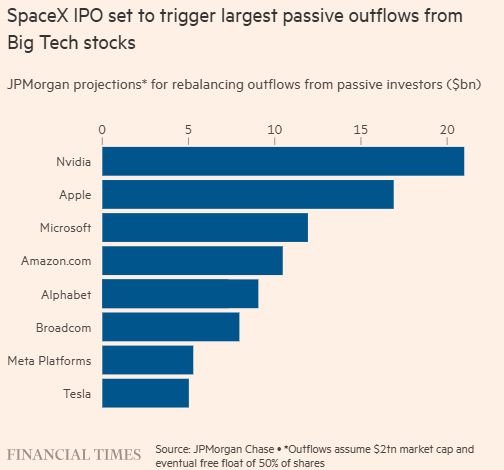
Peter Haynes, Head of Index and Market Structure Research at TD Securities, noted that both the sheer scale of the SpaceX IPO and the subsequent structural ripple effects of lock-up expirations are entirely unprecedented in recent indexing history.
Haynes added that institutional trading desks are already overwhelmed by investor inquiries regarding the logistics, size, and systemic impact of the transaction.
Some institutional desks are also positioning for a tactical sell-off in smaller-cap constituents, which face eviction from major benchmarks later this year to clear layout space for SpaceX and its ultra-large-cap peers.
Valérie Noël, Head of Trading at Syz Group, observed that shorting marginal Nasdaq 100 constituents—the prime candidates facing index exclusion—has emerged as one of the most heavily debated strategy setups surrounding the SpaceX listing.
Simultaneously, existing mega-cap index heavyweights will face programmatic selling pressure.
Todd Sohn, Chief ETF Strategist at Strategas, pointed out that the thin post-IPO free float means the index inclusion process will look remarkably frantic.
Passive funds have to accommodate ETFs tracking trillions in assets with a float that might represent a mere 5% of the company's total equity.
Sohn warned that an aggressive post-IPO price surge could force passive managers to buy into the stock at heavily extended valuations.
If SpaceX spikes 100% in its first week of trading and passive funds are mandated to match index weightings, they have to execute at that price regardless of valuation metrics.
Christian Raute, Head of Market Trading Strategy at Citigroup, echoed these concerns, noting that the compressed window between the IPO and index inclusion points to a period of heightened localized volatility.
Raute stated that given the sheer scale of the asset, it presents a unique structural challenge, and the equity could become exceptionally expensive in the near term.
Ultimately, however, Raute believes global capital markets will absorb the massive liquidity demands seamlessly, noting that institutional desks are highly sophisticated and structurally prepared to navigate these rebalancing dynamics.
Reinforcing this institutional appetite, a portfolio manager at a major U.S. hedge fund noted that across all three names—SpaceX, Anthropic, and OpenAI—their desk intends to maximize allocations. The manager emphasized that from an institutional standpoint, they face absolutely no liquidity constraints.