
IBM Surges 12% on $1 Billion Federal Quantum Funding as Option Traders Drive Bullish Bets

U.S. equity traders are increasingly coalescing around a highly profitable macroeconomic narrative: backing pioneering deep-tech frontiers through the lens of a domestic corporate revival.
When paired with direct, strategic intervention from Washington, the setup has become a potent template for outsized market returns.
Intel Corp.’s massive state-backed run serves as the primary playbook for this theme.
Now, with the Trump administration executing its latest strategic capital injection, century-old technology titan International Business Machines Corp. (IBM) appears positioned to replicate that exact turnaround trajectory.
The New York-based multinational—historically dubbed "Big Blue"—remains a foundational pillar of the global enterprise IT ecosystem.
Crucially, IBM has established an early lead in the commercial quantum computing arms race, developing computational architectures that leverage subatomic mechanics to solve complex operational matrices far beyond the processing limits of classical silicon supercomputers.
The immediate catalyst for Thursday's breakout came from the U.S. Department of Commerce, which unveiled a landmark $2 billion federal incentive package distributed across nine selected quantum computing enterprises.
In a continuation of the administration's mercantilist approach to critical technology sectors, the financing agreements are structurally tied to the federal government receiving minority equity stakes in the participating entities.
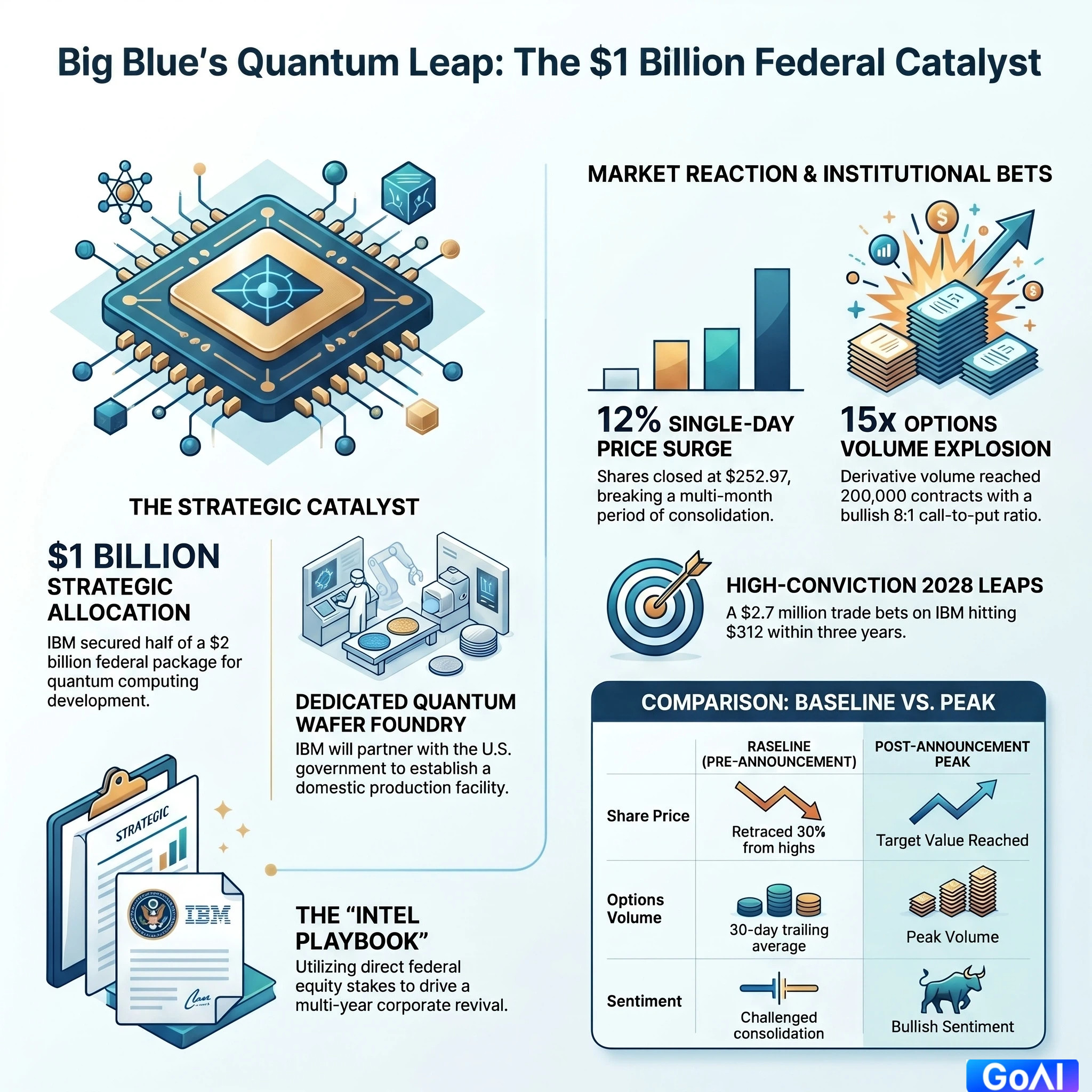
As the single largest beneficiary of the strategic package, IBM secured a definitive $1 billion allocation. The company subsequently confirmed it will partner with the U.S. government to establish America's first dedicated quantum wafer foundry, backed by the proposed $1 billion federal subsidy.
Fueled by the sovereign funding commitment, shares of IBM spiked over 12% during Thursday's session to close at $252.97.
The headline tailwind triggered an immediate institutional scramble in the options market.
According to transaction data from the Chicago Board Options Exchange (Cboe), aggregate derivatives volume in IBM exploded to nearly 200,000 contracts, representing a massive 15-fold increase over the equity's 30-day trailing daily average.
The underlying order flow skewed overwhelmingly bullish, with call options outstripping puts by an asymmetric 8:1 ratio.3
Total call buying activity topped 42,000 contracts against 27,500 written, while total put buying volume languished below the 4,000 contract threshold.
Prior to Thursday's policy-driven inflection point, IBM had experienced a challenging consolidation.
Despite a multi-year secular bull run driven by its structural pivot toward hybrid cloud architectures and enterprise software services, the stock had retraced roughly 30% from its November highs, caught in a broader thematic sell-off across cloud-centric software operators.
However, derivative flow indicates a rapid institutional sentiment reversal. Block trade data highlighted a prominent options trader executing a high-conviction LEAPS position, committing $2.7 million in premium to acquire over 500 call contracts with a $260 strike price expiring on December 15, 2028.
This move indicates a strong bet that the Trump administration's backing will serve as the catalyst for a multi-year bull run.
For this massive directional bet to achieve profitability at expiration, IBM shares must climb past a breakeven threshold of approximately $312, implying a 30% structural upside curve from current spot levels.
The market's structural positioning mirrors the capital allocation patterns that defined Intel's market bottom. Intel’s multi-year downward valuation curve reversed sharply following direct equity involvement by the federal government last year.
Since locking in that sovereign backstop, Intel equity has surged 500% from its cyclical lows, delivering historic windfalls to long-dated call option allocators who aggressively anticipated the state-backed turnaround.