
Korea Post Expands Into AI Data Centers, Western Real Estate to Offset Deepening Postal Losses

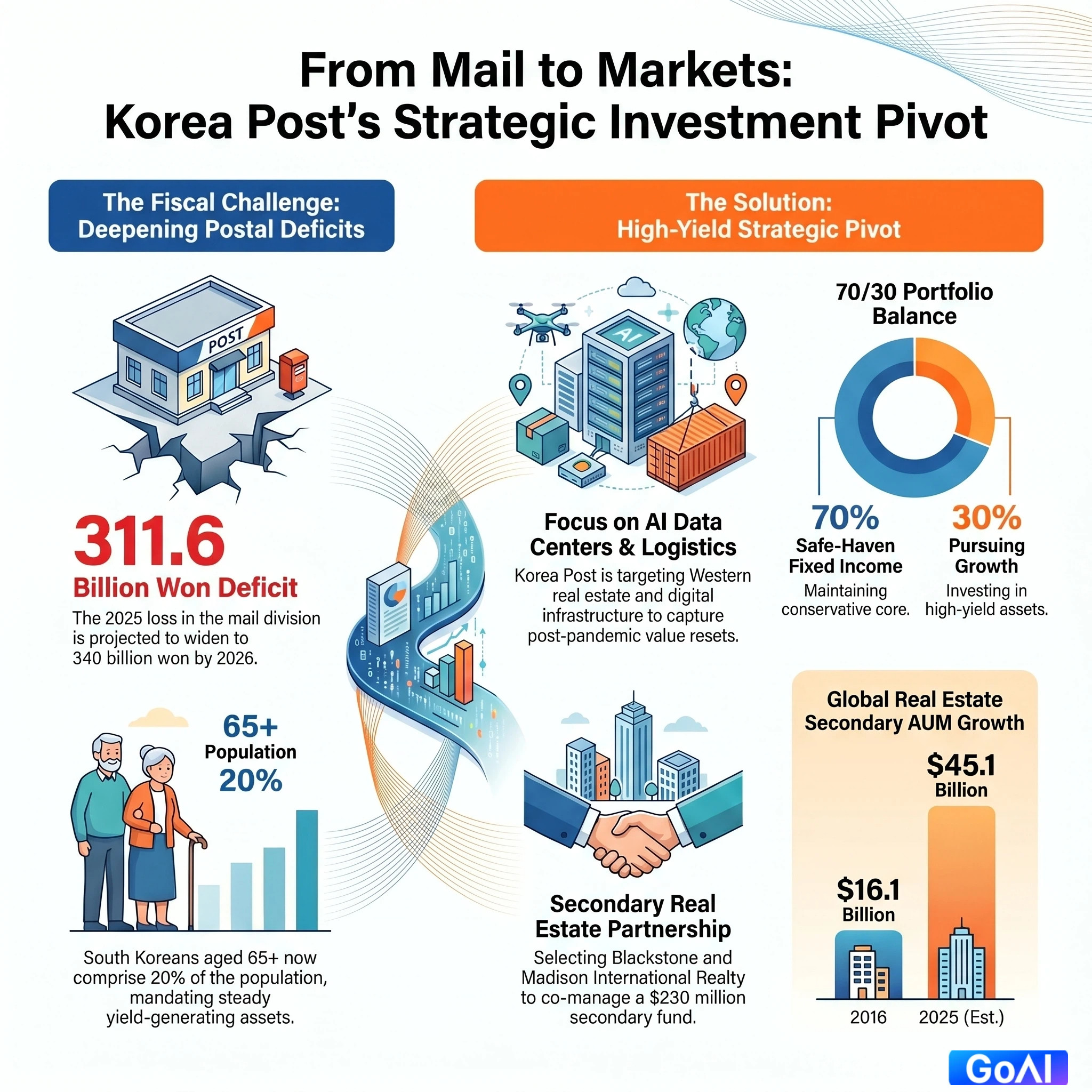
Facing mounting losses in its traditional mail business, Korea Post is accelerating a strategic pivot toward high-yield assets.
The state-run postal agency is boosting its exposure to Western real estate, focusing heavily on AI data centers, logistics facilities, and multifamily housing to shore up institutional returns.
Korea Post, which manages approximately 157 trillion won ($104 billion) across its savings and insurance funds, stands as one of South Korea's largest institutional investors.
The agency views the post-pandemic commercial real estate downturn as a compelling entry point into developed markets. In-hwan Park, President of Korea Post, noted that valuations in developed economies like the U.S. have largely corrected.
This valuation reset, Park said, offers a strong margin of safety for real estate secondary market investments, allowing institutional buyers to acquire underlying asset stakes at a discount.
To execute this strategy, Korea Post has selected global asset management giant Blackstone and real estate investment firm Madison International Realty as preferred bidders to co-manage a secondary real estate fund valued at roughly $230 million.
Real estate secondary funds have increasingly become a primary vehicle for global allocators.
According to data provider Preqin, real estate secondary assets under management (AUM) reached an estimated $45.1 billion as of September 2025, a massive leap from just $16.1 billion in 2016.
Highlighting this momentum, Singapore-based Aquilius Investment Partners closed its second Asia-Pacific real estate secondaries fund at $1.1 billion in November 2025, marking the largest vehicle of its kind in the region.
Postal Deficits Drive Pivot
The asset reshuffle underscores the deep operational headwinds facing traditional postal networks. Korea Post's mail division logged a 311.6 billion won deficit in 2025, with losses projected to widen further to 340 billion won in 2026.
Under South Korean law, Korea Post is permitted to use investment returns from its savings and insurance arms to plug deficits in its postal operations.
However, as a state-backed institution catering to retail depositors and policyholders, the agency maintains a conservative baseline portfolio.
Park emphasized that Korea Post continues to allocate roughly 70% of its capital to safe-haven assets, primarily fixed income, to cushion against market volatility stemming from geopolitical frictions, such as the US-Iran conflict.
South Korea's demographic shift also reinforces the mandate for steady, yield-generating assets, with citizens aged 65 and older now accounting for 20% of the total population.
For the remaining 30% of its portfolio, however, Korea Post is pursuing enhanced yields via mid-risk, mid-return instruments, including private credit and mezzanine financing.
On the international front, Korea Post currently employs currency hedging for overseas bonds and alternative assets, while leaving international equities unhedged.
With U.S. interest rates remaining structurally higher than South Korea's, hedging costs have climbed, prompting the agency to review its current FX hedging framework.
Park clarified that any future adjustments would not involve an aggressive shift toward fully unhedged FX exposure.
Meanwhile, domestic equity markets have provided a strong tailwind this year, with the benchmark KOSPI index surging over 80% year-to-date. Park noted that these robust investment gains are expected to significantly alleviate the financial strain from the legacy postal deficit.
"I am cautiously optimistic that we may not need to worry as much about postal losses this year," Park said.