
Halved in a Week: A Japanese Fiber-Optic Leader Exposes the Dangerous Flip Side of Global AI Euphoria

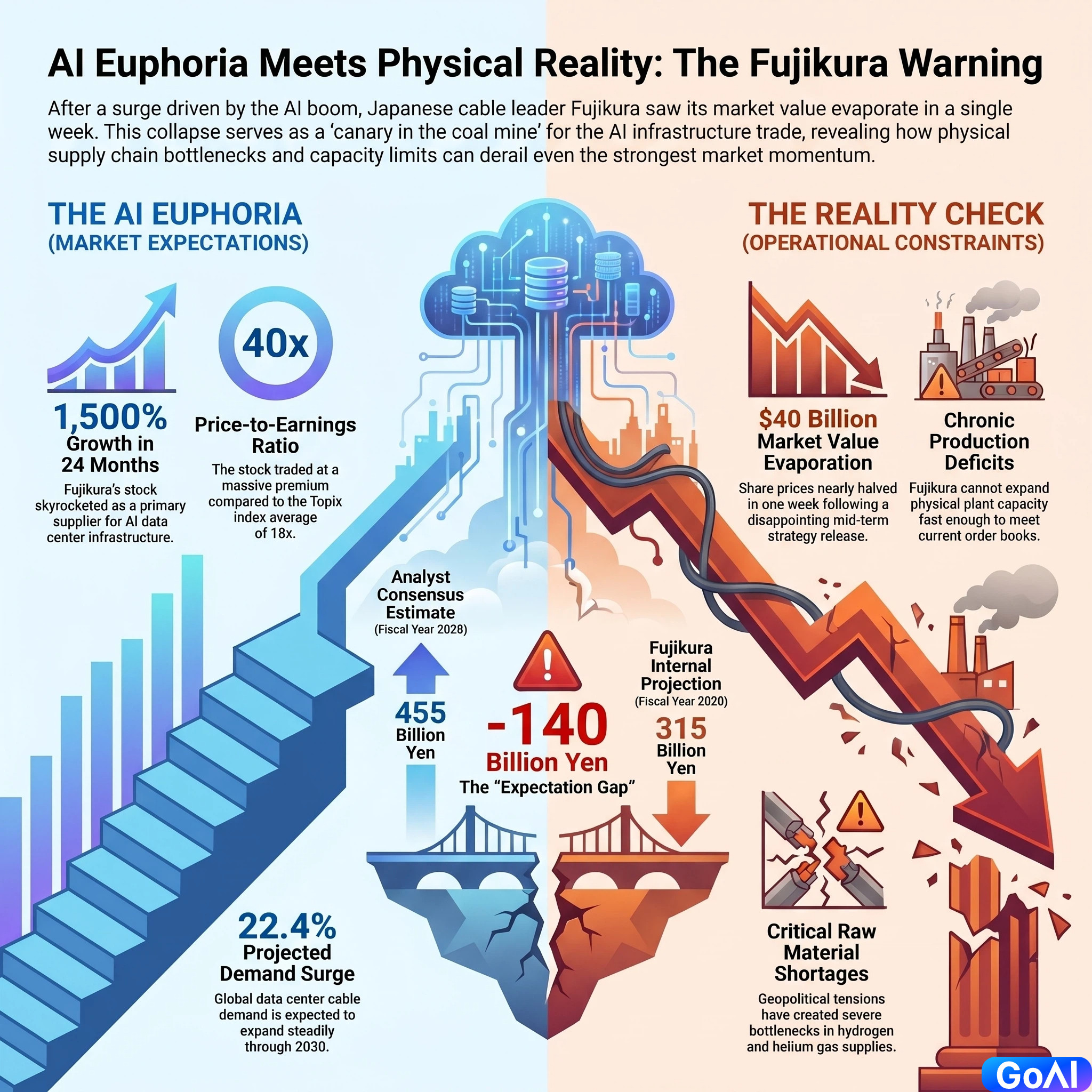
A $40 billion market value evaporation across a 141-year-old Japanese cable pioneer has flashed a stark warning sign across global equity markets driven by artificial intelligence (AI) euphoria, forcing market participants to confront the underlying fragility of the AI-themed bull run.
Market data shows that fiber-optic cable manufacturer Fujikura Ltd. saw its share price nearly halved during the week ending May 20, triggered by a wave of institutional liquidation following a disappointing earnings forecast and a lackluster mid-term strategy corporate release.
While the stock has since reclaimed a fraction of those losses, it remains down nearly 30% from its historic closing high notched on May 13. Shortly after Tuesday's opening bell, the equity fell an additional 5%.
This dramatic roller-coaster ride underscores how rapidly momentum can turn for market darlings operating along the AI frontier—particularly when investors realize that explosive expectations for infrastructure expansion have completely outstripped a manufacturer's physical capacity to deliver.
Norikazu Shimizu, an analyst at Iwai Cosmo Securities, noted that Fujikura’s failure to sufficiently expand production capacity created a severe gap between market expectations and operational reality.
The company simply cannot ramp up output quickly enough to meet the current explosion in incoming order books.
As a critical supplier of fiber-optic cables used to link servers and switches within AI data centers, Fujikura emerged as one of Japan's hottest trades over the past two years amid surging demand for generative AI models.
As a key member of the "Portsmouth Consortium"—a specialized cohort tasked with constructing data center infrastructure across the United States—the company's share price skyrocketed over 1,500% in the 24 months leading up to mid-May.
Now, however, institutional desks are increasingly questioning whether Fujikura can scale production swiftly enough to backstop its premium valuation multiples.
In its mid-term corporate strategy unveiled on May 19, the manufacturer projected operating profits of 315 billion yen ($2 billion) for the fiscal year beginning April 2028, falling significantly short of the 455 billion yen consensus analyst estimate.
President Naoki Okada confirmed that even after a new production facility in Chiba Prefecture comes online, structural capacity deficits will persist.
This reassessment of the AI infrastructure trade has already triggered ripple effects beyond Fujikura, as Japanese investors recalibrate execution timelines.
Growing anxieties over material bottlenecks and supply chain constraints hindering data center projects have dragged down peer fiber-optic cable manufacturers Furukawa Electric and Sumitomo Electric Industries, both of which have underperformed the benchmark Nikkei 225 index since May 13.
Are Cable Manufacturers the First Domino to Fall?
"If the market wakes up to the reality that power grid bottlenecks are delaying data center buildouts either at the inception or completion phases, cable manufacturers will be the first to face severe structural deratings," noted Amir Anvarzadeh, a Japan equity strategist at Asymmetric Advisors.
The sell-off exposes broader anxieties regarding the long-term sustainability of AI-correlated valuation multiples. Even after the recent contraction, Fujikura’s price-to-earnings multiple sits above 40x, a stark premium compared to the broader Topix index average of roughly 18x.
Prior to the earnings release, the stock's Relative Strength Index (RSI) hovered near 80, indicating deeply overbought technical conditions.
Raw material constraints are exacerbating these operational strains. Fujikura has signaled supply chain anxieties surrounding hydrogen and helium gas availability, with helium shortages heavily compounded by ongoing geopolitical tensions in Iran.
On the demand side, secular technological risks are also emerging on the horizon.
Rapid advancements in optical transceiver architectures are projected to eventually reduce the volume of physical cabling required within next-generation data centers.
While William Nestuk, an analyst at Pelham Smithers Associates, views this as a definitive long-term threat, he notes that a material dent in demand is likely several years away.
To be sure, near-term demand dynamics for physical cabling remain fundamentally robust.
CRU Group forecasts global data center cable demand to expand by 22.4% between 2024 and 2030, a structural growth trajectory heavily anchored by the North American hyperscaler market.
Furthermore, fiber-optic manufacturers command significant pricing power, as their cloud-computing behemoth clients possess the capital buffers to easily absorb elevated component costs.
Nestuk suggests this fundamental backdrop leaves room for a tactical technical rebound in Fujikura equity, though a return to pre-earnings valuation peaks remains highly improbable.
Ultimately, Fujikura’s swift fall from grace serves as a warning that the days of unchecked capital concentration into AI infrastructure proxies may be numbered, as institutional allocators actively seek to trim exposure to stretched valuations and supply-side bottlenecks.