
JPMorgan: Markets Overestimating Rate-Hike Risks; Low-Volatility Equities Primed to Benefit

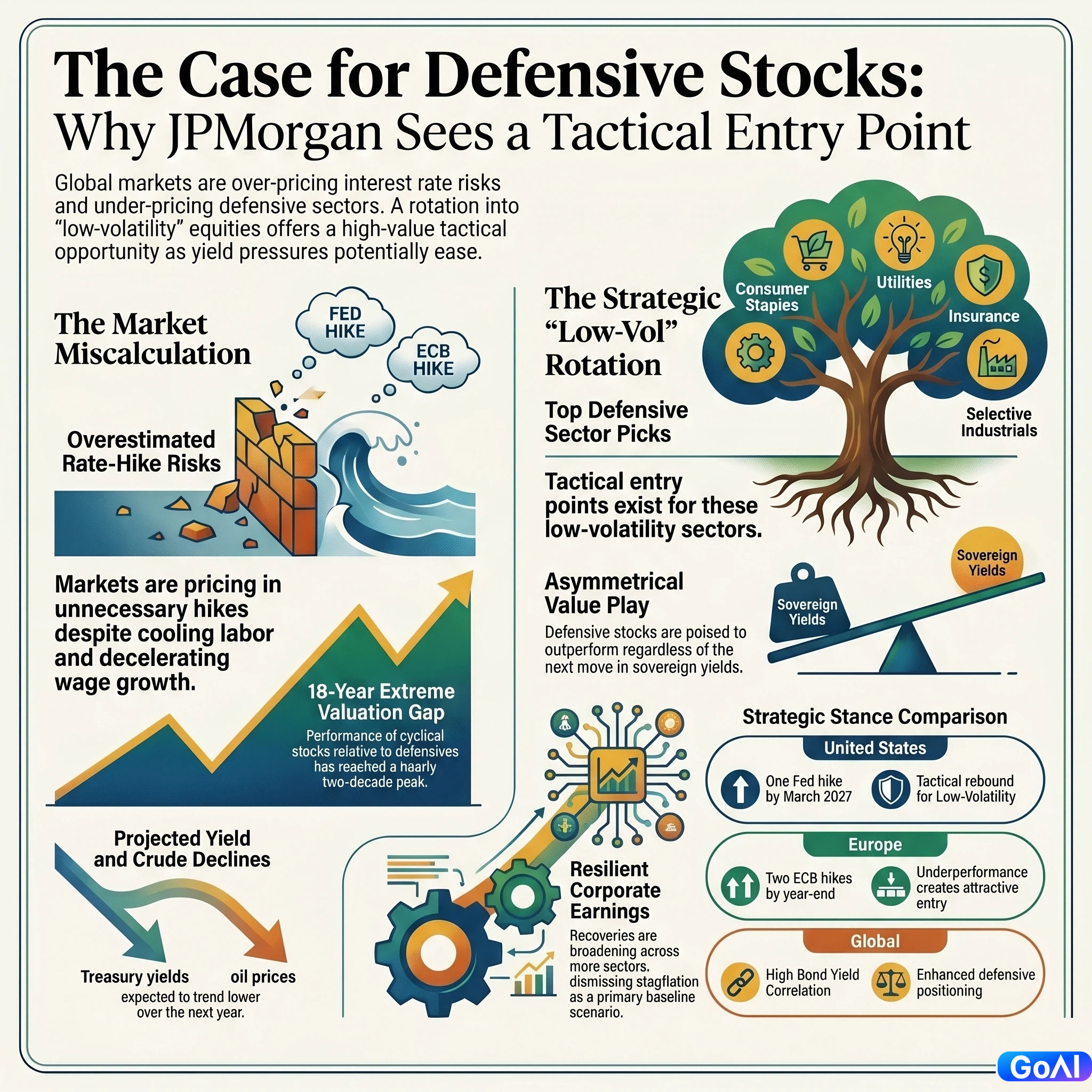
Global financial markets are currently overestimating the probability of further central bank rate hikes, creating a tactical entry point for a rebound in low-volatility sectors such as consumer staples and utilities, according to JPMorgan Chase & Co.
While market participants worry that the energy shock from the war in Iran could trigger a aggressive tightening cycle reminiscent of the post-2022 geopolitical shock, JPMorgan’s equity strategy team, led by Mislav Matejka, notes distinct structural differences this time.
The team expects that because the primary objective among conflicting parties remains finding a diplomatic resolution, both Treasury yields and crude prices are poised to trend below current spot levels over the next 6 to 12 months.
Furthermore, they project resilient corporate earnings and dismiss stagflation as a baseline scenario for the second half of the year.
The strategy team argues that cooling labor markets and decelerating wage growth dynamics in the United States make a structural "wage-price stagflation spiral" highly improbable.
Currently, rates markets are pricing in one Federal Reserve hike by March 2027 and two European Central Bank hikes by the end of this year.
Low-volatility defensive titles have been largely discarded during the current artificial intelligence-driven bull market.
A Goldman Sachs metric tracking the relative performance of US cyclical stocks against defensives has pushed to an 18-year extreme.
Matejka noted that while low-volatility equities across the US and Europe underperformed significantly over the past few months as bond yields climbed, this sell-off creates an attractive entry point. The firm’s long recommendation also encompasses insurance providers and selective industrials.
JPMorgan contends that these defensive plays present asymmetrical value regardless of the next directional move in sovereign yields.
If Treasury yields spike further—with the 10-year yield breaking toward the 5% threshold—low-volatility stocks could decouple from their traditional inverse correlation with rates and outperform purely on deeply discounted technical valuations.
Conversely, if recent yield gains reverse, these defensive sectors are poised to resume outperforming the broader market, replicating the trading patterns observed before the outbreak of the war in Iran.
This rotation thesis aligns with views from Morgan Stanley's chief investment officer, Michael Wilson, who noted that a cooling in bond yields and crude pricing could broaden market breadth away from the current extreme mega-cap tech concentration.
Wilson reiterated that corporate earnings recoveries are steadily broadening across more sectors. He emphasized that elevated yields do not pose an existential threat to equity valuations as long as they are driven by robust underlying economic growth rather than hawkish central bank policy pivots.