Ten Times Faster Than Nvidia: Micron Sprints from $500 Billion to $1 Trillion in Just 48 Days

Nearly half a century ago, an Idaho potato tycoon who famously couldn't type became the first major backer to bet big on Micron. Today, the rest of the global investment community is scrambling to follow suit.
The Boise, Idaho-based memory manufacturer crossed the historic $1 trillion market capitalization threshold on Tuesday, signaling that even the structural layer of the artificial intelligence hardware stack is being swept up in a relentless, year-long semiconductor mania.
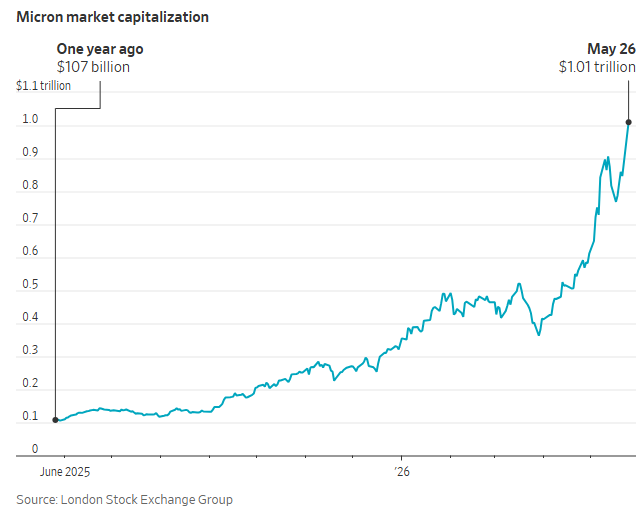
Micron shares skyrocketed 19% on Tuesday, cementing the nation’s largest domestic memory manufacturer as the newest standard-bearer for the tech rally. Over the past month alone, the stock has surged roughly 80%.
"By almost any metric, this velocity appears entirely unprecedented," noted Dan Russo, Co-Chief Investment Officer and Chartered Market Technician at Potomac.
Following this extraordinary technical expansion, Micron has become the 12th U.S. corporation to join the trillion-dollar club, and the first ever from Idaho.
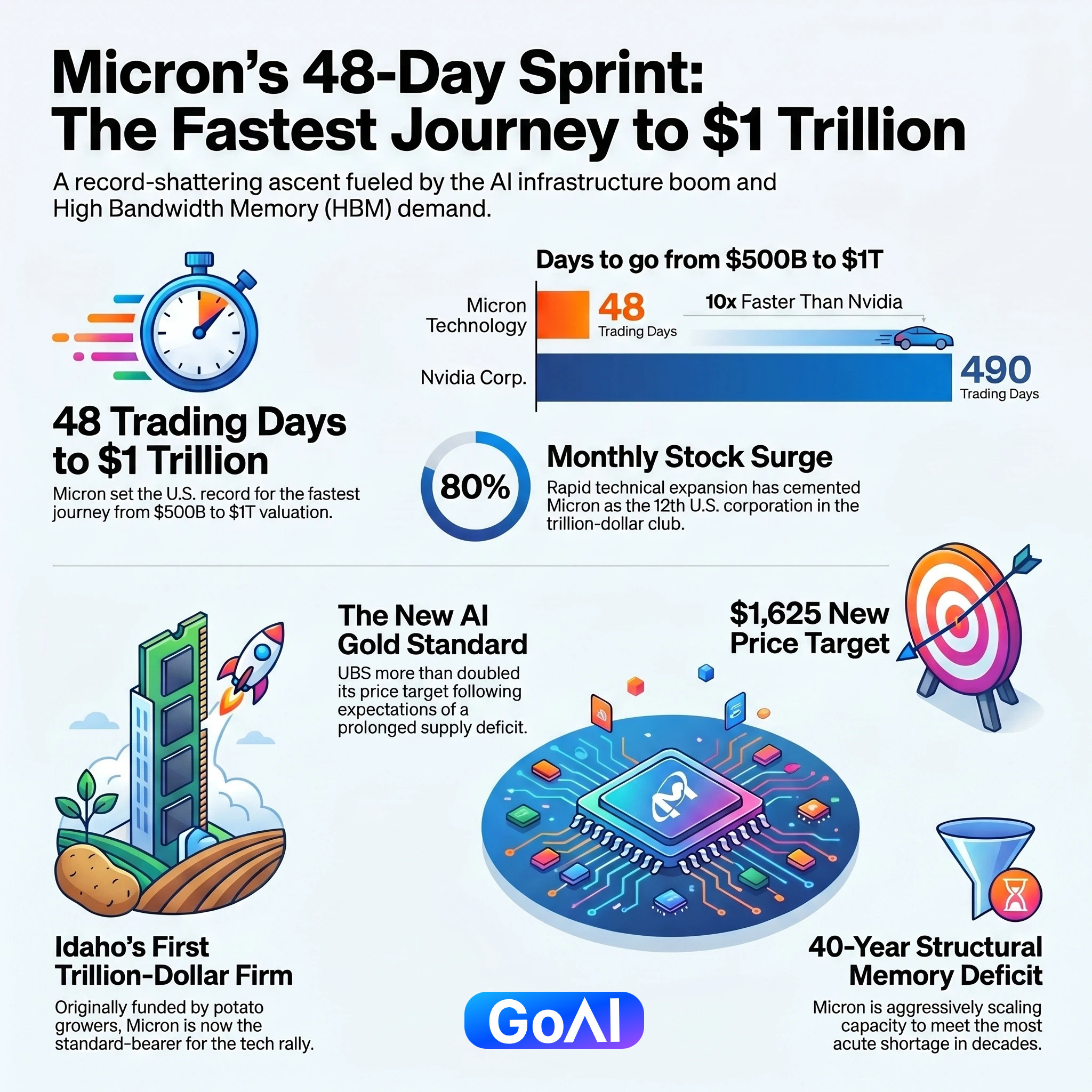
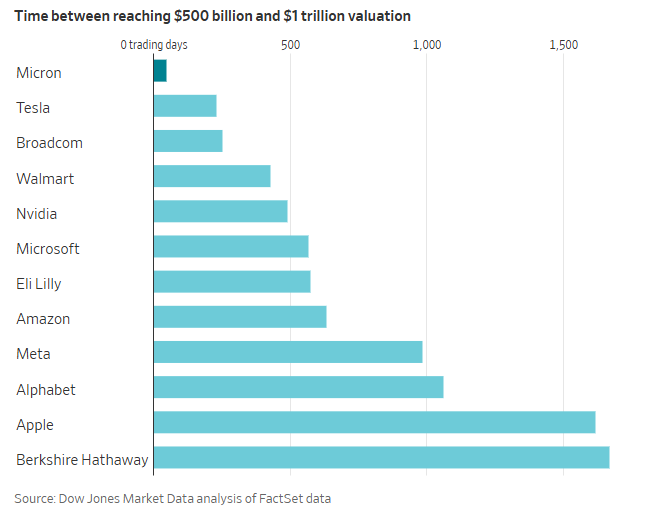
More stunning, however, is the sheer pace of its valuation ramp: Micron has established the fastest journey from $500 billion to $1 trillion in the history of U.S. capital markets.
According to Dow Jones Market Data, the chipmaker required a mere 48 trading sessions after first touching $500 billion to clear the $1 trillion milestone.
By comparison, AI frontrunner Nvidia Corp. required 490 trading days to traverse that exact same valuation curve.
"For decades, Micron was categorized purely as a commodity cyclical trade, fabricating very foundational, standardized silicon architectures," said Michael Rosen, Chief Investment Officer at Angeles Investments. "Today, Micron has transformed into an industry gold standard."
The equity's upward trajectory may still have an extended runway as Micron aggressively scales capacity to combat the most acute structural memory deficit the industry has faced in over 40 years.
On Tuesday, UBS lifted its price target on Micron from $535 to a Wall Street-high $1,625 per share—more than doubling its previous Friday close of $751.
The bank's research note highlighted expectations for a prolonged supply deficit across both primary memory categories, DRAM and NAND.
Micron commands the largest market share among domestic U.S. corporations in both crucial architectures. Founded in 1978, the firm’s initial seed capital was provided by wealthy Idaho potato growers, most notably J.R. Simplot.
While the company faced severe existential challenges a decade ago, its strategic global footprint expansion and pivot toward data-center-grade High Bandwidth Memory (HBM) have triggered a massive structural shift in profitability.
The company's execution even caught the attention of President Trump last week. "My goodness, look at Micron, they are doing fantastic," he noted during a rally in New York on Friday.
The memory-led frenzy fueled a broader rising tide across the entire U.S. semiconductor and memory complex on Tuesday, lifting the Philadelphia Semiconductor Index (SOX) by nearly 6%.
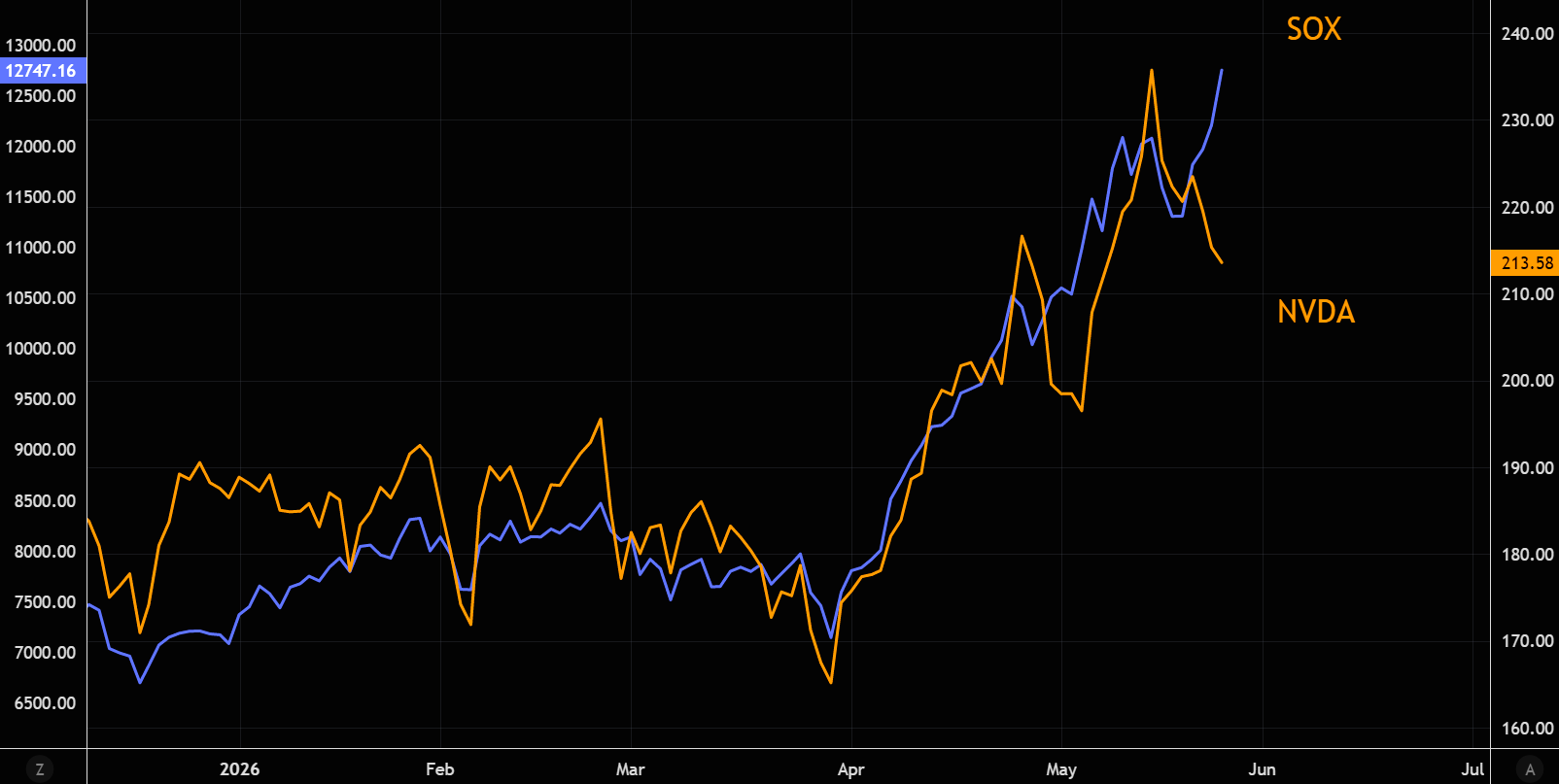
The momentum in memory has been so powerful that investors have largely looked past Nvidia's absence from this latest leg of the chip rally.
As illustrated below, it has been an exceptionally long time since market participants have observed such a stark divergence between the broader SOX index and Nvidia's individual price action.