
Echoes of 1987? Analysts Rally Behind Micron’s Parabolic Run: "Still Deeply Undervalued"

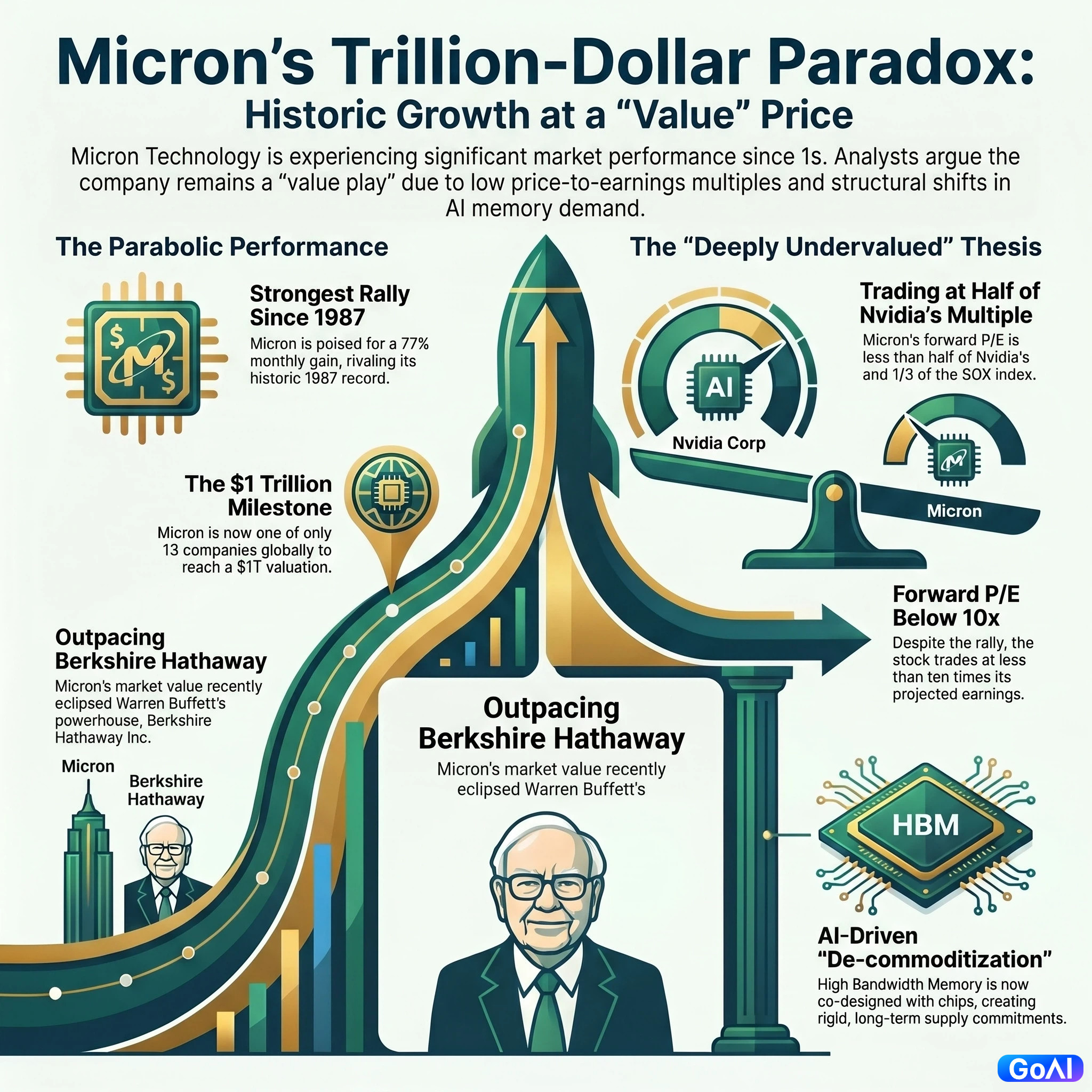
Micron Technology Inc. is on track to lock in its strongest monthly performance since 1987, yet Wall Street analysts continue to classify the memory titan as a pure value play—arguing that its equity remains deeply discounted relative to forward earnings potential.
The blistering rally has been fueled by unprecedented, structural demand for high-performance memory in the artificial intelligence era.
On Tuesday, Micron surged 19.29% to clear the $1 trillion market capitalization threshold, cementing its position as one of just 13 companies on Earth to hold a trillion-dollar valuation.
The advance extends a phenomenal run that has seen the stock skyrocket eightfold over the past 12 months.
The momentum showed no signs of abating on Wednesday, with Micron gaining an additional 3% to eclipse Warren Buffett's Berkshire Hathaway Inc. in market value.
For perspective, when Berkshire first touched the $1 trillion mark in August 2024, Micron’s total market capitalization hovered at just over $100 billion.
Sprinting more than 77% so far in May, the equity is poised to orchestrate its largest single-month gain since December 1987, when it posted a historic 78.8% monthly advance.
Yet, this parabolic price action has done little to deter value-oriented institutional allocators hunting for discounted entry points within the white-hot semiconductor complex.
Analysts note that Micron remains surprisingly cheap on a relative basis. The stock's forward price-to-earnings multiple sits at less than half that of Nvidia Corp., and represents just over a third of the broader Philadelphia Semiconductor Index (SOX) multiple.
David Miller, Chief Investment Officer and Portfolio Manager at Catalyst Funds, highlighted in a recent interview that despite the "extraordinary magnitude of the move," Micron’s forward P/E multiple remains firmly below 10x.
This indicates that the equity trades at less than ten times its projected earnings over the next 12 months—a classic signature of an undervalued asset, assuming earnings sustain or expand.
"The fascinating takeaway here is that even after a run of this magnitude, it can still be fundamentally justified as a value opportunity," Miller noted.
From a secular perspective, he added, Micron offers investors a rare vehicle to capture the critical AI memory buildout at a highly reasonable entry price, emphasizing that "the company simply cannot manufacture quickly enough to clear its backlogged order books."
Gil Luria, Managing Director at D.A. Davidson, concurred, noting that institutional allocators are waking up to the reality that memory is "the sole pocket of the broader AI trade still exchanging hands at a reasonable multiple."
"It is increasingly obvious that the modern memory ecosystem is entirely transformed from what we observed just a few years ago," Luria stated, attributing the structural shift to a highly consolidated supplier base and the implementation of multi-year long-term agreements (LTAs).
Luria also pointed to the rapid "de-commoditization" of the memory landscape. While standard memory architectures historically traded as undifferentiated commodities, next-generation High Bandwidth Memory (HBM) modules are now being co-designed directly alongside Nvidia’s latest cutting-edge silicon.
Consequently, these components are no longer interchangeable, forcing Nvidia and peer hyperscale data center operators to secure supply via rigid, long-term purchase commitments.
To be sure, some pockets of skepticism remain on the Street. Morningstar analyst William Kerwin expressed lingering reservations regarding the stock's long-term trajectory, warning that inevitable supply-side adjustments could eventually disrupt the bullish consensus.
"We remain somewhat defensive on the secular narrative... While we recognize that artificial intelligence will anchor a prolonged and robust upcycle, at the end of the day, this remains a cyclical industry," Kerwin cautioned.
He warned that a massive wave of global production capacity scheduled to come online between late 2027 and 2028 could serve as a severe downside catalyst for both memory pricing and Micron equity.