
Will Gold Sustain Its Luster? Analysts Project Long-Term Secular Bull Market After Brief Consolidation Window

Spot gold staged a modest rebound during Friday’s Asian trading session, reclaiming psychological support near the $4,500 threshold after slumping to a two-month low in the prior session.
Despite a growing list of macroeconomic headwinds, one prominent fund manager argues that the precious metal's secular uptrend remains firmly intact, adding that sustained higher spot prices will continue to anchor the performance of the broader mining complex.
The gold market is currently grappling with near-term liquidation pressure, as mounting inflationary anxieties prompt fixed-income desks to price in potential central bank rate hikes by year-end.
The threat of elevated interest rates naturally inflates the opportunity cost of carrying non-yielding tangible assets.
However, Tom Winmill, Portfolio Manager of the Midas Discovery Fund, noted in a recent interview that he views this localized weakness as a minor bump.
He emphasized that the fundamental pillars structural to gold’s multi-year rally remain robust—particularly against a backdrop of continuous central bank accumulation and compounding global structural economic imbalances.
"At current price levels, I see very few structural downside catalysts for gold over the near term," Winmill stated. "In fact, this consolidation could serve as a technical springboard for the next leg higher."
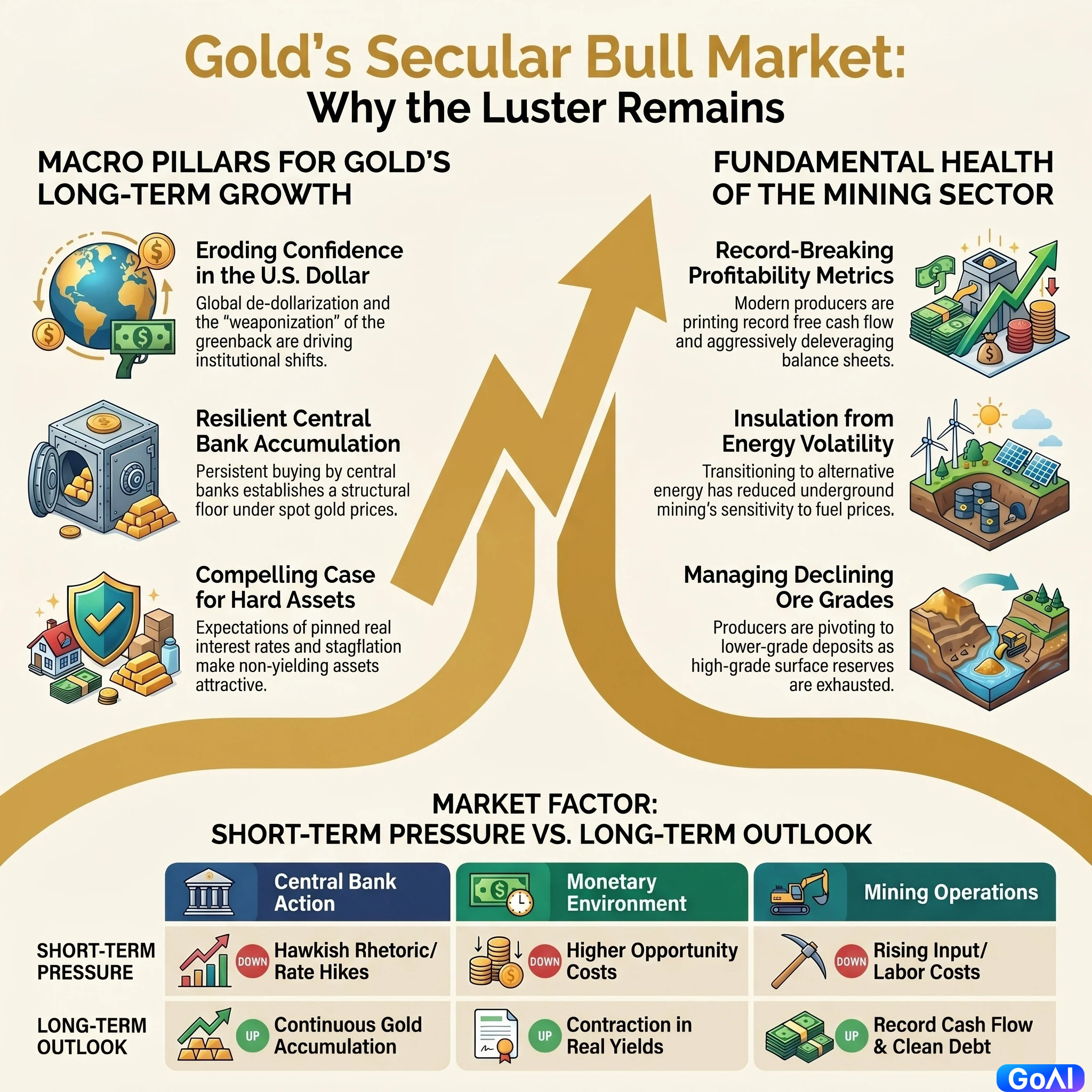
Winmill highlighted that one of the most critical secular drivers backstopping the precious metal complex is the persistent erosion of institutional confidence in the U.S. dollar's hegemony as the world's primary reserve currency.
"As the weaponization of the greenback and the de-dollarization of global GDP continue to gain traction, this structural shift is poised to play out over an extended horizon," he remarked.
"If the dollar continues to lose its authority as the anchor reserve asset, it will naturally weaken. This long-term risk profile for the greenback continuously feeds central bank demand, establishing a highly resilient floor under spot gold prices."
Furthermore, the toxic combination of stubborn inflationary pressures and decelerating economic growth could ultimately construct an ideal stagflationary environment for the metal.
While central banks maintain a hawkish rhetorical posture against inflation, Winmill remains skeptical that policymakers will possess the stomach to tighten monetary policy aggressively enough to trigger a severe corporate credit crunch or a deep economic recession.
Instead, he projects that real interest rates will remain pinned at historically low levels, preserving a highly attractive multi-year macro backdrop for hard assets.
"The ultimate macro destination here is a contraction in real yields," Winmill explained. "When that materializes, hard assets become significantly more compelling as the drag of opportunity cost evaporates."
Despite the recent stagnation in spot action, Winmill maintains that the broader secular bull market has miles left to run. Deep structural deficits, sticky systemic inflation, geopolitical friction, and uninterrupted central bank buying continue to provide ironclad long-term tailwinds.
"We are simply taking a breather here before the market catches its second wind and resumes its sprint," he noted.
Mining Sector Fundamental Outlook Remains Solid
While the consolidation in spot gold has injected short-term uncertainty across the mining investment landscape, Winmill believes Wall Street's anxieties regarding sector profitability are significantly overblown.
Though escalating energy costs and inflationary inputs have dented short-term sentiment, he argues that the market is heavily underestimating the operational strength of modern producers, which boast significantly cleaner capital structures compared to prior cycles.
"The market's margin anxieties are somewhat exaggerated, especially regarding underground mining operations that are inherently less sensitive to volatile fuel inputs," Winmill pointed out.
"A substantial segment of these producers transitioned to alternative energy sources years ago. This is far from their first rodeo managing spikes in crude prices."
The mining complex has just delivered some of its strongest profitability metrics in years, printing record free cash flow and aggressively deleveraging corporate balance sheets.
Winmill noted that even if producers face marginal compression due to higher royalty rates, rising labor costs, and declining ore grades, the sector's overall fundamental health remains vastly superior to what was observed during previous gold bull runs.
Note on Declining Ore Grades: This phenomenon refers to the continuous reduction in the concentration of valuable metals or minerals within extracted ore as mining depths increase.
This is primarily driven by the exhaustion of high-grade surface reserves, forcing a operational pivot toward lower-grade deposits, alongside extraction dilution and shifting techno-economic boundary conditions.
"The current market layout heavily favors disciplined, fundamentally driven allocators over purely speculative trading strategies," Winmill concluded.