
Wall Street Bulls Confident Rally Is Far From Over: AI Bubble Fears Dismissed as Groundless

While the market has rallied fervently, defying geopolitical conflicts and valuation concerns, growing unease surrounds the AI-driven bull run. However, for some Wall Street bulls, these fears born of the unknown are simply groundless anxiety.
Steve Chiavarone, Senior Portfolio Manager and Head of Multi-Asset Solutions at Federated Hermes, states that there is currently no bubble, noting that a true bubble would laugh at today's valuations.
Looking at historical data, secular bull markets typically last 20 years. He believes the market is only mid-cycle, and with the rally accelerating, there remains further room to run.
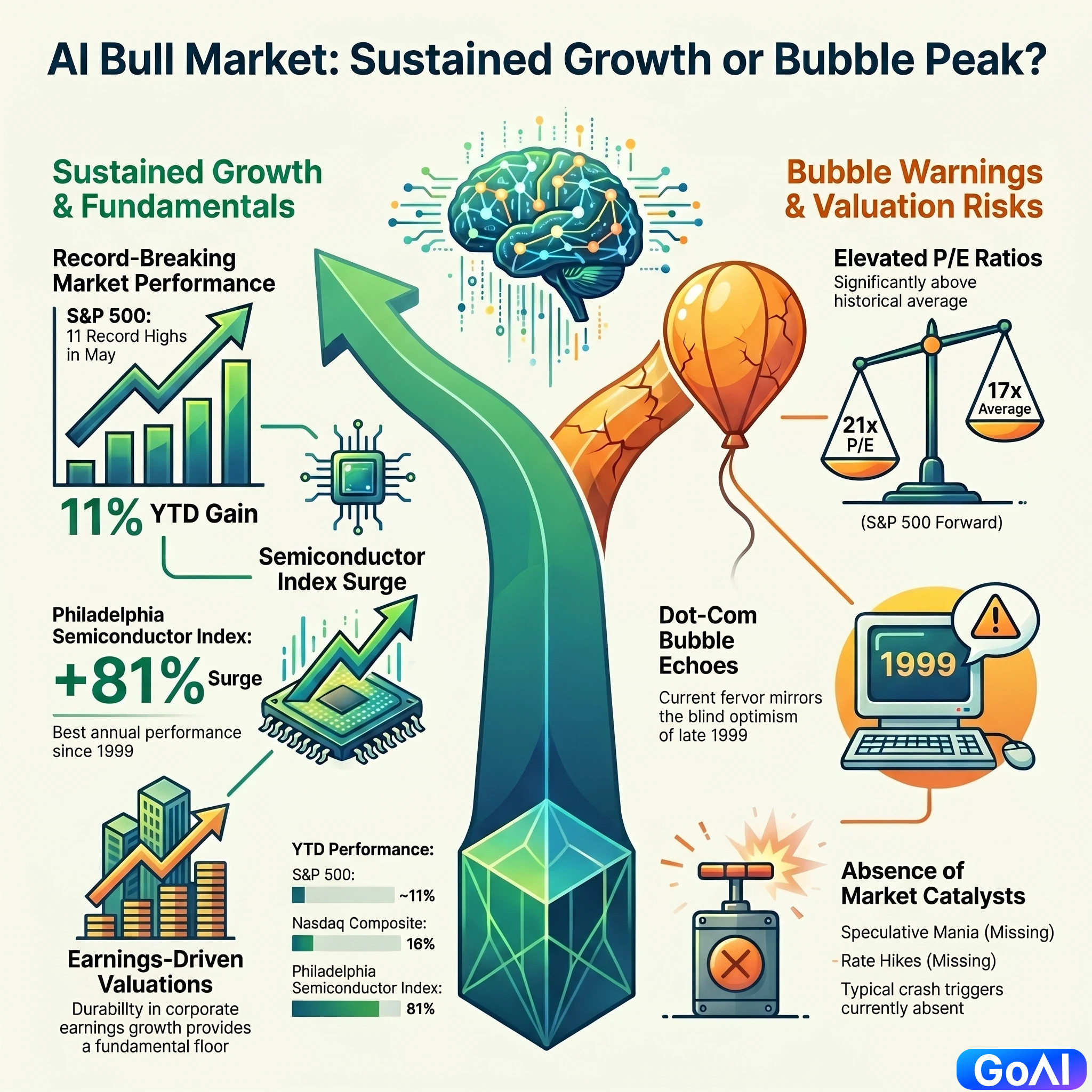
The S&P 500 hit 11 record closing highs in May—accounting for half of all trading sessions—bringing its year-to-date gain to roughly 11%. Technology stocks saw even more pronounced gains, with the Nasdaq Composite climbing 16%.
Meanwhile, the Philadelphia Semiconductor Index, which tracks major chipmakers, has surged 81% since the beginning of the year, tracking toward its best annual performance since 1999.
A key driver has been first-quarter earnings, which significantly beat Wall Street expectations. Consequently, several major investment banks, including Goldman Sachs and Morgan Stanley, have raised their year-end targets for the S&P 500 in recent weeks.
This earnings-supported valuation upgrade is clearly pivotal to the bullish sentiment.
Many investors remain firmly convinced that advancements in artificial intelligence, alongside massive capital expenditure in chips and data centers, will accelerate US economic growth and continuously drive corporate profitability.
Fear Versus Confidence
The rally in AI-concept stocks has pushed market valuation metrics higher. According to FactSet data, the S&P 500 trades at a forward 12-month price-to-earnings (P/E) ratio of approximately 21x, well above its 30-year average of 17x.
This valuation surge and the sheer velocity of the rally have triggered concern among some market observers. Legendary investor Michael Burry has repeatedly warned that Wall Street's current AI fervor mirrors the blind optimism of the dot-com bubble era.
Billionaire hedge fund manager Paul Tudor Jones also characterized the market boom last month as wild.
While he expects the bull market could persist for another one to two years, he noted that across P/E ratios and earnings, the current setup looks somewhat like October or November 1999, just months before the dot-com bubble peaked in March 2000.
However, Mike Wilson, Chief US Equity Strategist at Morgan Stanley, believes that while the market exhibits signs of crowding and could face a correction, the broader upward trend will continue to forge ahead.
Ben Snider, Senior US Equity Strategist at Goldman Sachs, also pointed out that the typical catalysts for the end of a bull market—such as speculative mania, margin contraction, or Federal Reserve rate hikes—are currently absent.
This reinforces his expectation that the market’s near-term upward momentum will persist.
Denise Chisholm, Director of Quantitative Market Strategy at Fidelity, emphasized that the stock market offers a positive risk-reward trade-off, primarily because earnings growth is proving to be far more durable than generally anticipated.
She argues this earnings durability is the true linchpin of a secular bull market, providing a solid fundamental floor for current valuations.