
A 16% Two-Month Skyrocket: US Stock Rally Rarer Than Ever Since WWII—What History Tells Us About Where the Market Goes Next

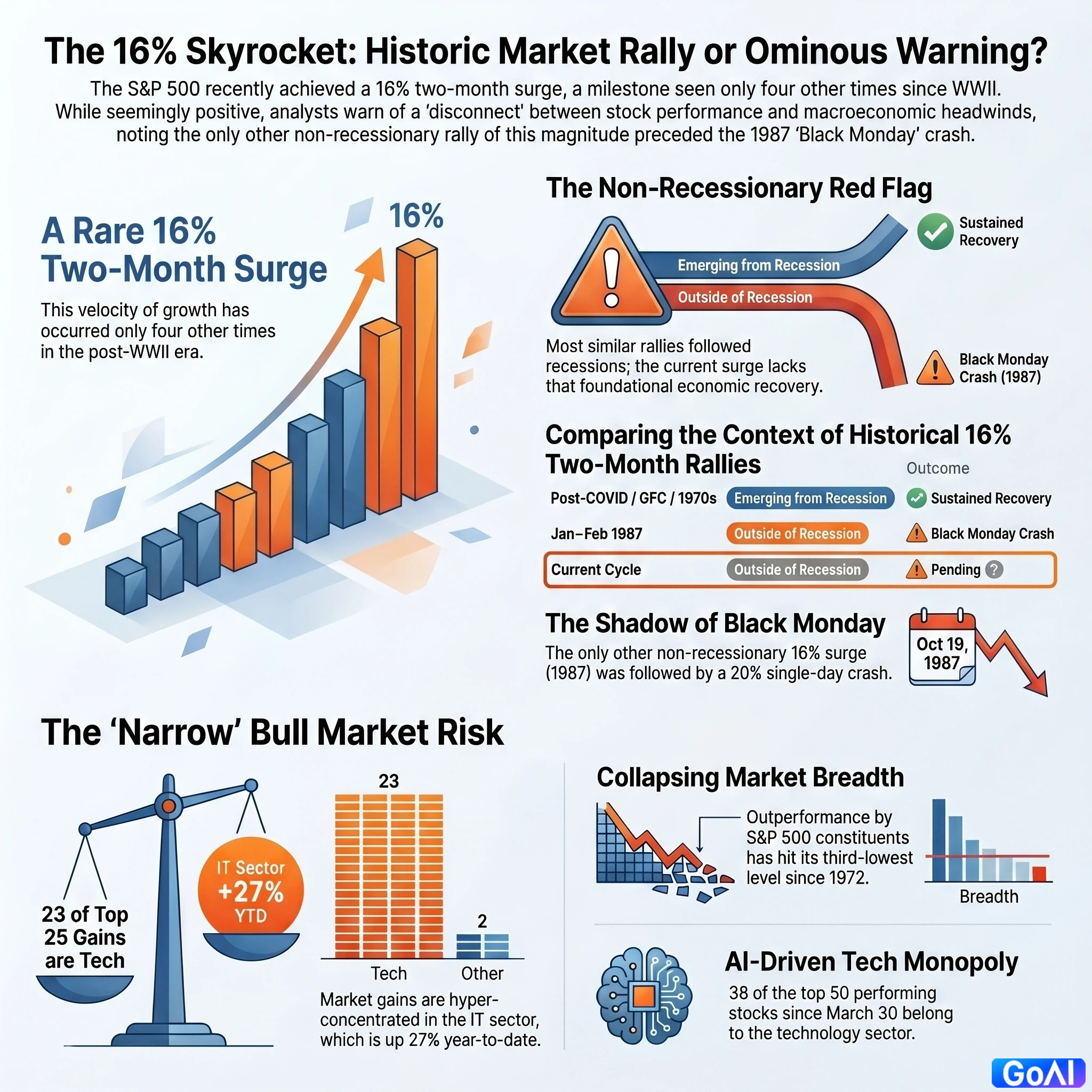
The US stock market has just staged a rare rally seen only four times since World War II. Despite the ongoing war with Iran, the S&P 500 Index has registered one of its strongest two-month performances on record.
While this is a remarkable milestone, it also serves as a stark warning for the market's forward trajectory.
According to a fresh note from Deutsche Bank analysts, the S&P 500 recorded a historic surge across April and May, with the index weaponizing a blistering 16% gain in just two months.
Such a rapid rate of appreciation is exceedingly rare. Excluding the current cycle, a two-month advance of this velocity has occurred only four times in the post-WWII era.
For investors, history suggests this could be an ominous sign.
In three of those four historical precedents, the market's explosive upside materialized as the US economy was emerging from a structural recession: specifically, the post-COVID rebound, the recovery following the Global Financial Crisis, and the snapback after the first oil shock of the 1970s.
In those instances, the aggressive market expansion was fundamentally backstopped by an economic recovery and a renewal of investor confidence.
However, the fourth exception occurred in January and February of 1987. That specific historic surge was immediately followed by the catastrophic "Black Monday" crash, which sent the S&P 500 plunging over 20% in a single trading session.
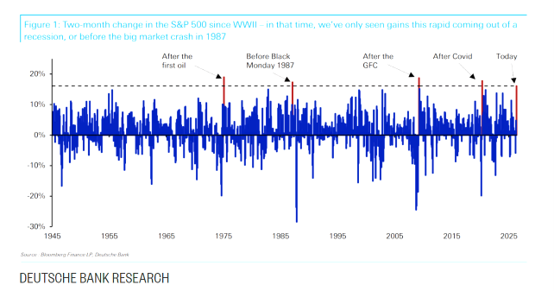
"Given that the current rally is not occurring in the wake of an economic recession, it stands out as particularly striking," Deutsche Bank analyst Henry Allen wrote Tuesday.
"The only post-WWII precedent where the S&P 500 advanced this aggressively outside of a recessionary backdrop occurred just months before a historic stock market crash."
As US equities continuously print fresh highs, the narrative surrounding an imminent market correction is gaining significant traction.
Deutsche Bank has categorized this price action as a glaring "disconnect," highlighting the stock market's relentless upward momentum despite the ongoing conflict with Iran and a steady stream of geopolitical and macroeconomic headwinds.
The firm pointed to other structural disconnects currently permeating the market. Allen noted that with inflationary pressures turning increasingly severe, the risk of the Federal Reserve adopting a more hawkish policy stance is mounting.
"This is also worth noting, as hawkish shifts by the Federal Reserve have been directly tied to several multi-asset sell-offs in recent years—such as in 2015–2016, late 2018, and throughout 2022," Allen added.
Tech Monopoly Triggers Broad Breadth Anxieties
On Tuesday, driven by compounding AI optimism, the three major US indexes locked in minor gains to extend their record-breaking closing streaks. The flagship S&P 500 Index ticked up 9.94 points, or 0.13%, to finish at 7,609.90.
The S&P 500 has advanced more than 11% year-to-date, though the gains remain highly concentrated, with the Information Technology sector alone engineering a massive 27% surge.
A growing chorus of analysts is warning that the current rally suffers from a severe lack of market breadth, creating an extreme "narrow bull market" defined by acute sectoral divergence. This hyper-concentration inside tech is increasingly viewed as a technical red flag.
In a note released Tuesday, Bespoke Investment Group pointed out that while the S&P 500 has rallied aggressively off its March 30 low, "market breadth remains narrow" with "the vast majority of the gains clustered heavily within the tech sector." From March 30 through Monday, technology equities have skyrocketed over 45%.
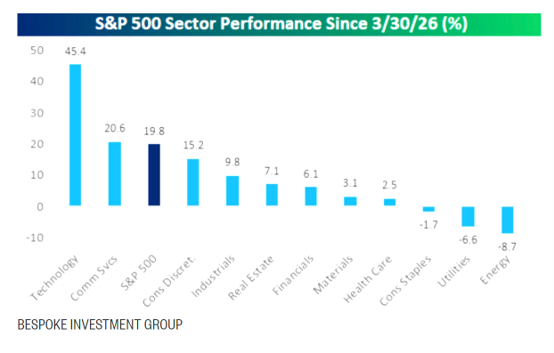
"Of the top 50 performing stocks since the March 30 trough, 38 belong to the tech sector," Bespoke noted. "Furthermore, tech names comprise 23 of the top 25, and command the top 13 spots entirely."
Rob Anderson, a strategist at Ned Davis Research, noted Tuesday on social platform X that the percentage of S&P 500 constituents outperforming the index over the past two months has collapsed to its third-lowest level since 1972.