
Is a Double Not Enough? Goldman Sachs Upgrades Kospi Target, Setting Sights on 12,000 Milestone

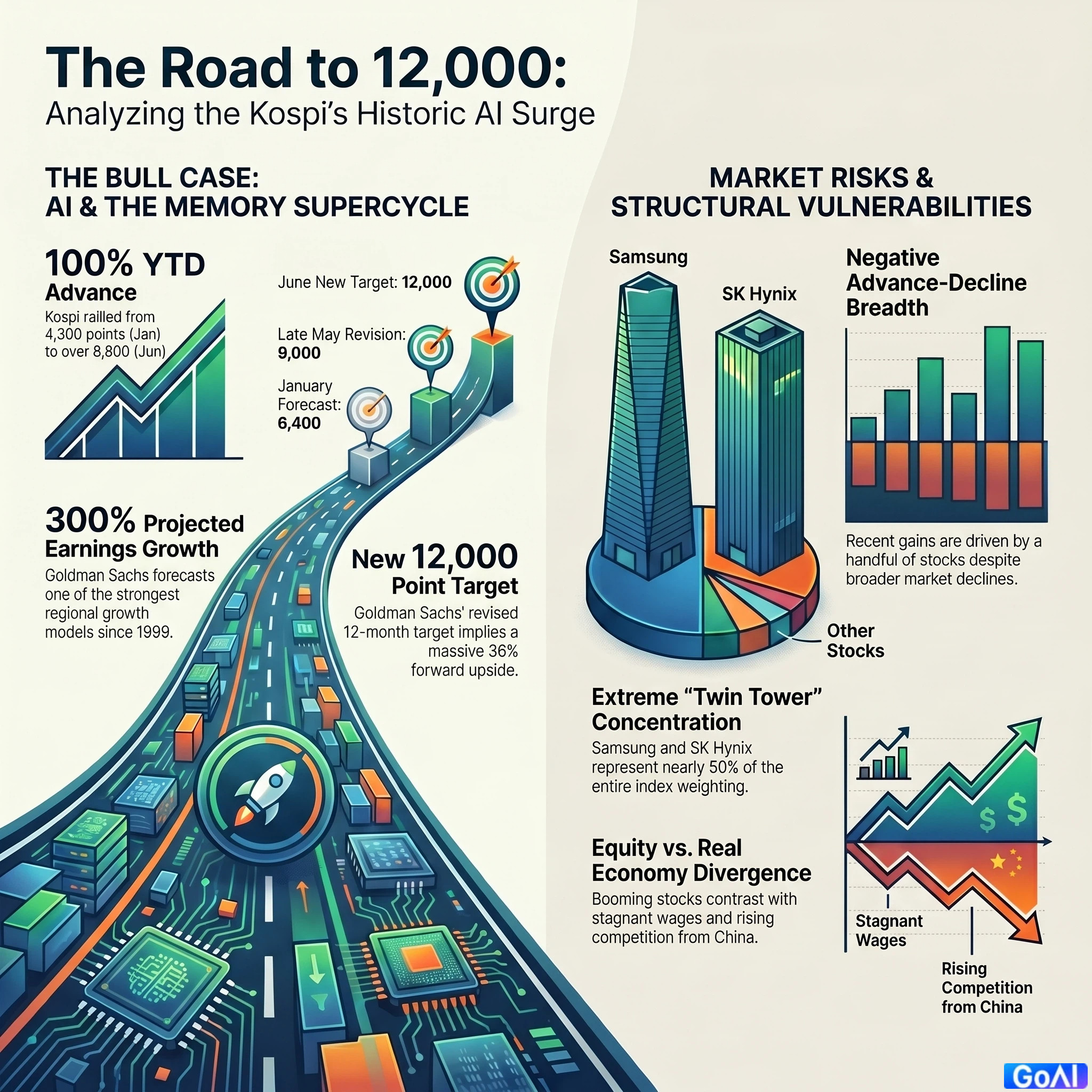
As of early June, South Korea’s benchmark Kospi index has rallied from roughly 4,300 points at the start of the year to clear the 8,800 threshold, securing a blistering year-to-date advance of over 100% and effectively doubling in 2026.
However, a selection of market strategists note that the historic run may still have runway left as South Korea’s artificial intelligence chip heavyweights continue to power explosive forward earnings growth.
Goldman Sachs on Wednesday upwardly revised its 12-month target price for the Korea Composite Stock Price Index (Kospi) to 12,000 points, implying a massive forward upside of over 36% from current trading levels.
“Earnings are driving returns in Asian equities,” Timothy Moe, Chief Asia-Pacific Equity Strategist at Goldman Sachs Research, wrote in a fresh report.
Moe added that the firm remains Overweight on South Korea, anchored by expectations of "higher corporate earnings, an underappreciated duration to the memory cycle, and clear re-rating catalysts."
In January, the Kospi hovered near the 4,300 level before catapulting past 8,800 by early June. The near-100% year-to-date moonshot has thoroughly obliterated Goldman’s initial annual forecast of 6,400, as well as its mid-year revised range of 7,000 to 9,000 points.
Remarkably, Goldman Research had just adjusted its 12-month Kospi target to 9,000 in late May.
At the time, the firm highlighted that the South Korean equity market was primed for extended structural upside, arguing that surging semiconductor earnings within the current "memory chip supercycle" are fundamentally re-ordering the Asian investment landscape.
“South Korea is our highest-conviction market allocation,” Moe wrote in the late-May note.
“Our projection for corporate earnings return growth in South Korea this year stands at a staggering 300%. Outside of the post-Asian Financial Crisis recovery phase in 1999, this represents one of the strongest growth forecasts ever modeled for any regional market in Asia.”
Goldman’s overarching investment thesis remains locked in—South Korea is the primary beneficiary of a structural macro supercycle sweeping the semiconductor memory complex.
Underpinning this cycle is a record-breaking deficit in memory supply, compounded by insatiable computing demand linked to artificial intelligence and compounding capital expenditures from global hyperscalers.
Because memory fabricators carry high operational leverage, these aggressive pricing tailwinds are converting directly into blockbuster bottom-line profitability.
Even so, defensive anxieties are beginning to surface across trading desks. Global financial services firm BTIG cautioned that the velocity of the current rally is accompanied by acute technical risks.
“Over the past six trading sessions, the Kospi has advanced 12.15%. However, the index's advance-decline breadth has turned materially negative on a daily basis, and by a substantial margin,” noted Jonathan Krinsky, Chief Market Technician at BTIG.
“This is the structural byproduct of what transpires when a handful of hyper-cap stocks command nearly 50% of an entire index's weighting.”
Peter Kim, Global Strategist at KB Financial Group, echoed these concentration concerns, noting that South Korea’s “Twin Towers”—Samsung Electronics and SK Hynix—continue to aggressively outpace the broader tape, leaving the semiconductor cycle as the near-exclusive engine behind equity performance.
“The euphoric volatility in the stock market is masking underlying structural vulnerabilities within the domestic economy and its industrial base,” Kim wrote in a client note. “China is rapidly eroding market share previously held by South Korean exporters, while the domestic consumer economy remains broadly soft.”
The glaring divergence between a roaring equity bull market and a sluggish domestic economy is complicating the forward landscape for central bankers and policymakers. Even as equity and real estate valuations climb, South Korea's real economy remains weighed down by stagnant wage growth, deceleration in employment metrics, and structurally elevated energy costs.
Nevertheless, global institutional allocators appear content to overlook these macroeconomic frictions for now, as AI-driven earnings acceleration continues to dominate regional tape action.
Goldman Sachs estimates that aggregate earnings per share (EPS) across the Asia-Pacific region will expand 60% through 2026, with the technology sector positioned to remain the undisputed vanguard of market performance.