
Gold Set for a Phoenix Rebirth? Commerzbank Sees Multi-Month Upside, Models $5,200 Target

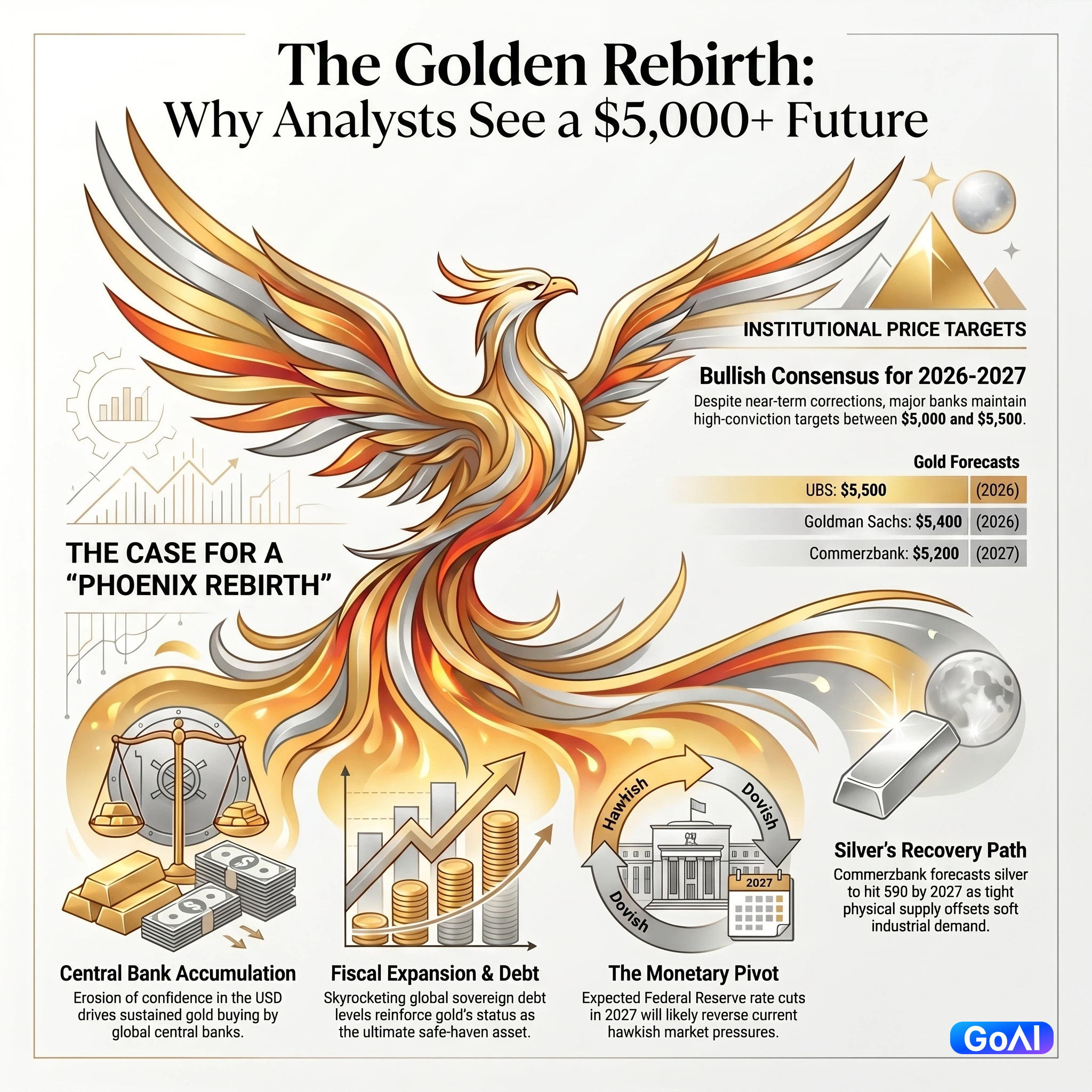
Carsten Fritsch, a senior commodity analyst at Commerzbank, noted Thursday that while gold prices have remained depressed due to a structural hawkish shift in US monetary policy expectations since the outbreak of the war with Iran, the precious metal is ultimately primed to break out of its current consolidation phase.
In his latest note, Fritsch pointed out that the macroeconomic consensus has aggressively pivoted—shifting from factoring in pre-war Federal Reserve rate cuts to now fully pricing in a high probability of at least a 25-basis-point interest rate hike by spring 2027.
Consequently, Commerzbank downwardly revised its year-end gold target from an initial $5,000 per ounce to approximately $4,800 per ounce. Crucially, this adjusted target still implies substantial forward upside over the coming months.
"Our new baseline scenario assumes a two-month transitional window, after which Brent crude prices will decline following the reopening of the Strait of Hormuz," Fritsch wrote. "This unwinding of energy pressures will effectively reverse current market expectations for further rate hikes."
Remaining resolutely bullish on gold's secular potential, Fritsch bucked both the broader consensus and the recent hawkish rhetoric from Federal Reserve officials, arguing that the central bank's next structural move is far more likely to be a rate cut. He models the first reduction to materialize in the second quarter of 2027.
"As a result, we are maintaining our year-end 2027 gold forecast at $5,200 per ounce," he stated.
"The structural pillars backstopping the gold bull market remain entirely intact," Fritsch added. "These include an ongoing erosion of confidence in the US dollar as the world's primary reserve currency, which is poised to drive sustained official-sector accumulation by central banks.
Institutional and retail gold demand should also remain highly elevated, supported by skyrocketing global sovereign debt levels. This fiscal expansion leaves monetary policy structurally too loose relative to sticky inflation, further reinforcing the asset's safe-haven appeal."
As bullion undergoes a tactical near-term correction, a battery of Wall Street megabanks have routinely lowered their near-term targets while leaving their long-term structural investment theses intact.
For instance, UBS last week trimmed its year-end 2026 gold forecast to $5,500 per ounce from $5,900, citing persistent headwinds from elevated US Treasury yields and a relentlessly strong dollar.
Nevertheless, UBS maintains that the structural gold bull run is far from over. Analysts Dominic Schnider and Wayne Gordon noted that investors simply need to exercise greater patience in the face of macro friction.
Notably, their adjusted forecast still indicates that bullion prices can tack on an additional $1,000 by the end of the year.
Citigroup similarly adopted a bearish near-term bias, forecasting that gold prices will drift down to touch $4,300 per ounce within the next three months. However, the bank refrained from turning systematically pessimistic over the medium term, keeping its 6-to-12-month target locked in at $5,000 per ounce.
Goldman Sachs, by contrast, remains a high-conviction gold bull, predicting that the metal will stage a powerful comeback by late 2026. Analysts Lina Thomas and Daan Struyven wrote that gold’s medium-term outlook remains rock-solid, modeling a march to $5,400 per ounce fueled by relentless central bank bidding and the expectation of two remaining Fed rate cuts this year.
In tandem with its gold recalibration, Commerzbank also dialed back its projections for silver, tracking a year-end target of approximately $80 per ounce.
"Beyond the downward revision in gold prices, soft industrial demand trends also point to a mild contraction in silver prices," Fritsch wrote.
"According to the Silver Institute's latest assessment, industrial demand is on track to decline for a second consecutive year, marking a four-year low. Even so, physical silver market balances remain structurally tight, leading us to expect a price recovery next year."
The bank expects silver to trade at approximately $90 per ounce by year-end 2027, down marginally from its prior target of $95 per ounce.