
SpaceX's "IPO of the Century" Faces Fresh Valuation Skepticism; Expert Says Real Value Is Lower and AI Sector Is Miles from Profitability

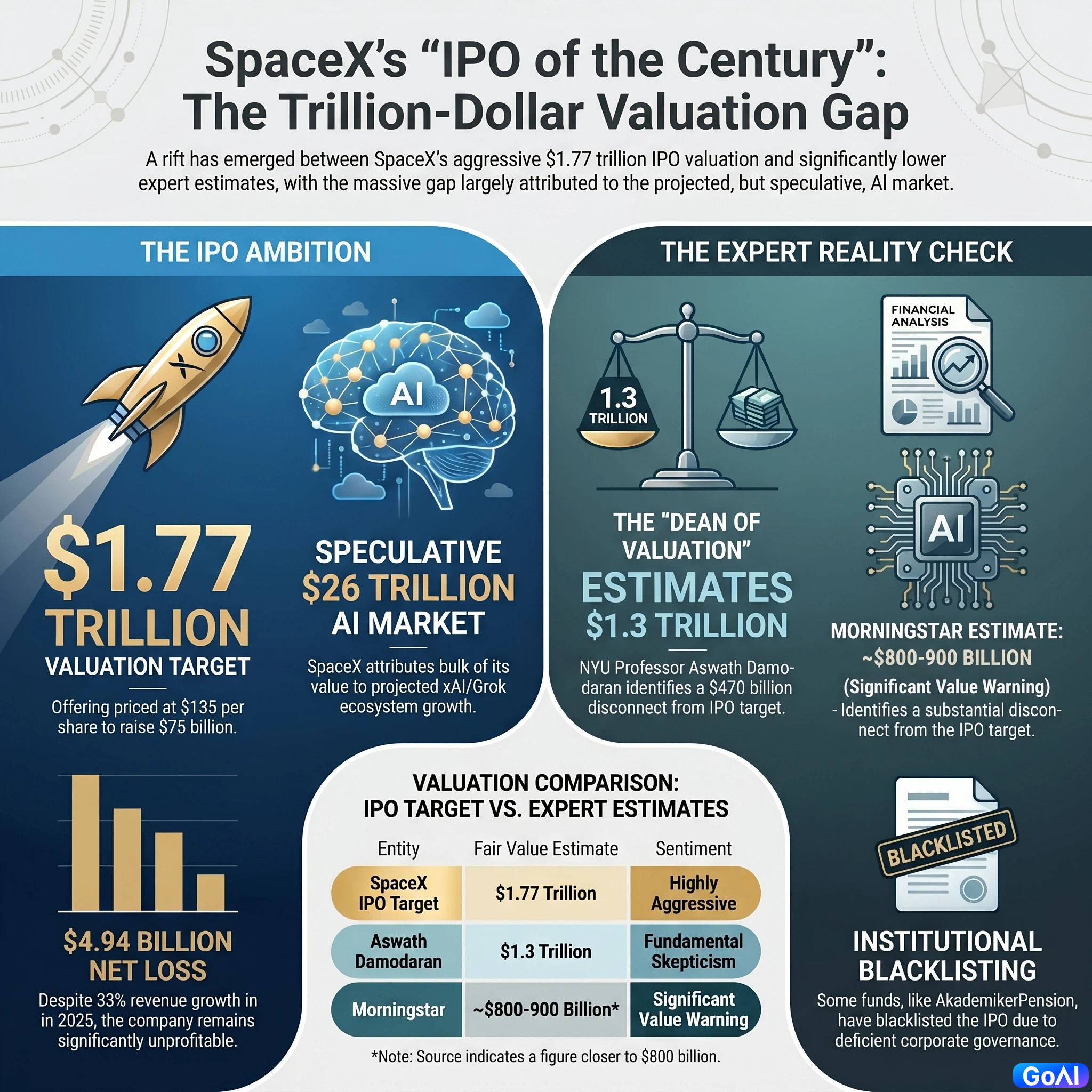
SpaceX's historic "IPO of the century" is scheduled to launch this Friday (June 12). Yet, despite intense market anticipation, investors are growing increasingly skeptical of whether the aerospace pioneer's targeted $1.77 trillion valuation holds water.
The latest prominent skeptic to weigh in is Aswath Damodaran, a professor at NYU’s Stern School of Business widely revered as Wall Street’s "Dean of Valuation." Damodaran argues that the company's intrinsic value is materially lower, modeling a fair-value appraisal of closer to $1.3 trillion.
Under the current terms, Elon Musk’s SpaceX will officially list on the Nasdaq this Friday. The firm finalized its offering price at $135 per share, plotting to raise $75 billion through the issuance of roughly 555.6 million shares to chase the $1.77 trillion valuation target.
The company operates a highly complex enterprise spanning launch services, Starlink satellite broadband, and a growing AI ecosystem.
Given Musk's polarizing public persona and the sprawling footprint of the business, establishing a baseline valuation has become a key debate for institutional allocators.
Financial disclosures show that while SpaceX logged a robust 33% revenue expansion in 2025 to reach $18.67 billion, it also ran a steep net loss of $4.94 billion.
Detailing his analysis on a recent finance podcast, Damodaran pointed out that the primary disconnect stems from the aggressive assumptions SpaceX has applied to the total addressable market (TAM) of its artificial intelligence division.
This unit houses xAI and the Grok chatbot ecosystem, which were absorbed via an acquisition of xAI earlier this year.
In its regulatory IPO filings, SpaceX projected the standalone TAM for its AI business at an eye-watering $26 trillion, commanding the lion's share of its estimated $28.5 trillion aggregate corporate market opportunity. Damodaran characterized these core assumptions as overly optimistic.
For global allocators, the debate highlights a critical inflection point: is the pricing of this offering—set to rank as one of the largest IPOs in corporate history—tethered to fundamental realities, or backed by speculative assumptions regarding long-term AI growth?
The ultimate answer will not only dictate SpaceX's post-listing equity performance but reshape how the market values high-flying technology and AI peers currently trading at rich multiples.
Damodaran constructed his valuation model by separately auditing SpaceX's three core segments: rocket launch operations, the Starlink satellite network, and its AI business.
For each unit, he calculated market opportunities, realistic forward market shares, and potential operating margins. Through this lens, he identified the AI division as the company’s least mature asset class and the furthest removed from generating meaningful free cash flow.
Yet, despite his mathematical conclusion that SpaceX is mispriced relative to its proposed IPO target, Damodaran noted that the stock could still perform strongly post-debut.
Given the company's outsized institutional profile and intense retail euphoria, he suggested that near-term price action will likely be driven by pure market momentum and thematic sentiment rather than traditional fundamental metrics.
Damodaran is far from alone in his caution; a growing list of research desks and institutional allocators have published fair-value estimates tracking well below the official IPO target:
- Morningstar: Appraised the company's fair value at approximately $7800 billion—barely half of the target IPO figure. Analysts warned that the xAI integration could act as a "value-destructive" drag on the parent company, noting that a worst-case scenario could trigger catastrophic balance-sheet losses.
- AkademikerPension: The Danish pension fund formally blacklisted SpaceX from its investment mandate, stating that its reasonable valuation should not clear the $1 trillion mark while strictly criticizing what it characterized as deficient corporate governance structures.