
Is "Black Friday" Merely a Prelude? Goldman and Barclays Sound Shared Warning on Deepening US Equity Risks

Despite the friction of a lingering conflict with Iran, US equities have routinely staged an seemingly bulletproof "up-only" narrative, insulated by deep artificial intelligence optimism and robust corporate earnings.
Yet, last Friday's sudden and violent liquidation caught institutional desks flat-footed, prompting Wall Street analysts to warn that allocators should not casually dismiss the rout as a transient, one-off anomaly.
Trading desks across Barclays Plc and Goldman Sachs Group Inc. issued synchronized notes of caution, pointing out that extreme position crowding, narrow market breadth, and the structural reality of higher-for-longer interest rates have left the broader tape acutely vulnerable to sudden, systemic drawdowns.
"These compounding dynamics have engineered an environment where the mechanical unwinding of factor trades risks delivering a shock that is far more severe than headline index-level volatility metrics imply," Goldman traders, including Lee Coppersmith, wrote in a client note.
Last Friday's price action offered a stark demonstration of how rapidly fortune can reverse for the market's biggest winners once thematic sentiment shifts.
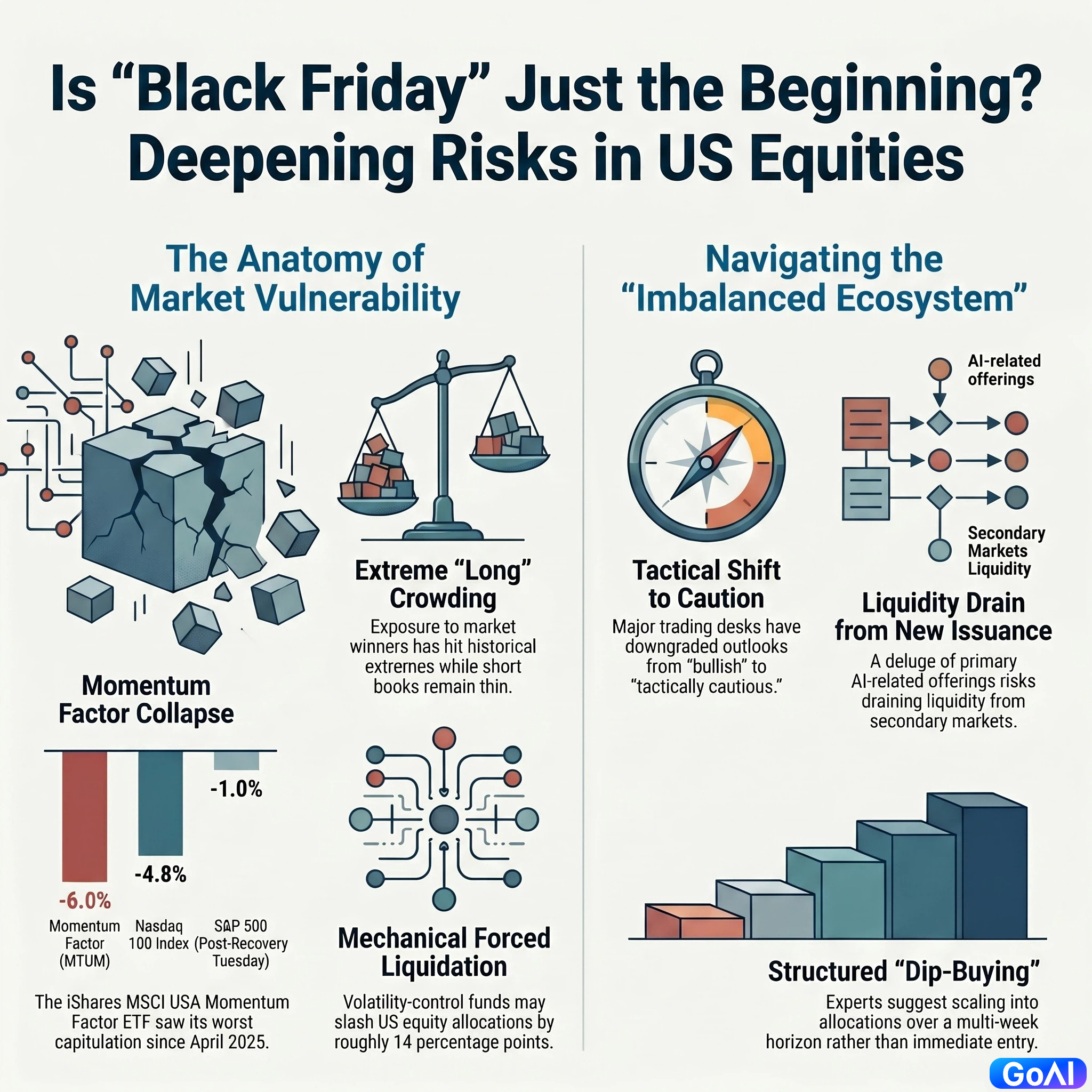
The iShares MSCI USA Momentum Factor ETF (MTUM) plummeted 6% on the session, logging its most severe single-day capitulation since the tariff-fueled "Liberation Day" liquidation of April 2025.
Concurrently, the Nasdaq 100 Index slumped 4.8% as traders aggressively rotated out of mega-cap tech in a mad scramble for defensive allocations.
Data compiled by Goldman highlights that crowding within momentum strategies—longing the market's runaway winners and shorting its chronic underperformers—has scaled to historical extremes on the long side. Conversely, exposure across short books remains exceptionally thin.
This asymmetric positioning dramatically amplifies the risk of a violent, crowded reversal, particularly if incoming macro data injects fresh uncertainty regarding the AI monetization cycle, the Fed’s forward policy trajectory, or a secondary spike in inflation.
Systematic and algorithmic allocators are poised to exacerbate these downside pressures. Commodity Trading Advisors (CTAs) and volatility-control strategies had scaled their aggregate equity exposure to its highest levels since February, leaving them mechanically primed to execute forced liquidation programs should price churn persist.
Alexander Altmann, Global Head of Equity Tactical Strategy at Barclays, estimated that in the wake of Friday's plunge, volatility-control funds may be forced to slash their US equity allocations by roughly 14 percentage points. Such a move would mark the most aggressive single-day de-risking operation witnessed since February 6.
While a portion of this de-risking may have been absorbed during Friday's session, the mechanical nature of systematic selling typically operates with a minor lag, suggesting the broader tape could remain under structural pressure through the early part of the week.
"When market volatility hits these extreme thresholds, it exerts a highly material, deterministic impact on short-term price action," Altmann noted.
J.P. Morgan’s trading desk mirrored these anxieties on Monday, systematically downgrading its near-term equity outlook from "bullish" to "tactically cautious." Traders warned that the tape is highly likely to remain choppy as institutional participants continue to trim risk from tech mega-caps that have enjoyed parabolic year-to-date runs.
Nevertheless, Andrew Tyler, Head of Global Market Intelligence at the firm, suggested that the secular bull case remains valid. "We ultimately believe that buying the dip remains the correct structural play," Tyler noted, though he added that given immediate drawdown risks, "it is far more prudent to scale into allocations over a multi-week horizon spanning this week and next."
Tyler cited several imminent risks facing the market, including fixed-income volatility, forced positioning unwinds, a potential cyclical cooling in the AI trade, and an impending acceleration in primary equity issuance.
Indeed, institutional desks are bracing for an unprecedented pipeline of initial and secondary offerings.
A vast queue of corporations is seeking to tap public markets to fund capital-intensive AI ambitions, raising critical questions on Wall Street: is there sufficient liquidity on the buy-side to smoothly absorb this supply, and what structural compressions will this exert on aggregate equity multiples?
A contingent of strategists worries that against a backdrop of highly crowded positioning, this deluge of primary paper risks systematically draining liquidity away from existing secondary floats—a friction point amplified by elevated discount rates and cooling macroeconomic growth metrics.
Altmann of Barclays characterized the current landscape as an "exceptionally imbalanced ecosystem," warning that if the wind direction shifts across major factor pools, momentum strategies are primed for an even more violent unwinding process.
To be sure, a fraction of "buy-the-dip" capital deployed onto the tape on Monday, lifting the S&P 500 by 0.3% and the Nasdaq 100 by 0.86%.
However, that recovery proved short-lived on Tuesday; a wave of institutional profit-taking across the semiconductor complex forced both benchmarks back into the red, with the Nasdaq finishing down approximately 1%.