
US Commercial Crude Inventories Draw Down by Over 9 Million Barrels; Strategic Petroleum Reserve Plummets to Near Three-Year Low

As the global market fast approaches the structural supply-demand tipping point flagged by commodity analysts, crude prices face acute upside risks over the coming weeks against a backdrop of relentlessly dwindling inventories and lingering supply-chain paralysis.
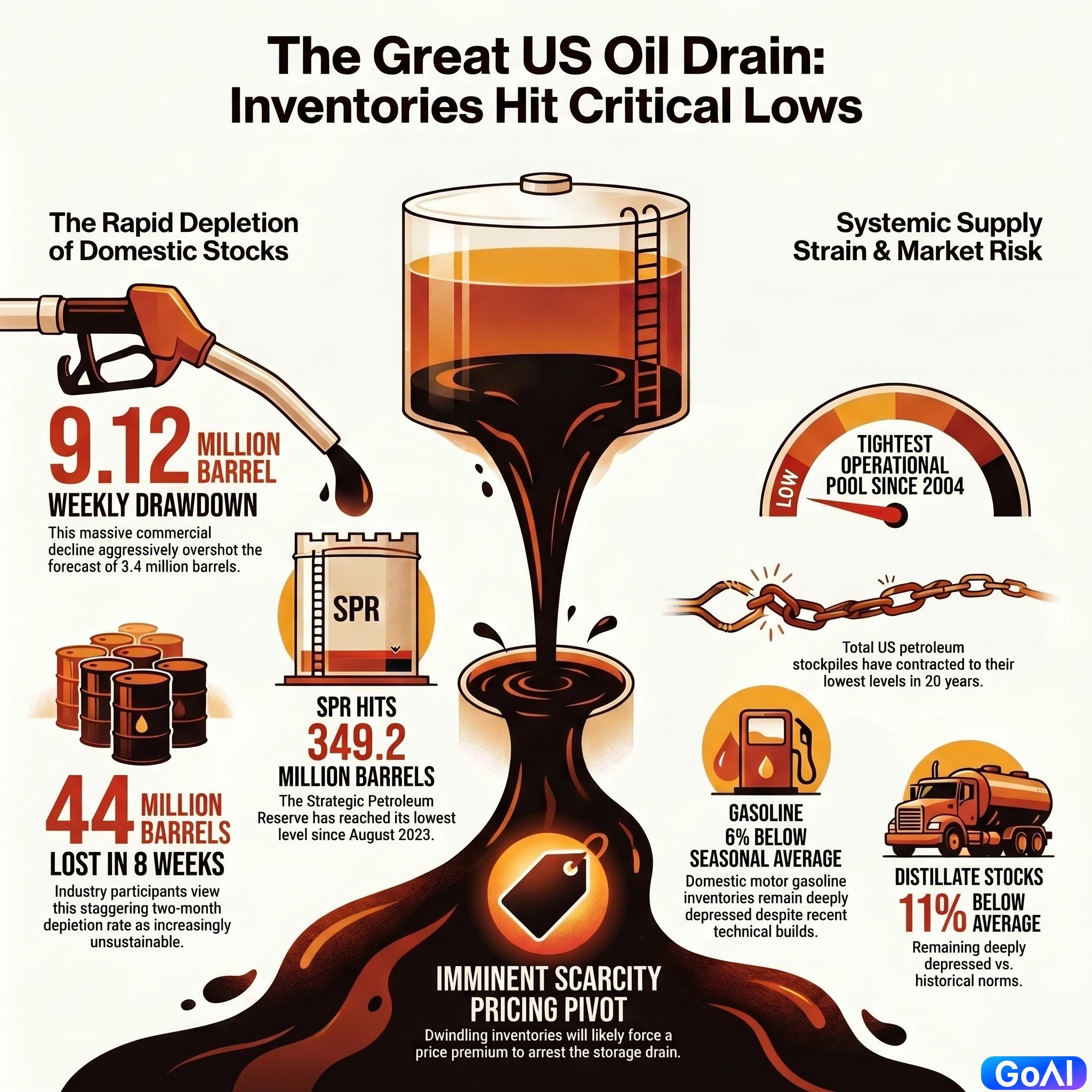
According to weekly estimates compiled by the American Petroleum Institute (API), US commercial crude inventories drew down by a massive 9.12 million barrels for the week ending June 5, aggressively overshooting consensus forecasts for a modest 3.4-million-barrel decline.
The blockbuster drop follows a substantial 6.75-million-barrel inventory drawdown recorded during the prior week.
The API tracks commercial operational inventories held across private industry in the United States. Over the past eight weeks alone, domestic crude stockpiles have contracted by a staggering 44 million barrels—a depletion rate increasingly viewed as unsustainable by industry participants.
Concurrently, the US Strategic Petroleum Reserve (SPR) continues to hemorrhage barrels. Official data indicates that the SPR released an additional 7.9 million barrels of crude for the week ending June 5, dragging total emergency stockpiles down to 349.2 million barrels.
This marks the lowest storage level printed since August 2023, leaving the emergency reserve sitting at a steep 376-million-barrel deficit relative to its maximum nameplate capacity.
This follows slightly earlier government data showing that by the tail end of May, aggregate US petroleum stockpiles—encompassing both crude and refined products like gasoline—had contracted by 10.6 million barrels to 1.57 billion barrels, marking the tightest operational pool recorded since 2004.
An Overview of the US Storage Complex
According to the latest regulatory dashboard from the US Energy Information Administration (EIA), domestic crude production ticked slightly lower to 13.71 million barrels per day (bpd) for the week ending May 29, down from 13.72 million bpd in the prior week, though still tracking 299,000 bpd above year-ago levels.
Downstream, gasoline inventories also joined the wider drawdown, shedding 1.19 million barrels for the week ending June 5.
The latest EIA metrics note that even prior to this latest print, domestic motor gasoline inventories were already tracking 6% below their seasonal five-year average, despite a brief technical build of 3.45 million barrels registered the week before.
US distillate stockpiles bucked the broader trend, building by 1.3 million barrels to reverse a 214,000-barrel draw from the prior week. Even so, the EIA emphasized that for the week ending May 29, aggregate distillate inventories remained deeply depressed at 11% below their seasonal five-year historical average.
Meanwhile, operational storage at Cushing, Oklahoma—the physical delivery hub for benchmark NYMEX WTI crude futures—drew down by 1.13 million barrels over the reporting period, compounding a 279,000-barrel draw from the week prior.
In a broader macro warning, the EIA projected that collective OECD petroleum inventories are on track to breach the 2.3-billion-barrel threshold to the downside, a multi-decade low for the developed-economy bloc.
Energy analysts have previously underscored that because the United States has effectively evolved into the global market’s swing producer of last resort, this aggressive hollowing out of domestic storage carries systemic implications.
As physical inventories dry up, US crude benchmarks will naturally require an embedded scarcity premium to forcibly arrest the domestic storage drain and curb relentless export flows—a pricing pivot that threatens to deliver a crushing blow to global energy buyers.