
SpaceX Listing Triggers Passively Managed Capital Rush; How Automated Inflows Will Distort Market Pricing Mechanics

While the operational logistics for SpaceX’s initial public offering are still finalizing, institutional debates regarding a massive wave of mandatory programmatic buying by passive funds are already echoing across Wall Street.
Academic experts and quantitative market observers note that because benchmark-tracking vehicles are positioned to pipe billions of dollars in automated inflows into SpaceX, the aerospace group’s equity could face an artificial upward re-rating, potentially igniting a self-reinforcing feedback loop.
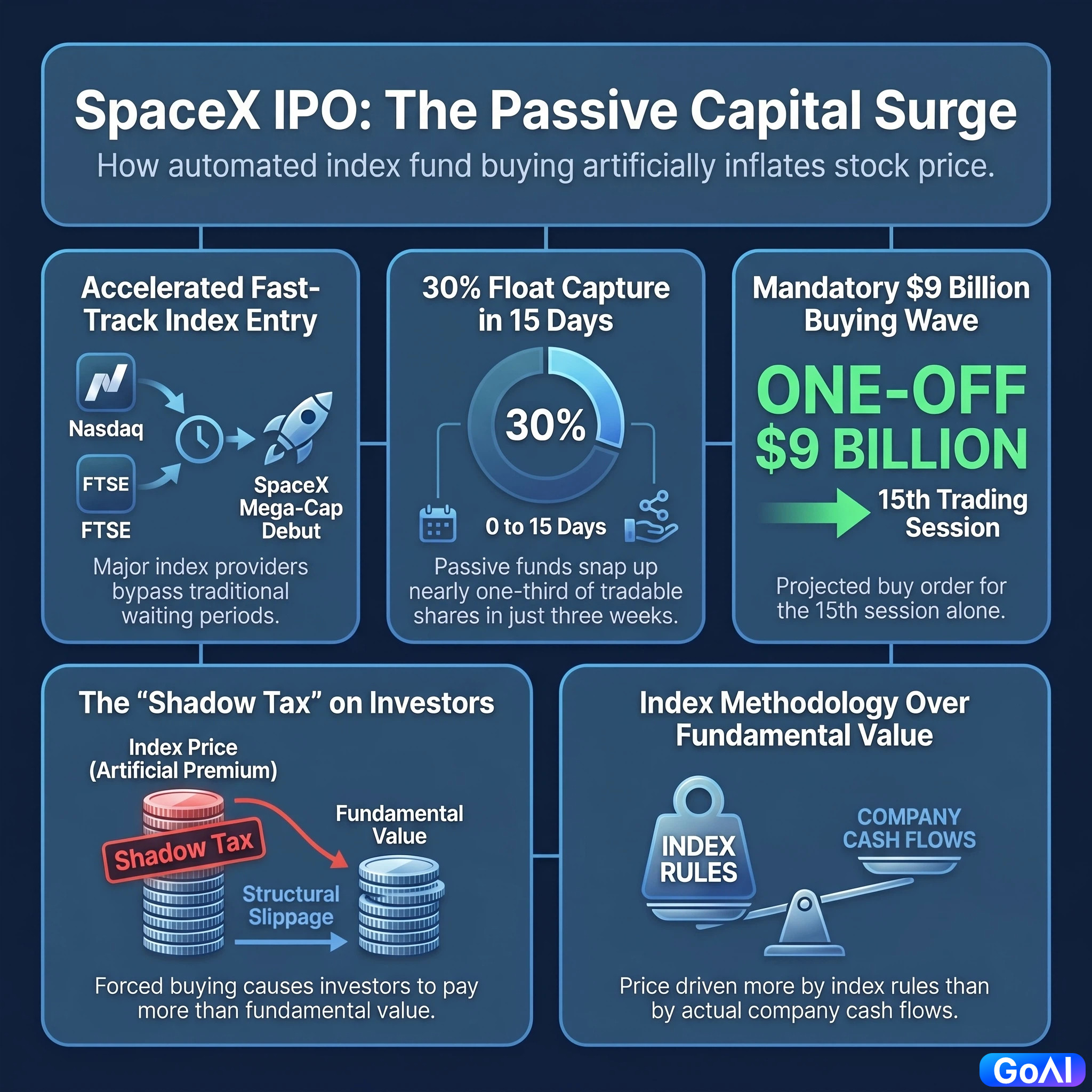
Global index architects including Nasdaq, FTSE Russell, and MSCI are universally preparing to fast-track SpaceX into their flagship indices.
Both Nasdaq and FTSE Russell have systematically recalibrated their baseline rules, engineering accelerated entry paths for mega-cap IPOs.
According to data modeled by Intropic, a research desk specializing in index rebalancing flows, passive vehicles could capture approximately 30% of SpaceX’s floating equity just 15 trading sessions post-debut.
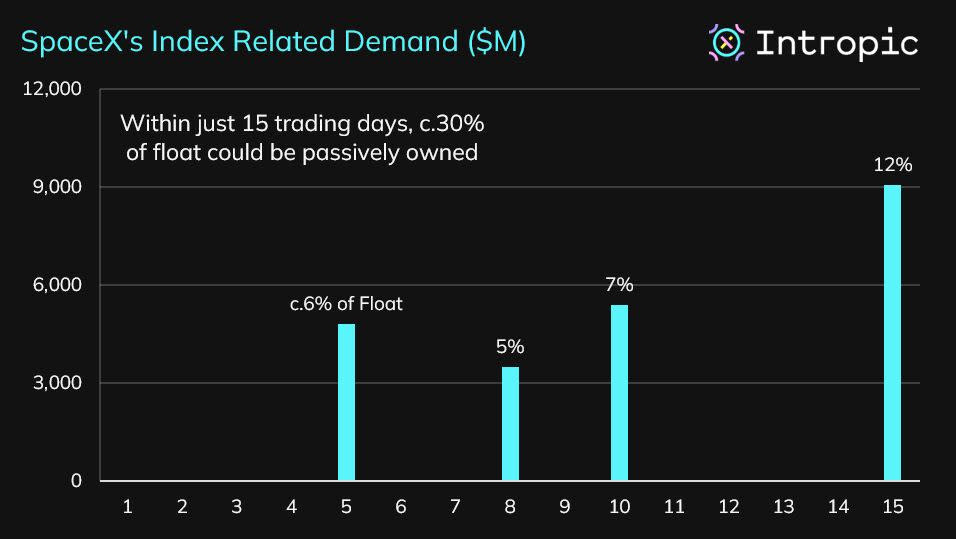
Under legacy, slower-track integration timelines, that passive capture ratio would have cleared barely 4%.
Intropic Flow Projections
The quantitative model plotted by Intropic indicates that SpaceX will face successive waves of mandatory benchmark-driven buying on its 5th, 8th, 10th, and 15th sessions of secondary trading.
Notably, on the 15th trading day alone, one-off passive demand is projected to approach $9 billion, representing roughly 12% of the company's entire free float.
Consequently, given the naturally constrained pool of tradable equity during the initial phase of the listing, index funds and exchange-traded funds (ETFs) are mathematically bound to aggressively corner a massive block of shares within a hyper-compressed window.
This highly predictable structural demand is already poised to push the stock price higher well ahead of schedule.
Active managers, hedge funds, and market makers routinely front-run these flows by accumulating SpaceX equity early, planning to dump inventory onto passive index funds once the mandatory execution windows open.
By the time passive capital officially deploys, buying prices are often heavily distorted.
Marco Sammon, an assistant professor at Harvard Business School, noted that the aggressive push by major index providers to fast-track SpaceX stems partly from implicit competition among benchmark operators.
He suggested that the listing could serve as a textbook case of asset prices being heavily dictated by index methodology rather than fundamental cash flows.
Sammon’s previous empirical research indicates that market anticipation of index inclusion can occasionally blunt the localized price shock.
This occurs because hedge funds and designated market makers accumulate the underlying stock progressively ahead of time, providing needed liquidity to passive funds during the formal rebalancing window.
Yet, SpaceX presents a far more volatile edge case. As a listing poised to rank as the largest IPO in modern corporate history, the asset layers Elon Musk’s outsized public premium onto massive secular themes across commercial aerospace, Starlink connectivity, and artificial intelligence monetization.
Compounding this narrative with simultaneous fast-track indexing from multiple providers could aggressively amplify buy-side pressures.
This structural dynamic brings the concept of the "shadow tax" back to the forefront.
While passive index funds market themselves as low-cost vehicles that merely reflect the broader market, the reality of fast-tracking hot mega-caps forces retail and institutional investors to execute purchases at an artificial premium, quietly incurring structural slippage.
Ultimately, market participants note that the SpaceX debut will serve as much more than a capital-markets coronation for Musk’s corporate empire—it is positioned to be a definitive case study on the systemic influence of passive indexing on modern market structure.