
Goldman Reaffirms AI Boom: Tech Capex Underestimated, Token Usage to Surge 24x by 2030

As the resumption of US-Iranian military hostilities and a hawkish recalibration of Federal Reserve rate expectations force a broader repricing of the tech sector, some investors are losing faith in the AI rally.
However, Goldman Sachs pushed back against this skepticism in a Wednesday note, emphasizing that even after recent upward revisions, capital expenditure on AI by hyperscalers is poised to handily outpace market expectations.
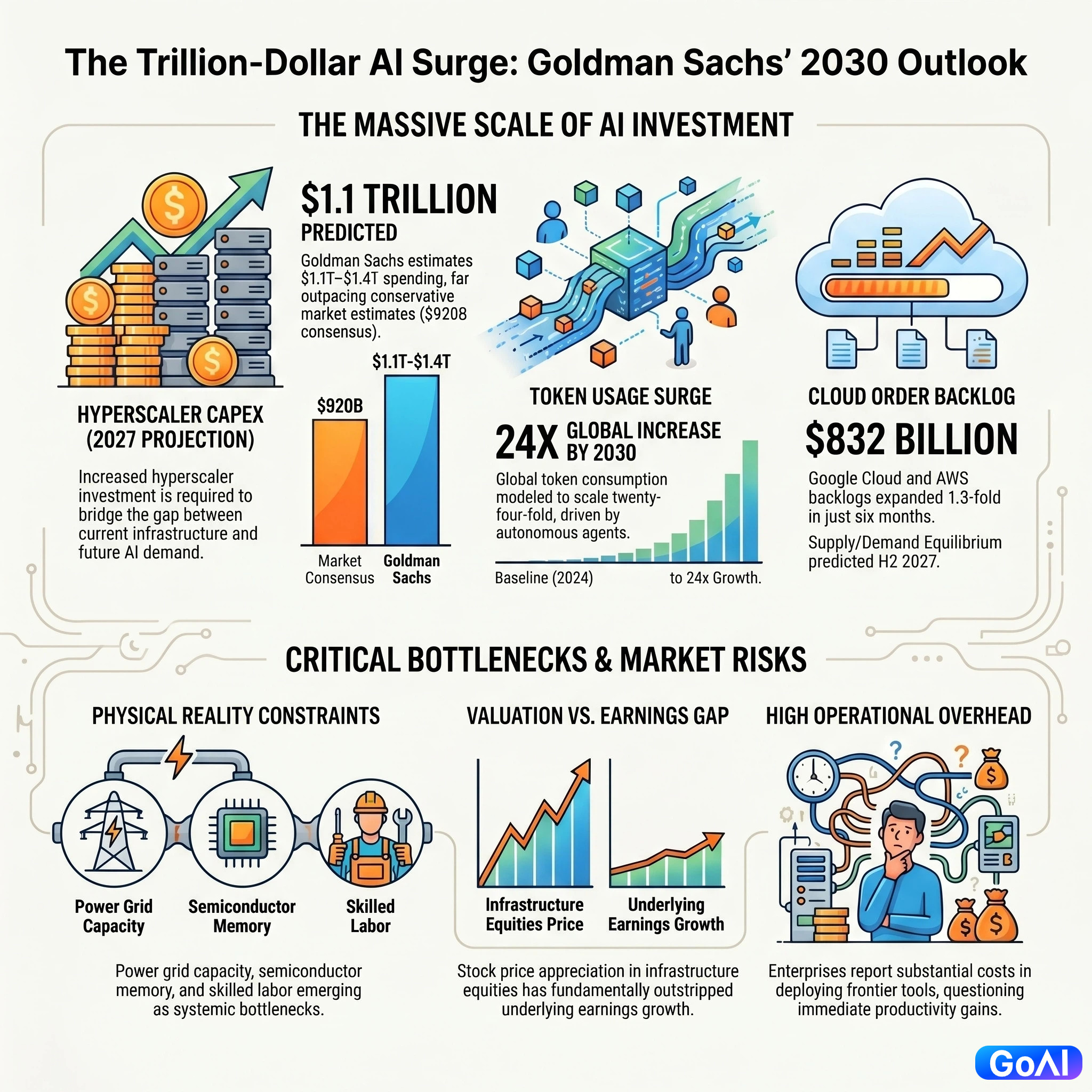
The firm argues that Wall Street's consensus projections of $920 billion for 2027 hyperscaler capex remain far too conservative.
Instead, Goldman estimates aggregate spending will march toward $1.1 trillion, with an upside bull-case scenario climbing as high as $1.4 trillion.
According to Goldman, global demand for AI compute capacity remains in its infancy, and total token consumption is modeled to scale 24-fold by 2030, heavily catalyzed by the proliferation of autonomous enterprise agents.
Because heavier token throughput mechanically mandates an exponential increase in underlying compute capacity, this trajectory is set to unlock sustained demand for next-generation data centers, silicon, networking hardware, and power infrastructure.
Tangible evidence backstopping this thesis can be found within the cloud hyperscalers' financial scorecards, as Google Cloud and AWS collectively exited the first quarter with an aggregate order backlog of $832 billion.
This massive pool of deferred revenue represents an explosive 1.3-fold expansion compared to metrics logged just six months prior.
Goldman projects that AI supply and demand balances will not reach equilibrium until at least the second half of 2027.
This means that capital deployment will remain elevated for significantly longer than institutional allocators currently model, which should continue to anchor robust earnings growth for infrastructure firms.
Nevertheless, the path forward is facing near-term friction. A growing cohort of enterprises has recently flagged that deploying frontier AI tools incurs substantial operational overhead.
This has left it an open question whether immediate productivity gains will successfully offset rich model costs.
Furthermore, Goldman highlighted that the most formidable bottlenecks facing the AI ecosystem moving forward are tethered to physical realities rather than capital availability.
A multitude of data center deployments have already faced systemic construction delays, as advanced semiconductor memory, power grid capacity, and skilled engineering labor increasingly emerge as critical macro constraints.
Concurrently, the bank issued a tactical warning regarding intensifying localized competition, noting that valuation multiples across a swath of AI infrastructure equities have expanded rapidly.
Ultimately, several momentum names are printing stock price appreciation that has fundamentally outstripped underlying earnings growth, a divergence that mechanically exacerbates the risk of sudden market volatility.