
Micron 26FYQ3 Earnings Preview: Can Cyclical Trajectories Transition into Secular Growth?

After the US close on June 24, Micron Technology—one of the global memory triumvirates—is scheduled to report its 26FYQ3 financial results and issue forward guidance for the subsequent fiscal quarter.
Backed by a relentless run-up in global memory equity valuations and spot pricing, market expectations continue to migrate upward.
A growing body of sell-side research posits that the memory vertical is shedding its pure-play cyclical attributes to become an indispensable bedrock layer of artificial intelligence infrastructure. However, the precise velocity and sustainability of this expansion remain tethered to downstream demand dynamics and the industry's broader capacity expansion footprint.
Currently, consensus estimates project 26FYQ3 revenue at $36.0 billion to $37.0 billion, with whisper numbers stretching up to $40.0 billion. Gross margins are modeled at 81% to 83%, net margins at 65% to 67%, EPS at $20.00 to $22.00, and capital expenditures at $7.5 billion to $8.0 billion.
For forward-looking indicators, the Street expects 26FYQ4 revenue guidance to land around $44.0 billion to $45.0 billion, with gross margins holding steady and CapEx tracking a minor sequential uptick.
Our baseline projections model 26FYQ3 revenue at $37.5 billion to $39.0 billion, gross margins at 82% to 85%, net margins at 66% to 67%, and EPS at $21.00 to $22.50 on CapEx of $7.5 billion to $8.5 billion. We project 26FYQ4 revenue guidance at $44.0 billion to $46.0 billion, with full-year CapEx potentially revised upward to $27.0 billion to $30.0 billion.
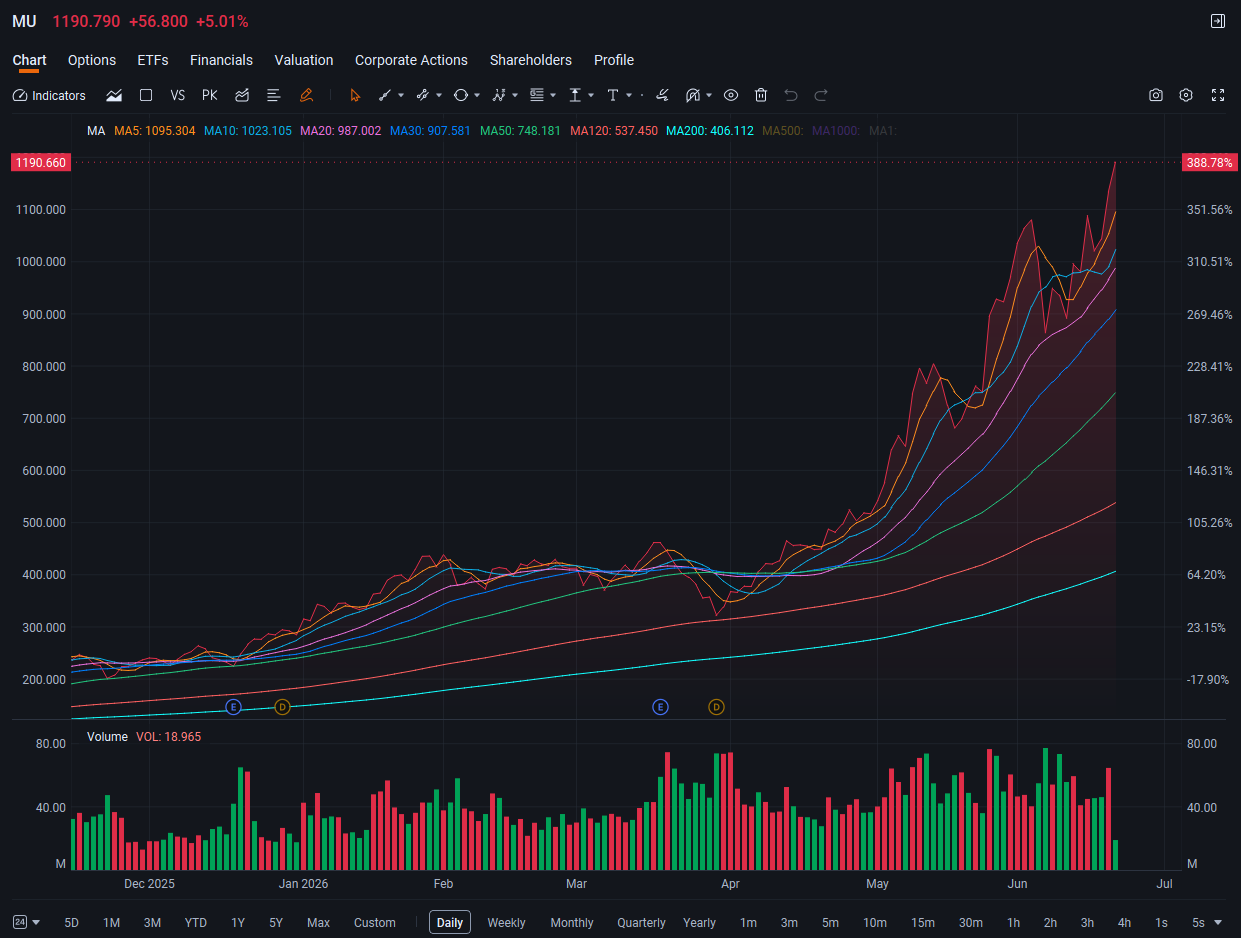
We establish a short-term price target of $1,300 per share, implying structural upside alongside a compressed trailing P/E multiple.
Consequently, we maintain a cyclical valuation framework for the equity rather than pricing it as a secular growth asset. Whether the storage vertical can permanently decouple from its legacy commodity boom-and-bust characteristics remains the pivotal debate.
From a purely quantitative standpoint, Micron is well-positioned to comfortably exceed baseline consensus parameters. The structural test hinges on the scale of the beat and its proximity to top-tier whisper numbers.
Furthermore, CapEx needs to exhibit disciplined execution rather than aggressive upward revisions, which historically trigger immediate market anxieties over structural oversupply and free cash flow (FCF) dilution.
Notably, Micron’s post-earnings contraction in the prior quarter was fueled precisely by an unexpected CapEx beat and a full-year upward revision. In short, stellar core metrics must print even higher, while capital projects must remain strictly within boundaries—a paradox that highlights the hyper-elevated bar set by the market.
At the segment level, Wall Street models data center revenue (CMBU + CDBU) scaling to 70% of total mix, representing a 90% to 100% sequential expansion.
Blended DRAM average selling prices (ASPs) are projected to climb 65% to 70% sequentially on a 5% to 7% volume expansion. NAND ASPs are modeled up 75% to 89% sequentially on 1% to 5% volume growth.
Crucially, high-bandwidth memory (HBM) pricing remains insulated by long-term supply agreements (LTAs), positioning ASPs for a mild sequential advance. Concurrently, HBM shipments are modeled up 20% to 25% sequentially, capturing the tailwinds of the Blackwell volume ramp and initial Rubin validation pipelines.
Broadly speaking, top-line performance remains fundamentally a function of price realization rather than absolute unit volumes. This micro structure must evolve in subsequent quarters.
To validate the thesis of a cyclical-to-secular structural transition, several critical variables require scrutiny.
First, is consumer consumption sustainable over the long term, and what is the current structural integrity of existing long-term supply agreements? Second, can average selling prices consolidate at elevated levels, or will producers execute tactical price concessions on non-HBM legacy nodes to drive volume?
Third, has the cleanroom build-out cycle meaningfully compressed, and will simultaneous capacity expansions by Micron, Samsung, and SK Hynix catalyze an industry-wide supply glut? Fourth, what are the structural implications if AI accelerators alter HBM integration density or aggressively advance processing-in-memory (PIM) designs?
While these structural concerns may not dominate the immediate earnings call Q&A, they remain paramount for long-term equity allocations.
Additionally, hyperscaler cloud capex remains the most rigid demand anchor for advanced memory arrays. However, because memory components have registered the steepest cost inflation within the server bill of materials (BOM), hyperscaler FCF profiles are facing visible strain, necessitating large-scale debt financing.
Under tail-risk scenarios, one cannot rule out hyperscalers aggressively renegotiating LTA pricing or intentionally reducing high-cost HBM procurement in favor of legacy configurations like DDR5, given that the delta on these input costs has scaled exponentially.
Within the artificial intelligence value chain, it is structurally imperative for upstream providers to exercise pricing discipline and deliberately throttle capacity expansion to ensure market sustainability. Firms must avoid an aggressive monetization approach that prematurely chokes downstream demand—a structural reality across global upstream commodity channels that explains their high cyclicality.
Failure to do so could trigger a repeat of the 2022 lithium carbonate cycle, where spot prices breached RMB 600,000 per ton, effectively paralyzing the downstream ecosystem and forcing highly profitable miners into rapid losses.
Fortunately, the memory complex currently commands robust structural demand, high technological barriers to entry, and extended lead times for capacity allocation. Nonetheless, maintaining industry self-discipline while protecting downstream economics will require highly sophisticated game-theoretic maneuvering among the big three producers.
For capital market participants, extreme positioning density and highly elevated leverage ratios represent significant structural vulnerabilities.
Encouragingly, South Korean regulatory interventions alongside Wall Street risk mandates have begun enforcing structural limits on single-stock leveraged ETFs. For long-duration allocators, dampening the trajectory of the upward slope is a net positive.
However, because the asset retains definitive cyclical properties, disciplined profit-taking at cyclical peaks remains necessary to hedge against historic drawdown profiles exceeding 70%.