
Is the US AI Bull Market Fizzling Out? Over 60% of Tech Stocks Enter Bear Market After Crashing 20%+ From Highs


Artificial intelligence stocks have been the main engine driving the US market higher for the past several months, but now they are dragging down the entire tech sector. Is this just a quick correction, or does it signal a broader market reshuffle?
Market analyst Mike Zaccardi pointed out on X that over 60% of stocks in the S&P 500 Information Technology sector have dropped more than 20% from their 52-week intraday highs.
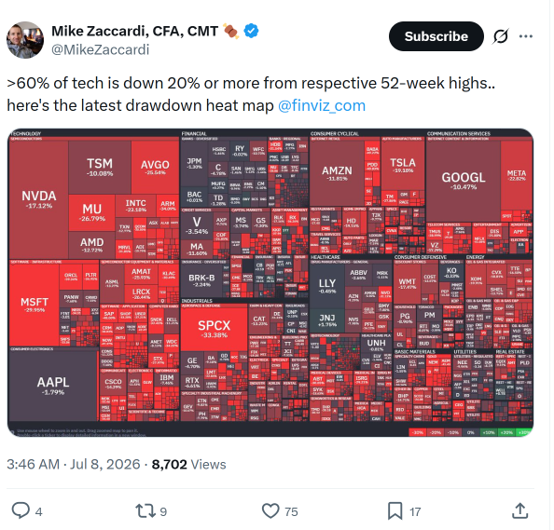
This data was confirmed by Dow Jones Market Data. By some definitions, these stocks have officially stepped into "bear market" territory.
Mega-cap semiconductor stocks have taken the hardest hit. Micron Technology has fallen 25% from its recent high, Broadcom is down 21%, and Marvell Technology has plunged 30%.
Just a Normal Correction After a Massive Run?
While the scale of this tech sell-off looks alarming, some analysts think it is just a normal pullback following a massive rally.
After a killer second quarter—where the Philadelphia Semiconductor Index logged historic gains—investors are likely just rushing to lock in profits.
"Since kick-starting the third quarter in early July, we’ve seen broader profit-taking across the tech infrastructure space," said William Kerwin, an equity analyst at Morningstar. "For instance, chip equipment stocks caught a heavy beating on Tuesday."
He noted that over the past few quarters, tech stocks have tended to come under pressure in the month following earnings, only to bounce back right before the next batch of financial reports drops.
The Debate Shifts to the Sustainability of Memory Demand
As the hottest trade for most of the year, memory stocks had an incredibly strong start to the first half of 2026. SanDisk shares rocketed 858% in H1, making it the top-performing stock in the S&P 500.
The Roundhill Memory ETF, which launched in April, was up as much as 190% at its peak.
However, memory stocks have faced a brutal sell-off since hitting their highs in late June. Over the past few weeks, shares of Seagate, Western Digital, and SanDisk have all mirrored Micron by dropping over 20%.
The Roundhill Memory ETF has now tumbled 25% from its late-June peak.
This highly cyclical memory industry is now right in the crosshairs of a fierce debate: investors are trying to figure out whether the AI boom can keep driving sustained demand for these products.
Kerwin also mentioned that Samsung’s preliminary earnings report earlier this week served as one of the catalysts for the recent sell-off. Even though Samsung reported a massive 19-fold jump in profits year-over-year, Kerwin noted that some investors simply had even higher expectations.
He pointed out that the report "might signal a bit of a cooling off in the pricing surge for memory chips from companies like Micron."
Even though spot prices for DRAM and NAND flash have seen slower growth lately, Evercore analyst Amit Daryanani believes that long-term contracts and fixed pricing with mega-cap cloud providers tell a much better story about the memory market.
He thinks these long-term agreements will fundamentally improve revenue visibility and predictability for these companies.
"We believe that despite short-term volatility, memory remains a highly attractive slice of the tech ecosystem," Daryanani stated in a note on Wednesday.
"It makes perfect sense for investors to trim their winning positions ahead of the next earnings cycle to re-evaluate pricing durability and the capex spending pace of hyperscale clients."