
Goldman Sachs’ Blockbuster Earnings: Is It Time to Buy?

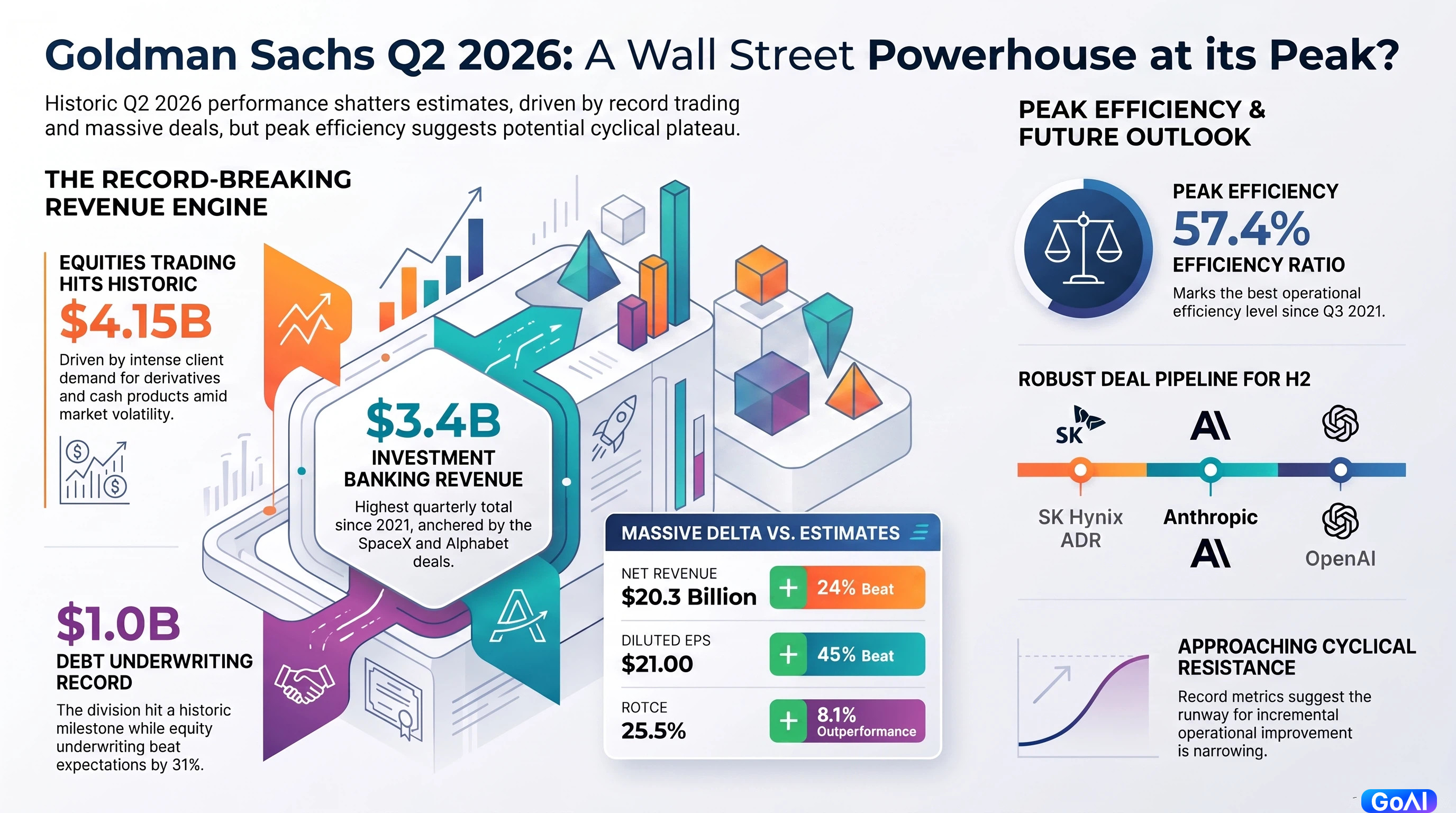
Goldman Sachs delivered a stellar Q2 2026 earnings report, handily beating Street estimates.
Beyond a booming investment banking division, its equities trading desk clinched a historic high, fixed-income rebounded from a prior-quarter slump, and both its efficiency ratio and ROTCE improved dramatically.
While the bank solidified its global investment banking leadership, the blowout quarter raises a pivotal question: can Goldman sustain this blistering momentum?
In Q2 2026, Goldman generated net revenue of $20.3 billion (beating expectations by 24%) and diluted EPS of $21.00 (shattering estimates by 45%).
For an old-line Wall Street firm, these growth metrics look as explosive as those of a red-hot semiconductor play.
Segment Breakdown: Investment Banking & Capital Markets
Investment Banking
The division pulled in $3.4 billion, its highest quarterly total since 2021.
-
Advisory: Contributed $1.38 billion, aligning with estimates.
-
Equity Underwriting: Reached $985 million, beating expectations by 31%. This surge was primarily driven by fees from the SpaceX IPO and Alphabet’s massive $85 billion equity raise.
-
Debt Underwriting: Set a historic milestone, hitting a record $1.0 billion.
While global M&O activity and deal volumes hit record highs in Q1, Goldman’s M&A advisory revenue surprisingly slipped 8% quarter-over-quarter.
Whether broader advisory activity is actually cooling remains to be seen; cross-referencing upcoming results from JPMorgan and Morgan Stanley will be essential to draw a definitive conclusion.
Furthermore, while the equity underwriting beat was impressive, the pricing of underwriting fees for high-profile deals like SpaceX and Alphabet is typically highly visible and predictable.
The large gap between actual results and expectations suggests Wall Street analysts may have failed to promptly update their financial models.
FICC and Equities Trading: Riding Macro Volatility
Fixed Income, Currency, and Commodities (FICC)
FICC revenue landed at $4.6 billion, with trading revenues contributing $3.38 billion. This was primarily driven by hot activity in interest rate products and commodities (such as rate swaps, crude oil, natural gas, gold, and silver).
While geopolitical tensions in the Middle East, shifting inflation expectations, and monetary policy speculation fueled this spike, these catalysts are inherently episodic.
Whether Goldman can maintain this trading velocity through the second half of the year remains highly uncertain.
Equities Trading
Equities trading delivered a record-breaking $4.15 billion. Wide-ranging market swings across semiconductor, memory, and software stocks created fertile ground for trading commissions.
Goldman highlighted that derivatives and cash products were the primary engines here, reflecting intense client demand for execution and risk management (such as spot equity, ETFs, options, and equity swaps) amid heightened market volatility.
Yet, just like FICC, this performance is highly dependent on macro conditions that may not persist.
Efficiency and Profitability Metrics Close to Peak
Two critical banking metrics, the Efficiency Ratio and ROTCE, saw extraordinary improvements:
-
Efficiency Ratio (lower is better, reflecting operating expenses as a % of revenue): Dropped to 57.4%, comfortably beating the 62.0% consensus and marking its best level since Q3 2021.
-
ROTCE (Return on Tangible Common Equity): Reached 25.5%, vastly outperforming the 17.4% forecast and marking its strongest print since Q2 2021.
While these numbers are phenomenal, they also signal that the runway for incremental operational improvement is narrowing, much like trying to push a semiconductor gross margin from 86% to over 90%.
Historically, Goldman’s performance has been highly cyclical, with peaks and troughs in its efficiency ratio and ROTCE aligning precisely with broader market cycles.
While we cannot predict if Goldman will completely break out of this historical pattern, further operational gains will undoubtedly face steeper uphill battles from here.
Investment Thesis: Maintain "Buy" Rating with Balanced Caution
Despite cyclical risks, the short-term catalysts for Goldman remain robust:
-
Macro Environment: U.S. macroeconomic indicators remain resilient, and capital market activity remains elevated.
-
Deal Pipeline: High-profile listings like the July SK Hynix ADR, alongside highly anticipated upcoming deals for Anthropic and OpenAI, bolster an already deep primary market backlog.
While Goldman Sachs remains a highly compelling investment, the risk-reward profile is shifting toward equilibrium, and near-term upward momentum may face some turbulence. We temporarily maintain our "Buy" rating, remaining cautiously optimistic on the stock.