
Japan-South Korea "Memory Trio" Q2 Earnings Preview: Can Blockbuster Results Save Halved Stocks?

As artificial intelligence continues to drive memory demand, the financial health of the world’s leading memory manufacturers is drawing widespread industry attention.
This week, the Asian memory trio—South Korea's SK Hynix and Samsung Electronics, alongside Japan's Kioxia—are set to roll out their latest quarterly earnings reports.
For global investors, these prints will not only reflect individual profitability, but also serve as a crucial barometer for the future trajectory of global AI infrastructure spending and the memory supply-demand balance.
More importantly, global memory equities have faced severe selling pressure recently, with SK Hynix and Kioxia shares cut nearly in half from their peak levels.
Against this backdrop, whether strong earnings from these three giants can turn the tide and restore market confidence will be closely watched.
Can SK Hynix Rebound on Earnings?
SK Hynix takes the stage first this week. As the market leader in High Bandwidth Memory (HBM), SK Hynix is scheduled to report its Q2 earnings on Wednesday morning (July 29), local time.
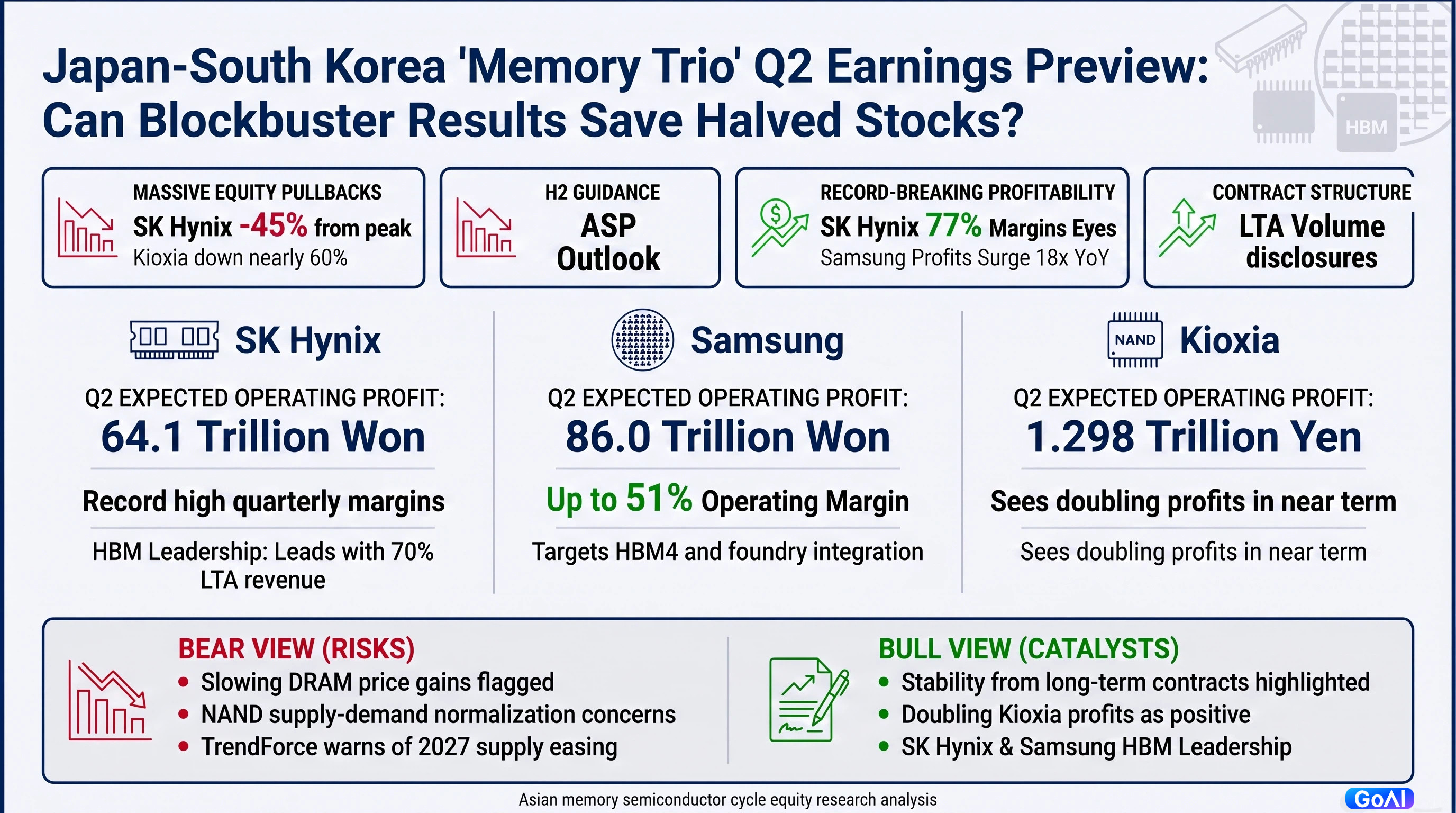
Against a backdrop of surging DRAM and NAND flash prices, domestic brokerages project SK Hynix’s Q2 revenue to hit 84.1 trillion won, with operating profit reaching 64.1 trillion won—up sharply from the 37.6 trillion won recorded in Q1.
This implies that SK Hynix's first-half operating profit alone could top 100 trillion won, surpassing its entire full-year 2025 profit by 17 trillion won and demonstrating the explosive power of the current memory supercycle.
SK Hynix's Q2 operating margin is expected to reach 75% to 77%, expanding further from the record 72% reported last quarter.
According to industry analysts, as long-term supply agreements (LTAs) account for a larger share of shipment volumes, sales to major tech hyperscalers and AI data center operators are expected to represent 70% of total revenue.
This structural shift significantly reduces exposure to memory cycle volatility and improves earnings predictability.
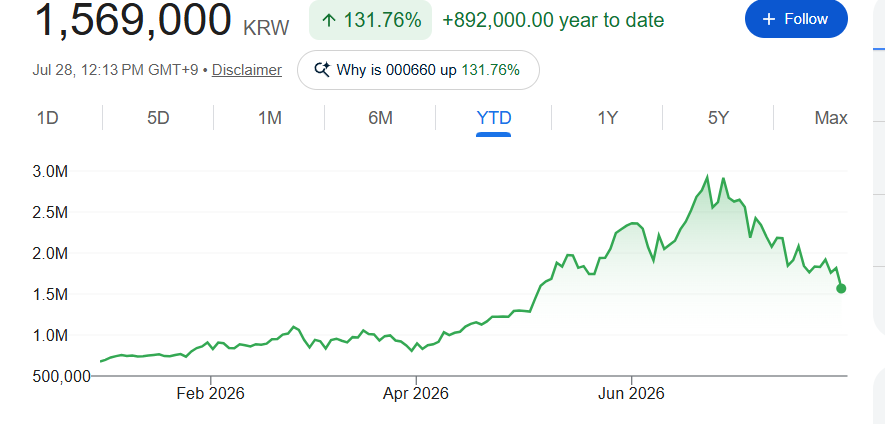
Despite outrageously strong fundamentals, SK Hynix shares have suffered a steep sell-off, falling roughly 45% from their previous peak as of Tuesday's trade, while its U.S.-listed ADRs have dipped below their IPO price.
Given these dynamics, investors will focus heavily on whether SK Hynix can steadily execute capacity expansions in the second half while sustaining hyper-growth and ultra-high operating margins.
Additionally, whether mega-cap tech companies maintain their current pace of AI data center capital outlays will serve as a key yardstick for assessing the company's path forward.
Can Samsung Secure HBM Leadership?
Samsung Electronics plans to release its full Q2 results on Thursday (July 30).
According to preliminary estimates released earlier, Q2 revenue reached 171 trillion won, while operating profit surged roughly 18-fold year-over-year to a record high.
Consensus estimates compiled by LSEG project Q2 operating profit at 86 trillion won, with some brokerages estimating as high as 90 trillion won—implying an operating margin of up to 51%.
If realized, Samsung would eclipse Nvidia's FY2026 Q1 performance to become the single most profitable tech company globally on a quarterly basis.
Indeed, Kim Yong-kwan, head of Samsung's semiconductor division technology office, noted in a recent internal meeting that the company's 2026 profit could exceed its cumulative semiconductor earnings over the past four decades.
Compared to SK Hynix, Samsung faces a different set of market questions.
First, Wall Street will closely monitor the timeline for its HBM4 qualification tests, mass production schedules with key customers, and yield stability on 1b and 1c nanometer nodes—all crucial to regaining its HBM market leadership.
Second, the margin profile of its non-memory businesses (including foundry and System LSI) will be a primary focus during the conference call.
Finally, investors will evaluate whether Samsung's integrated structure—operating both memory and foundry units—provides a distinct cost advantage in the HBM4 era.
Kioxia's Earnings Outlook and NAND Trends
Japanese NAND flash producer Kioxia is slated to report Q2 earnings on Friday (July 31).
In Q1 (Jan–Mar), Kioxia posted quarterly revenue of 1 trillion yen and operating profit of 596.8 billion yen, with operating profit quadrupling sequentially from Q4 2025.
At the time, Kioxia guided Q2 revenue to 1.75 trillion yen and operating profit to 1.298 trillion yen—doubling again from Q1 levels.
Following its Q1 release, Wall Street firms issued sweeping price target upgrades, sparking a surge in Kioxia’s stock price and briefly making it Japan’s most valuable company by market cap.
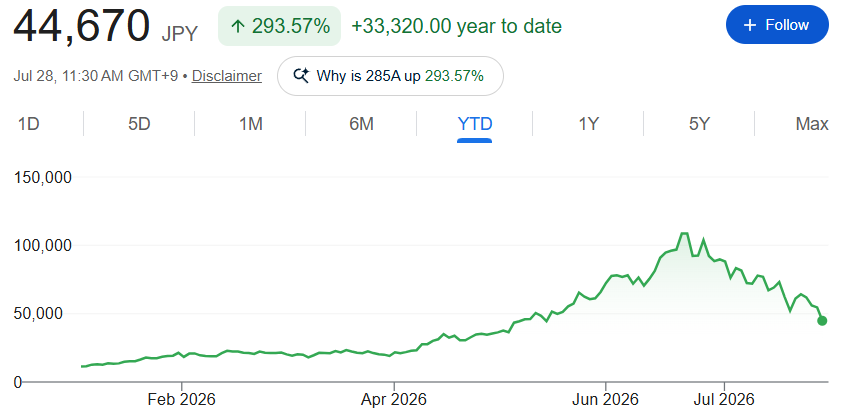
However, shares have tumbled nearly 60% from their June highs, including an 18% single-day plunge on Tuesday—its sharpest drop since last November.
Over the long term, TrendForce expects NAND demand to remain robust through 2027.
However, as suppliers continue node transitions, bit output expands steadily, and consumer electronics demand stays soft, the NAND supply-demand balance is expected to gradually normalize, with current tight supply easing by late 2027.
Beyond Headline Numbers
Despite glowing profit outlooks, the sharp sell-off across all three stocks underlines market anxiety that major tech companies could scale back AI infrastructure spending, which would hit future demand for AI chips and memory.
Consequently, institutional investors will pay close attention to management commentary during the earnings calls.
Executive guidance regarding second-half pricing and contract structures will shape how the market judges the current phase of the memory cycle.
In short, the market's primary focus is not just the size of the headline numbers, but whether memory makers can sustain high profitability through the second half.
Wall Street remains sharply divided on the trajectory of the memory cycle.
Firms including Morgan Stanley and research firm TrendForce point out that sequential price increases for mainstream DRAM contract prices have begun to moderate, suggesting the upward momentum in memory pricing may be nearing a peak.
Conversely, the bullish camp—led by Goldman Sachs and Citi—cites the growing prevalence of multi-year Long-Term Agreements (LTAs).
They argue that with 3-to-5-year contracts forming a larger portion of sales to big tech clients, unit price volatility will be far lower than in previous cycles. As a result, even if spot prices fluctuate, final corporate earnings will prove far more resilient.
Ultimately, the debate over when the memory cycle peaks will hinge on third-quarter guidance, DRAM/NAND average selling price (ASP) outlooks, and LTA disclosures provided during this week's calls.