
The Worst of The Semiconductor Sell-off Is Finally Behind Us

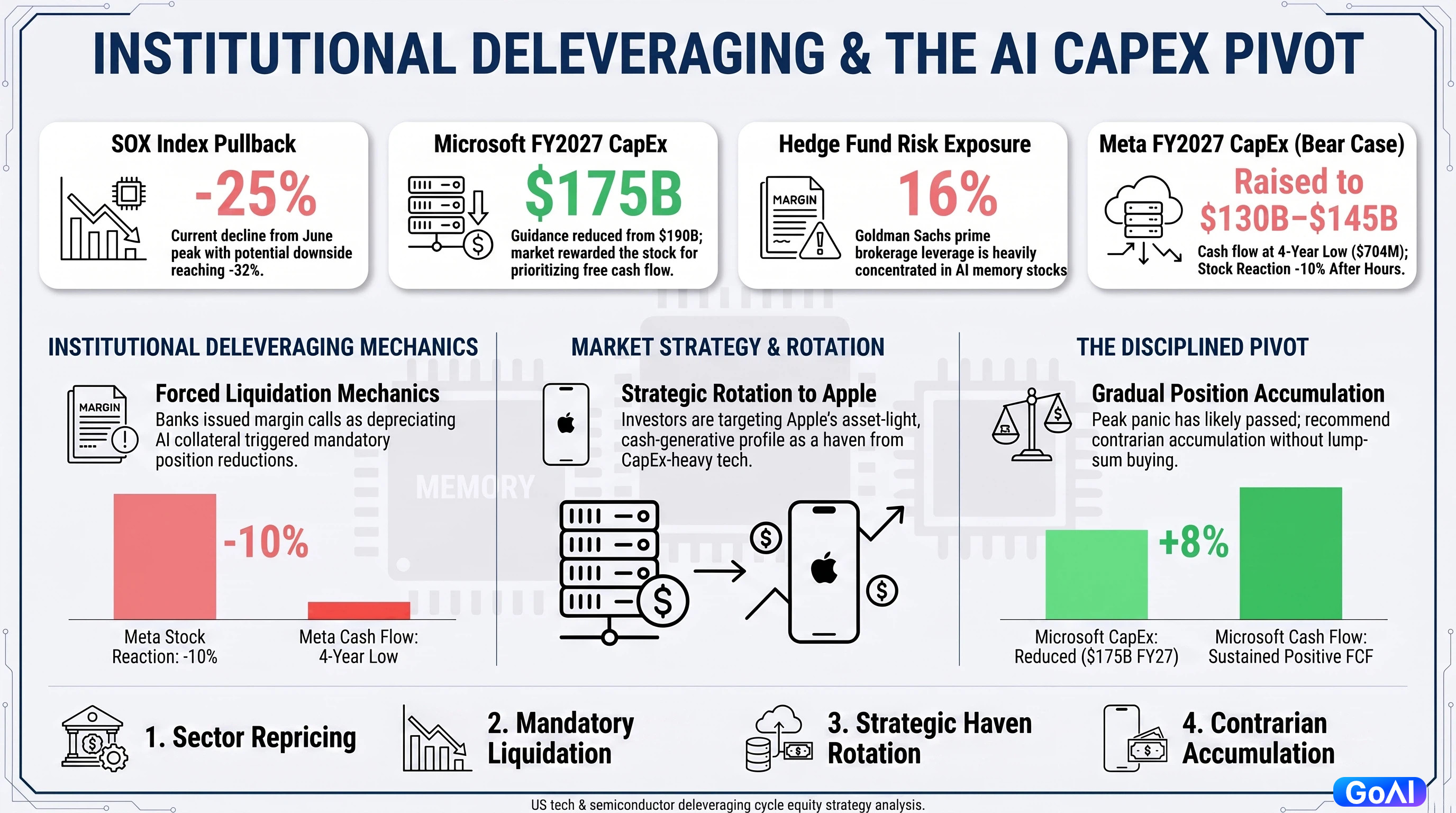
Yesterday’s tape had all the hallmarks of institutional deleveraging in U.S. equities, coming right on the heels of Micron’s sudden flash crash and subsequent 10% single-day plunge.
On the surface, the market is still digesting a familiar list of headwinds: SK Hynix failed to live up to sky-high earnings expectations, skepticism is growing over the sustainability of AI CapEx, and surging oil prices are reviving inflation and rate fears.
Yet those factors only explain why chip stocks pulled back—not why they experienced a vertical, cascade-style liquidation.
The real signal here is that Wall Street has actively begun pulling back on margin and credit.
According to the Financial Times, prime brokers including Goldman Sachs and JPMorgan have issued margin calls to select clients as the ongoing AI slide inflicts heavy losses across various hedge fund strategies.
These demands are targeted squarely at highly leveraged funds with concentrated bets in AI, memory, and semiconductor equities.
Earlier this year, hedge fund leverage touched historic highs, with Goldman Sachs revealing that roughly 16% of its prime brokerage risk exposure was tied directly to AI memory names.
With the SOX down roughly 25% from its June peak, the stock collateral backing these loans has rapidly depreciated, leaving banks with no choice but to demand extra margin or force position reductions.
In short, the market has crossed the line from "investors reluctant to buy" to "fund managers forced to sell."
The second flash crash in MU and the broader semiconductor route were almost certainly driven by this mechanics of forced liquidation.
Heading into earnings, institutional positioning proved remarkably prescient.
Options were pricing in an unusual 7%–9% implied move for Microsoft—a stock that typically sees muted post-earnings price action. That alone signaled that MSFT was likely preparing to reign in its CapEx guidance.
The sudden slide in chip stocks was essentially the market front-running this exact risk. Judging by Jim Cramer's heavy hints on X, the move was hardly a secret inside Wall Street circles.
When the numbers dropped, Microsoft popped 8% post-market—landing right inside the implied volatility band—and indeed delivered a trim to its CapEx trajectory.
Total Q4 CapEx supporting cloud and AI demand rose 70% year-over-year to $41 billion, coming in 3.5% below Wall Street estimates.
For fiscal Q1, Microsoft guides revenue between $89.85 billion and $90.95 billion. Full-year FY2027 CapEx is now projected at $175 billion—down from an earlier $190 billion estimate—while management reaffirmed that FY2027 free cash flow will remain positive.
Some media commentators attributed the change to accounting adjustments, such as extending useful life assumptions for offices and data centers from 15 to 25 years, or shifting facilities from finance to operating leases.
To me, that is financial hair-splitting. A cut is a cut—replacing direct CapEx with third-party leases is still a reduction in capital expenditure, plain and simple.
The message here is crystal clear: protect free cash flow at all costs and avoid slipping into negative territory. Capital spending will strictly match incoming revenue, with zero room for excess.
Azure’s top-line beat proves that underlying enterprise AI and cloud demand remain robust; but allowing CapEx to compound unchecked would have wrecked margins and cash flows.
Microsoft laid it out plainly: end-market demand is alive and well, but the spending pace must be reined in.
Meta, meanwhile, tumbled as much as 10% after hours on soft guidance and another CapEx hike, which dragged its quarterly free cash flow down to a near four-year low of $784 million.
Q2 revenue topped expectations at $60.8 billion (up 28% YoY vs. $60.3B expected), but Q3 guidance came in light at $62.5 billion at the midpoint versus the $63.2 billion consensus. To make matters worse, management raised full-year CapEx guidance to $130B–$145B, up from $125B–$145B.
Meta is facing the exact opposite dynamic of Microsoft: revenue is expanding, spending is escalating, but free cash flow is plummeting. Investors are rightfully demanding to know when these investments will actually turn into visible cash.
Tonight brings earnings from Apple and Amazon, and market participants are staying firmly on the sidelines.
Wall Street is looking for Apple revenue of ~$108.65 billion (+15.5% YoY)—potentially its fastest June quarter growth in five years—led by a projected 20.8% jump in iPhone sales. Options are pricing in a modest 4.0%–4.3% move, significantly lower than Amazon's implied volatility.
The print boils down to five core metrics: Greater China recovery momentum; whether iPhone growth reflects true end-user demand or channel inventory build-out; Services expansion and margins; component cost pressures from tariffs and rising memory prices; and management’s tone on edge AI and CapEx discipline.
Apple's primary narrative right now is its asset-light, cash-generative profile.
While Alphabet, Meta, and Amazon ramp up data center spending, Apple’s balance sheet remains relatively unencumbered. If it delivers solid numbers across top-line, margins, and AI roadmap execution, capital will likely continue rotating out of CapEx-heavy tech into Apple.
The catch is that options are pricing in a very tight range. Any clear miss on China, margins, or forward guidance could trigger a sell-off far wider than the options market implies.
For Amazon, consensus centers on revenue of $196.8B–$197.0B and AWS sales of ~$40.5B (+30%+ YoY), with AWS operating margins expected around 33.8%. Options imply a ~6% post-earnings move.
Amazon has four key questions to address: Can AWS growth accelerate from 30% into the mid-to-high 30s? Are Bedrock, Anthropic partnerships, and custom silicon generating material revenue? Will the ~$200 billion CapEx plan be revised higher? And can AWS margins absorb rising power, memory, and depreciation expenses?
Microsoft proved that heavy CapEx can be justified if it fuels Azure’s acceleration, while Meta was punished for burning through cash. Amazon sits right in the middle.
If AWS beats on top-line and keeps margins steady without raising CapEx guidance, it could trigger a relief rally across cloud, data centers, and AI chips. But if spending jumps without a matching boost to AWS revenue or margin guidance, Wall Street will lump Amazon in with Meta.
For the past three years, big tech CapEx revisions pushed semiconductor and compute names higher, with the consensus blindly repeating the "CapEx beat equals bullish on hardware" playbook.
That trade has officially hit a wall.
Google delivered a blowout quarter last week, but its shares cratered after free cash flow swung negative alongside higher 2027 CapEx guidance.
Meta raised its spending outlook and suffered the exact same fate.
Conversely, Microsoft trimmed its CapEx path while projecting positive cash flow, and its stock vaulted higher.
The market's message couldn't be clearer: the era of unrestrained AI infrastructure spend is over.
This doesn't mean AI demand is dead or that hyperscalers will stop buying chips. What ended is the market rewarding raw CapEx expansion. Going forward, multiple expansion belongs strictly to platforms that can monetize their AI spend—unfunded cash burn will be penalized.
JPMorgan noted that the growing split between CapEx spenders and equipment suppliers echoes late-stage dot-com dynamics: big tech keeps spending, supply chain stocks run faster, but ROI risks pile up underneath. If semiconductors fail to break back above key resistance levels, the SOX could see its drawdown widen to ~32% from its peaks.
The semiconductor pullback likely has further to run. AMD and MU led the recent leg down; while memory and CPUs anchored the second phase of the AI bull market, leadership also meant heavy positioning crowding.
All three major memory players—Samsung, SK Hynix, and Micron—have reported, and all three have trended lower post-earnings.
This underlines a clear shift in market priorities. Investors are looking beyond HBM shortages and pricing power, focusing instead on cycle durability, overcapacity risks, and peak CapEx from key customers.
In the CPU domain, Intel and ARM both fell post-earnings, leaving AMD as the last remaining earnings risk event in the group.
AMD remains one of the most crowded positions in the AI chip trade. Even a decent print won't cut it—management must deliver outright strength across MI300 revenue, order books, and guidance to prevent funds from trimming exposure.
Taking all this into account, the semiconductor consolidation phase will likely extend through early August.
Near-term price action will remain choppy, though downside should be relatively capped from here. Korean leverage has been thoroughly wiped out, memory and CPUs have completed a sharp catch-down, and Microsoft's CapEx trim is now out in the open—leaving AMD earnings as the final major hurdle.
The most violent market drawdowns happen when crowded positioning, unresolved catalysts, and forced liquidations hit all at once. Those pressures are now visibly easing.
Excessive leverage in Asian markets has been flushed out, semiconductor market leaders have completed their repricing, and Microsoft's spending slowdown is no longer a rumor. The peak panic phase is likely behind us.
That said, the end of panic selling doesn't guarantee an immediate V-shaped rebound.
Following a deleveraging event, institutional capital takes time to rebuild exposure.
AMD’s print, Amazon’s CapEx plans, Apple’s demand metrics, and Treasury yields will all continue to drive market volatility.
For contrarian buyers willing to look past short-term noise, this is where you gradually start accumulating positions—just avoid deploying all your cash at once or making binary bets on earnings flips.