
Goldman Sachs Sharply Hikes Global Wafer Fab Equipment Spending Forecasts; Semiconductor Supercycle Seen Extending to 2028

As the U.S. Q2 corporate reporting season winds down, semiconductor capital expenditures have broadly outpaced Wall Street consensus, while major equipment manufacturers have delivered increasingly bullish forward guidance.
Spurred by these twin tailwinds, Goldman Sachs has sharply upgraded its global Wafer Fab Equipment (WFE) spending outlook.
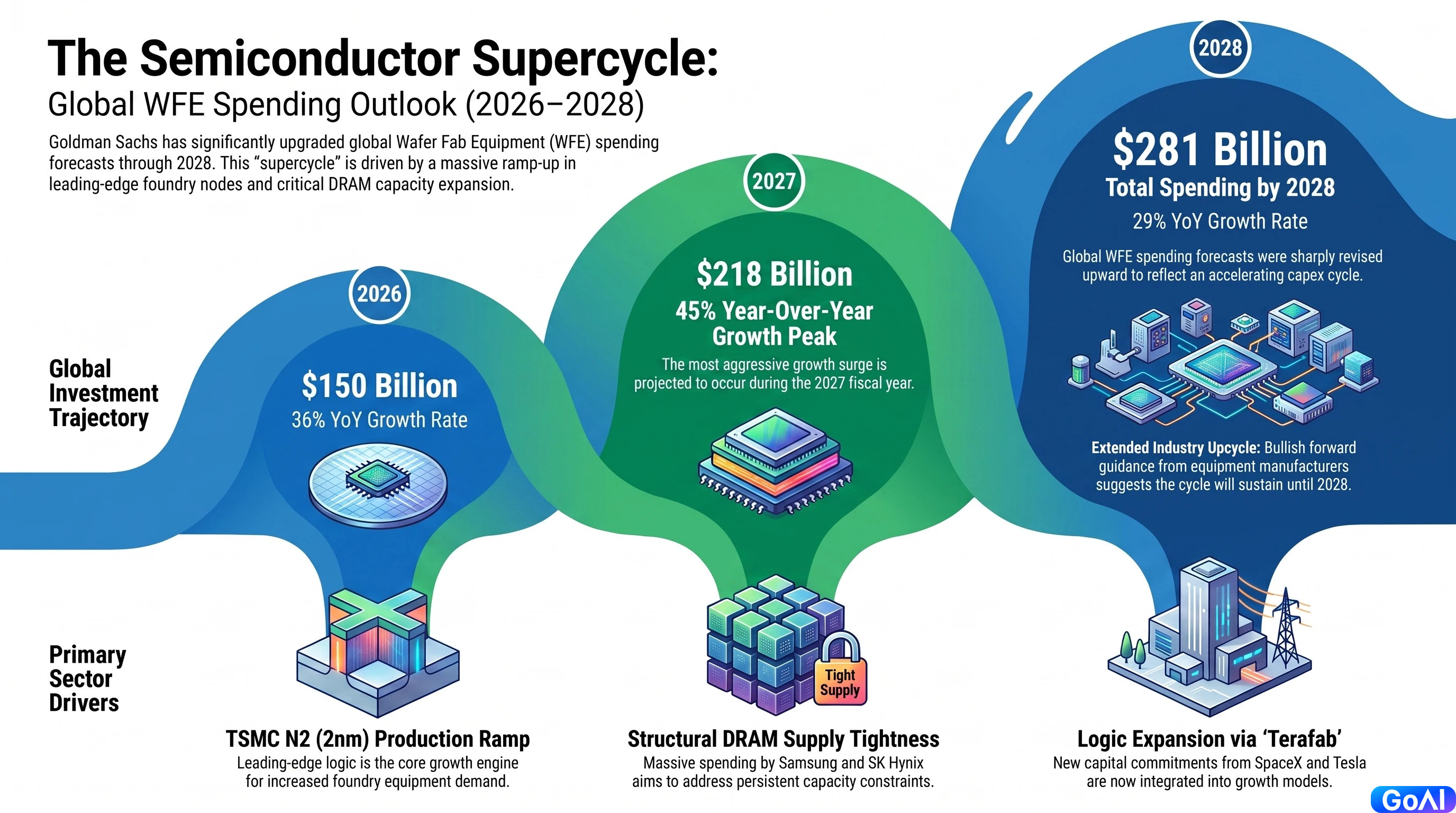
In a research note released Sunday (ET), Goldman Sachs raised its global WFE spending forecasts for 2026, 2027, and 2028 to $150 billion, $218 billion, and $281 billion, respectively—representing significant upward revisions that signal an accelerating global semiconductor capex cycle.
In terms of year-over-year growth, the bank boosted its global WFE growth projections to 36% from 32% for 2026, to 45% from 32% for 2027, and to 29% from 12% for 2028, underscoring expectations that the industry upcycle will extend through 2028.
TSMC N2 Ramp Drives Sharp Upward Revision in Foundry Capex
In the pure-play foundry segment, Goldman Sachs raised its 2026–2028 equipment spending projections to $58 billion, $84 billion, and $109 billion, implying year-over-year growth rates of 45%, 45%, and 30%—a material acceleration from its prior estimates of 30%, 30%, and 16%.
The upgraded foundry capex outlook is primarily anchored by Taiwan Semiconductor Manufacturing Co. (TSMC).
The report raised TSMC's annual capital spending projections by $8 billion across each year from 2026 to 2028, reflecting higher-than-expected equipment tool-in intensity for the N2 (2nm) node alongside persistent downstream end-market demand.
Goldman Sachs highlighted that TSMC's N2 node will enter high-volume manufacturing (HVM) ramp-up over the coming quarters, positioning leading-edge logic as the core growth engine for foundry tool demand.
DRAM Equipment Capex Upgraded, but Structural Supply Tightness Persists
The DRAM segment similarly saw steep upward revisions. Goldman Sachs lifted its 2026–2028 DRAM equipment capex projections to $48 billion, $72 billion, and $97 billion, representing year-over-year growth rates of 50%, 50%, and 35%, respectively, with 2028 logging the largest revision.
Upward momentum in DRAM equipment spending stems largely from South Korean memory giants Samsung Electronics and SK Hynix.
Goldman Sachs analyst Giuni Lee raised the three-year average DRAM capex forecast for Samsung by 22% and for SK Hynix by 19% across the 2026–2028 period.
Significantly, despite the surge in industry-wide capital outlays, Goldman Sachs expects DRAM supply to remain tight, with structural capacity constraints persisting into 2028.
By contrast, revisions across the NAND flash segment were more modest and mixed.
Goldman Sachs maintained its 2026 NAND equipment capex forecast at $11 billion, trimmed its 2027 estimate from $17 billion to $15 billion, and raised its 2028 projection from $20 billion to $22 billion.
The bank noted that near-term incremental NAND outlays will concentrate primarily on technology node migrations and fab conversions rather than greenfield capacity additions, supporting a tight NAND supply-demand balance through 2027.
Logic Tool Spending Set for Long-Term Structural Expansion
Goldman Sachs also materially lifted its medium- to long-term spending forecasts for leading-edge logic and mature nodes.
The firm raised its equipment spending estimates for this segment to $34 billion, $47 billion, and $53 billion for 2026, 2027, and 2028, respectively. The 2027 estimate was revised up by 34% (from $35 billion), while the 2028 forecast was upgraded by 43% (from $37 billion).
The upgrades are driven by two main catalysts: stronger-than-expected underlying demand revealed in Intel's earnings reports—prompting upward revisions to its capex plans—and a broader cyclical recovery across mature trailing nodes and analog markets.
Additionally, the initial capital commitment of roughly $16.8 billion from SpaceX and Tesla for the Terafab project has now been incorporated into the logic and specialty segment modeling, providing a meaningful medium-term growth driver.
Overall, Goldman Sachs reiterated its bullish stance on the semiconductor capital equipment sector.
The substantial capex upgrades offer clear positive read-throughs for equipment investors: elevated capital deployment across global chipmakers translates to robust order visibility for tool vendors, cementing the trajectory of a semiconductor equipment upcycle through 2028.