
Buffers Rapidly Depleting: HSBC Warns Next Global Food Shock Is Brewing

As multiple systemic vulnerabilities intersect across agricultural supply chains, major Wall Street institutions are issuing back-to-back warnings that a protracted and far-reaching global food crisis is rapidly taking shape.
Following warnings from JPMorgan Chase last week projecting that a global food crisis could erupt next year, HSBC analysts sounded an alarm on Tuesday, pointing to tightening grain supplies, an intensifying El Niño, disruptions across critical maritime chokepoints, and an acute supply squeeze that is driving grain prices sharply higher.
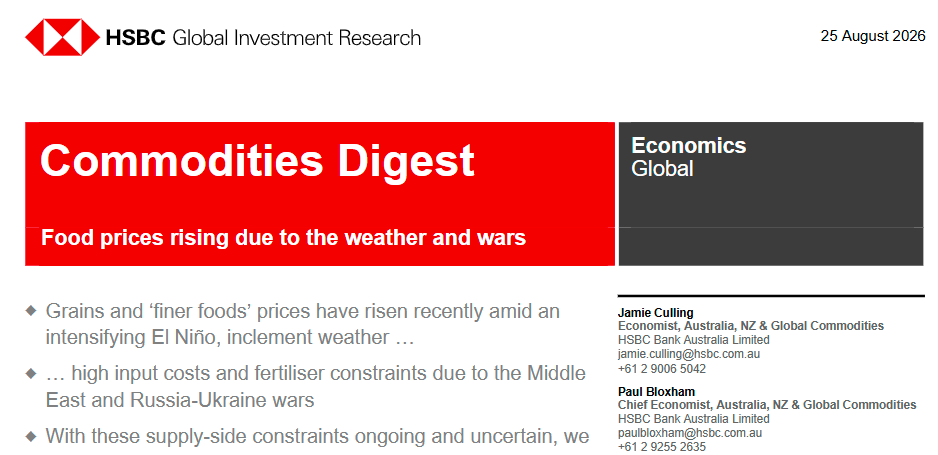
In a research note titled Food Prices Rising Due to the Weather and Wars, HSBC economist Jamie Culling noted that the supply squeeze is already materializing in spot markets. Through July, aggregate cereal prices—spanning wheat, corn, barley, and rice—rose 22% year-over-year.
"Having strong supplies and stocks going into this year has helped keep prices from spiking higher, but the buffer is now starting to be run down quickly," Culling warned clients.
Compounding Shocks Hit Agricultural Supply Chains
Culling emphasized that global agricultural supply chains are absorbing multiple concurrent shocks: the ongoing conflict in the Middle East, recent escalations in the Russia-Ukraine war, and severe weather anomalies, including Northern Hemisphere heatwaves and a strengthening El Niño.
According to the latest forecasts from the U.S. Department of Agriculture (USDA), global grain production in the 2026/27 marketing year is projected to fall below consumption.
This would mark the first structural supply deficit since 2020/21 and the largest supply gap since 2006/07.
As crop yields decline, global stocks-to-use ratios are set to tighten further.
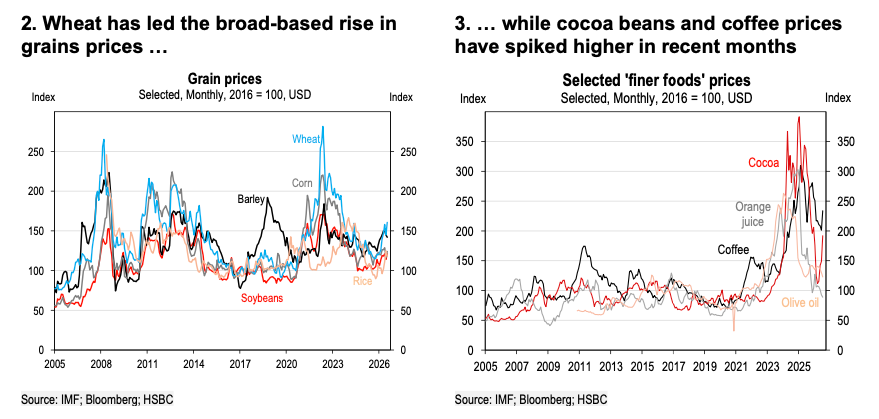
Agricultural commodity prices have already reflected the strain: beyond the 22% year-over-year climb in broad grain prices, soft commodities such as cocoa and coffee have surged aggressively.
Geopolitical friction in the Middle East remains a primary disruptor. The closure of the Strait of Hormuz continues to restrict the flow of global fertilizer and sulfur exports, keeping upstream production input costs elevated.
Retaliatory export restrictions implemented by several producing nations in response to the tightening market have compounded supply pressures.
In Eastern Europe, recent escalations in the Russia-Ukraine war have triggered a sharp decline in Black Sea shipping volumes.
Because the region accounts for nearly one-third of global wheat trade and one-fifth of the fertilizer trade, the disruptions represent a severe bottleneck just as the seasonal grain harvest accelerates.
Concurrently, damage to domestic Russian refineries has driven up regional diesel prices, lifting agricultural energy and transport overhead.
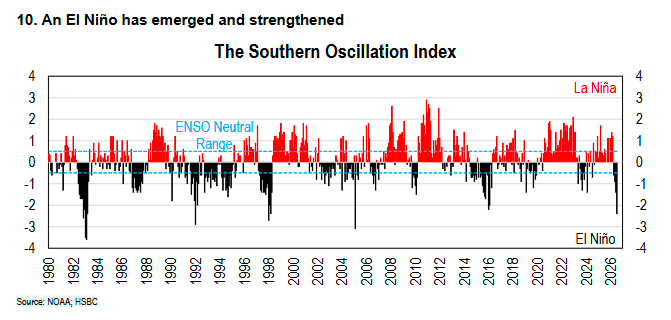
Weather volatility poses an equally severe threat: concurrent Northern Hemisphere heatwaves, an intensifying El Niño, and a positive Indian Ocean Dipole (IOD) have introduced significant downside risks to agricultural yields.
While historical El Niño episodes affect individual regions and crops differently, they consistently result in reduced harvest yields and upward price pressure.
Driven by climate-related risks, cocoa prices have spiked 50% over recent months alongside notable gains in coffee.
HSBC noted that extreme weather patterns also trigger non-linear compounding effects, such as heightened crop disease and pest outbreaks.
HSBC concluded that supply-side disruptions will continue to dictate agricultural commodity trajectories, subjecting global markets to a prolonged regime of higher baseline prices, amplified volatility, and acute food insecurity risks worldwide.