
Nvidia Earnings Preview: Markets Await Another Crucial Test for the AI Narrative

Nvidia (NVDA) is scheduled to release its second-quarter earnings for fiscal 2027 after the market close on Wednesday, August 26, followed by its earnings conference call.
Investors are closely tracking Blackwell shipment numbers and forward revenue guidance for the Data Center segment. Market analysts view the company’s outlook as the key pricing anchor for the global AI compute supply chain and a vital barometer for the broader tech capex cycle.
Revenue Approaching $100 Billion as Growth Stays Elevated
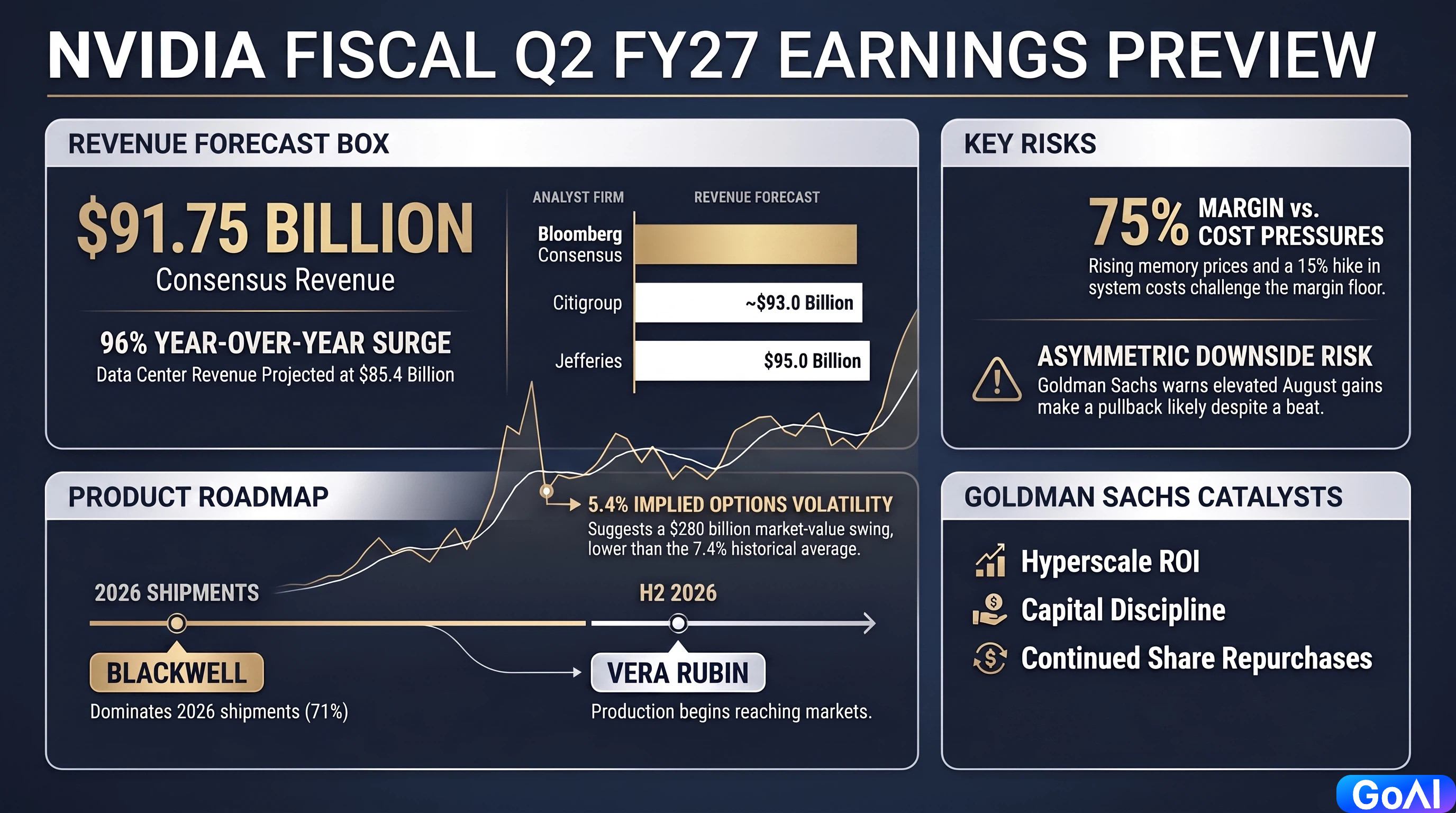
Consensus expectations compiled by Bloomberg project second-quarter revenue to surge 96% year-over-year to $91.75 billion, alongside adjusted net income of $50.64 billion, up 96%.
The Data Center unit remains the primary growth engine, with revenue projected to jump 107% to $85.4 billion. Several sell-side desks are even more constructive, with Jefferies forecasting $95.0 billion and Citigroup modeling roughly $93.0 billion.
Beneath the headline optimism, the market's potential price reaction remains uncertain. Bloomberg Markets Live strategist Mark Cranfield noted that the Cboe Volatility Index (VIX) is trading near its year-to-date lows ahead of the print, suggesting an environment where volatility is skewed to the upside.
U.S. equity futures traded slightly lower in pre-market action, with mega-cap tech shares showing modest losses. Nvidia rose 0.3%, SpaceX added 0.1%, while Meta, Amazon, and Tesla were largely flat.
Apple and Alphabet shed 0.1%, Microsoft slipped 0.4%, Micron Technology fell 0.5%, and SK Hynix slid 0.9%. In Asia, South Korean chipmakers Samsung Electronics and SK Hynix saw intraday gains narrow significantly into the close on August 26, pointing to broad institutional caution.
Upstream Cost Pressures Put 75% Gross Margin Target to the Test
In the first fiscal quarter ended late April 2026, Nvidia reported revenue of $81.6 billion, up 85% year-over-year, alongside a gross margin of 74.9%. Management guided second-quarter margins to 75.0% (±50 basis points), but cost pressures across the supply chain are beginning to surface.
Server manufacturers integrating Nvidia AI accelerators have notified major hyperscale customers that system prices will increase by more than 15% on hardware delivering early next year.
These adjustments affect platforms powered by both Vera Rubin and Grace Blackwell chips, driven by an acute supply squeeze and sharp price increases in high-performance memory. Server assemblers supplying Microsoft, Google, and Oracle have already communicated these revised pricing terms.
The increases align with a broader wave of price hikes across the global semiconductor space. STMicroelectronics recently rolled out its third round of price increases this year across automotive microcontrollers, power devices, and analog chips.
Other major suppliers, including Texas Instruments (TXN) and Infineon, have pushed through similar adjustments, extending lead times for automotive-grade components and compounding cost burdens for downstream automakers.
For a hardware supplier, sustaining gross margins near 75% remains historically exceptional. Preserving this margin floor in an inflationary cost environment will serve as a direct gauge of Nvidia’s underlying pricing power.
Vera Rubin Set to Follow Blackwell in Next Hardware Cycle
The operational roadmap following Blackwell represents one of the most anticipated discussions on Wednesday's call. Nvidia has confirmed that its next-generation Vera Rubin architecture has entered volume production, with initial partner systems scheduled to reach the market in the second half of 2026.
Institutional investors are looking for concrete shipment schedules and firm order visibility from management.
Jefferies estimates that Rubin-based hardware will account for roughly 12% of total GPU revenue in Q3, rising to over 40% in Q4, before overtaking Blackwell as the company’s main revenue driver in Q1 of fiscal 2028.
Amazon Web Services (AWS) has already outlined plans to deploy over one million Blackwell and Rubin GPUs beginning this year. At the same time, TrendForce projects Blackwell will account for 71% of Nvidia's high-end GPU shipments across 2026, keeping it firmly anchored as the near-term volume workhorse.
Execution on the Rubin rollout remains a central variable for whether Nvidia can sustain its hardware momentum into the next phase of the AI buildout.
Options Volatility Subsides as Goldman Highlights Asymmetric Downside Risk
Options positioning ahead of the report reflects a notable shift in trader expectations. The options market is implying a post-earnings single-day move of approximately 5.4%, representing a market-value swing of roughly $280 billion.
This implied move is lower than the 6.5% priced ahead of the May release and sits well below the company's 12-quarter historical average post-earnings volatility of 7.4%.
Matt Amberson, founder of ORATS, noted that the narrower pricing suggests diminished investor appetite for outsized price dispersion.
Susquehanna derivative strategist Chris Murphy added: "In the early phases of the AI cycle, Nvidia consistently delivered massive beats that sparked 10%, 15%, or 20% rallies. That regime has largely transitioned." Because expectations have reset higher, a standard earnings beat may not deliver the sharp upward rerating seen in earlier quarters.
While chip equities rallied on Tuesday—with Nvidia snapping a four-year-record seven-session losing streak—Goldman Sachs warned that a solid beat-and-raise quarter might not automatically lift the share price.
Goldman Sachs analyst James Schneider pointed out that with the stock up more than 12% in August, expectations are already elevated, making a post-earnings pullback more likely than an extended rally. The bank maintains that simply exceeding consensus and lifting forward guidance is no longer enough to push multiples higher on its own.
Schneider outlined three structural catalysts required to unlock further upside:
- Consistent improvement in monetization and return metrics among hyperscale cloud providers to underpin multi-year capex budgets.
- Capital discipline regarding customer financing vehicles to ease market scrutiny surrounding vendor-backed financing models.
- Continued capital allocation toward large-scale share repurchases and cash dividend programs.
Institutional investors are also expected to press executives on Nvidia’s financing arrangements—such as credit guarantees for OpenAI data centers—as well as the deployment timelines for over $3.1 trillion in cumulative AI infrastructure commitments across the top cloud operators.