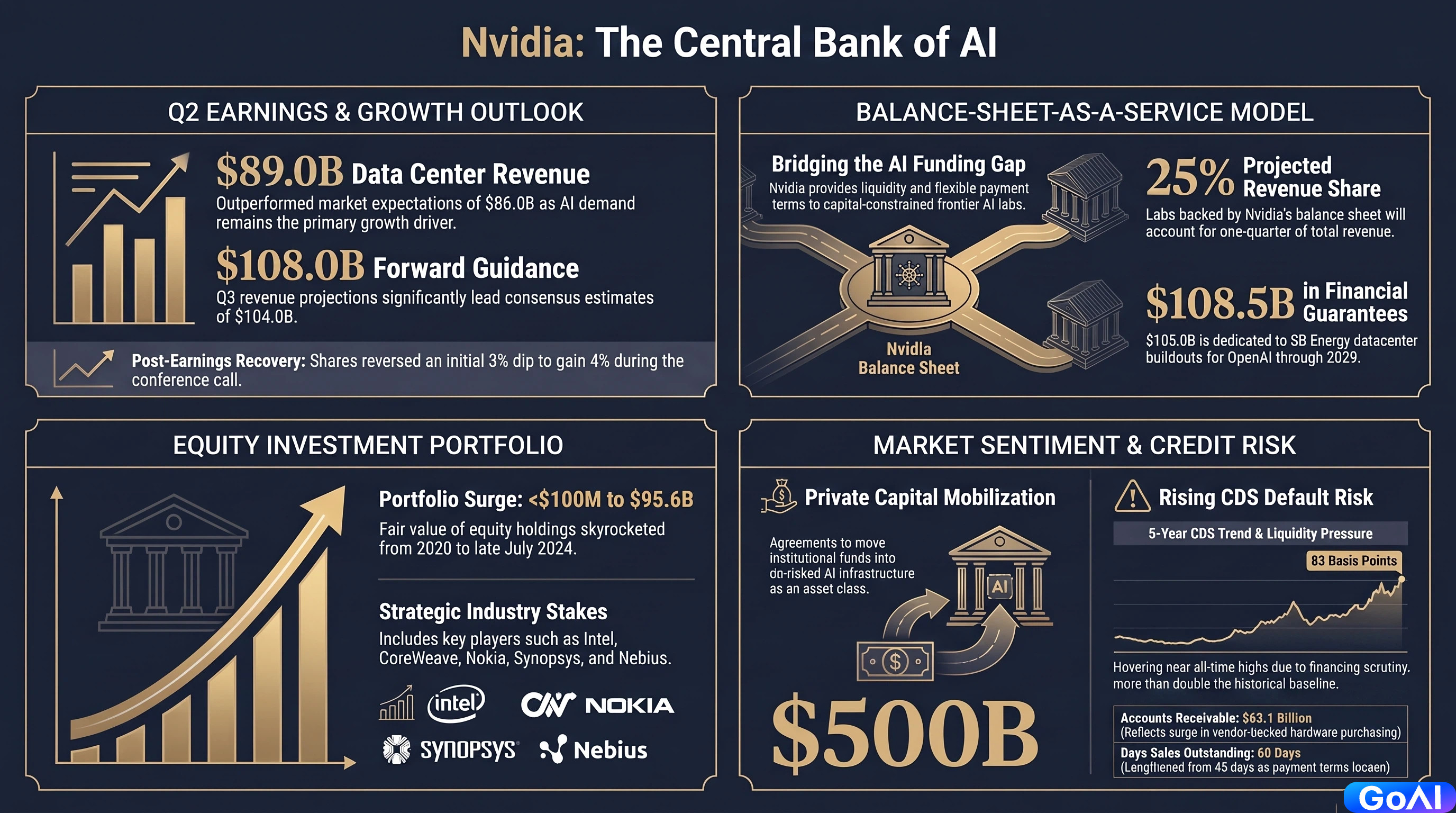
Nvidia made its fortune riding the artificial intelligence wave. Now, the company is stepping directly into the center of the financial machinery powering its next phase.
On Wednesday, Nvidia delivered blowout second-quarter results. Data Center revenue—the market's primary health check on AI demand—reached $89.0 billion against $86.0 billion expected.
Forward guidance came in equally aggressive, with third-quarter revenue projected at $108.0 billion versus consensus estimates of $104.0 billion.
While shares initially dipped 3% immediately following the release, the stock reversed course to gain 4% as the conference call got underway, putting it on track to break a four-quarter streak of post-earnings declines.
Beyond the income statement, analysts point out that the most structural transformation is taking place across Nvidia's balance sheet.
Nvidia as the "Central Bank of AI"
By late July, the fair value of Nvidia's public and private equity holdings reached $95.6 billion, up from less than $100 million in early 2020. Total equity investments now stand at roughly $99.0 billion.
Its portfolio s…