
Gold Bull Run Set to Reignite? State Street Eyes $5,000 Early Winter, $10,000 Long-Term

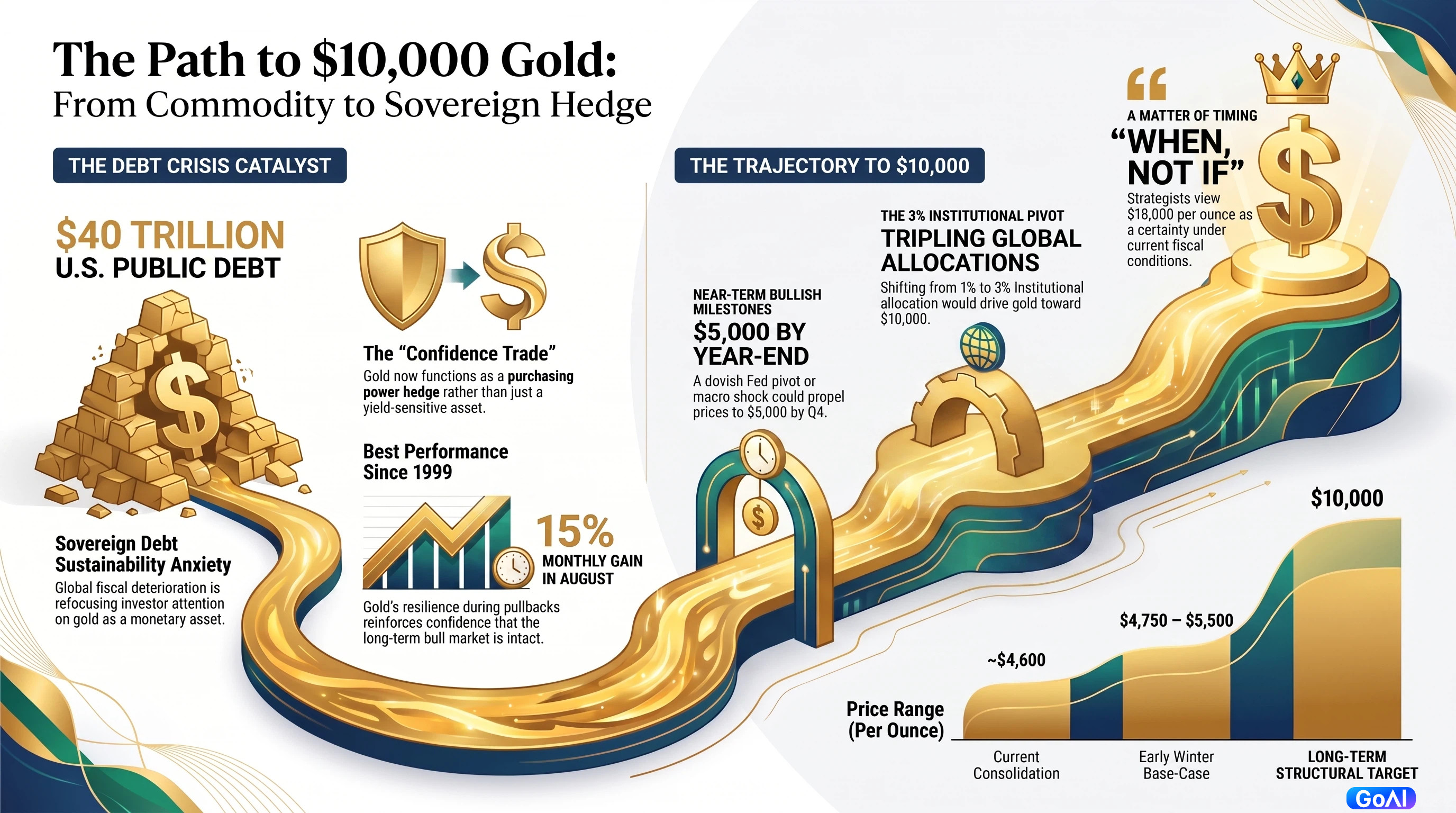
Recent pullbacks in gold appear to have done little to damage its secular investment thesis. With sovereign debt sustainability anxieties re-emerging across global markets, one strategist sees bullion testing $5,000 per ounce by year-end.
Aakash Doshi, Head of Gold Strategy at State Street Global Advisors, noted in a recent interview that investors should look toward even higher milestones.
Under the current global macroeconomic backdrop, he views gold reaching $10,000 per ounce as a matter of timing rather than probability.
Doshi's bullish outlook comes alongside a roughly 15% gain for gold in August—pacing its best monthly performance since January 1999. Spot gold is currently consolidating near $4,600 per ounce.
He explained that the "debasement trade" that drove gold to record highs earlier this year never truly disappeared; it merely went dormant as rising interest rates and dollar strength generated near-term headwinds for precious metals.
"At State Street, we never thought it was dead; we just thought it was paused. And now I think it's got a fresh wind in its sails," Doshi said.
"That momentum has been rekindled by key macro developments swinging back in gold's favor: the Federal Reserve has not matched hawkish market expectations, the U.S. labor market is softening, and the Treasury's decision to expand long-duration bond buybacks has refocused attention on deteriorating fiscal conditions," he added.
He noted that gold’s ability to defend the $4,000 per ounce floor during pullbacks before rebounding into the $4,600–$4,700 band reinforces confidence that the broader structural bull market remains intact.
State Street’s base-case projection models gold reaching between $4,750 and $5,500 per ounce by early winter. Doshi considers the low $5,000s (roughly $5,000 to $5,250) a reasonable target range, noting that upward trajectory could materialize sooner than previously modeled.
He added that a dovish Fed pivot or another macro shock could propel bullion to $5,000 as early as the fourth quarter.
"We are beginning to see a sharp resurgence in inflows from Western ETF allocators," Doshi said. "There is substantial room for participation to expand."
Sovereign Debt Anchor
While central bank policy remains an important tactical variable, Doshi emphasized that sovereign debt sustainability presents a far larger structural concern for global markets.
With U.S. public debt crossing $40 trillion, Doshi stressed that the issue extends well beyond Washington. Fiscal deterioration and elevated long-term borrowing costs have become global vulnerabilities, impacting the UK, Europe, and Japan, where governments continue to run sizable fiscal deficits outside economic recessions.
"That macro backdrop will continue to offer broad structural support for gold as a global monetary asset. The core concern is the absolute debt load and the scale of deficit spending in non-recessionary periods," he added.
Shifting Inter-Market Dynamics
The evolving fiscal landscape is forcing institutional allocators to reassess gold's historical correlations. Historically, rising sovereign yields—particularly real yields—posed headwinds for bullion by increasing the opportunity cost of holding a non-yielding asset.
However, Doshi noted that investors must dissect the underlying drivers of higher yields.
If yields rise because of accelerating economic growth and robust corporate earnings prospects, that backdrop presents genuine competition for gold.
Conversely, if yields climb because investors demand higher term premiums to compensate for inflation, uncontrolled fiscal issuance, and waning sovereign credit credibility, the market dynamics shift entirely.
In that regime, gold ceases to represent an opportunity cost and functions primarily as a purchasing power hedge.
"The thesis has shifted to: 'I hold gold against currency debasement, erosion of purchasing power, and debt monetization risks,'" Doshi remarked, noting that recent price action indicates this narrative is taking precedence.
This dynamic explains why gold has remained resilient alongside elevated long-term yields. While marginal declines in real yields typically benefit precious metals, a yield surge reflecting diminished confidence in sovereign fiscal discipline and a softer dollar can equally support gold prices.
"It is turning into a confidence trade," Doshi said. "Gold carries no credit risk, represents a scarce physical resource, and is underpinned by centuries of monetary history."
The Path to $10,000
Against this backdrop, Doshi outlines a path for bullion to ultimately challenge $10,000 per ounce.
He cautioned that the transition will not happen overnight and will depend on how broader financial markets digest compounding fiscal pressures. For instance, a recession could drive safe-haven bids into gold while concurrently restoring demand for government bonds, temporarily easing debasement pressures.
Nevertheless, Doshi maintains that the long-term vector remains clear: "I think $10,000 is a question of when, not if."
Doshi emphasized that gold does not require extreme asset reallocations by global institutions to reach five figures.
Gold-backed funds currently account for less than 1% of total global ETF and mutual fund assets. If institutional allocation targets shift toward a 3% baseline—roughly tripling current penetration—that rotation alone would generate sufficient structural demand to push gold toward $10,000 per ounce.