
Tesla Cybercab Set for High-Stakes Debut; Wall Street Watches Fleet Scale as Rival Waymo Preemptively Pushes Back

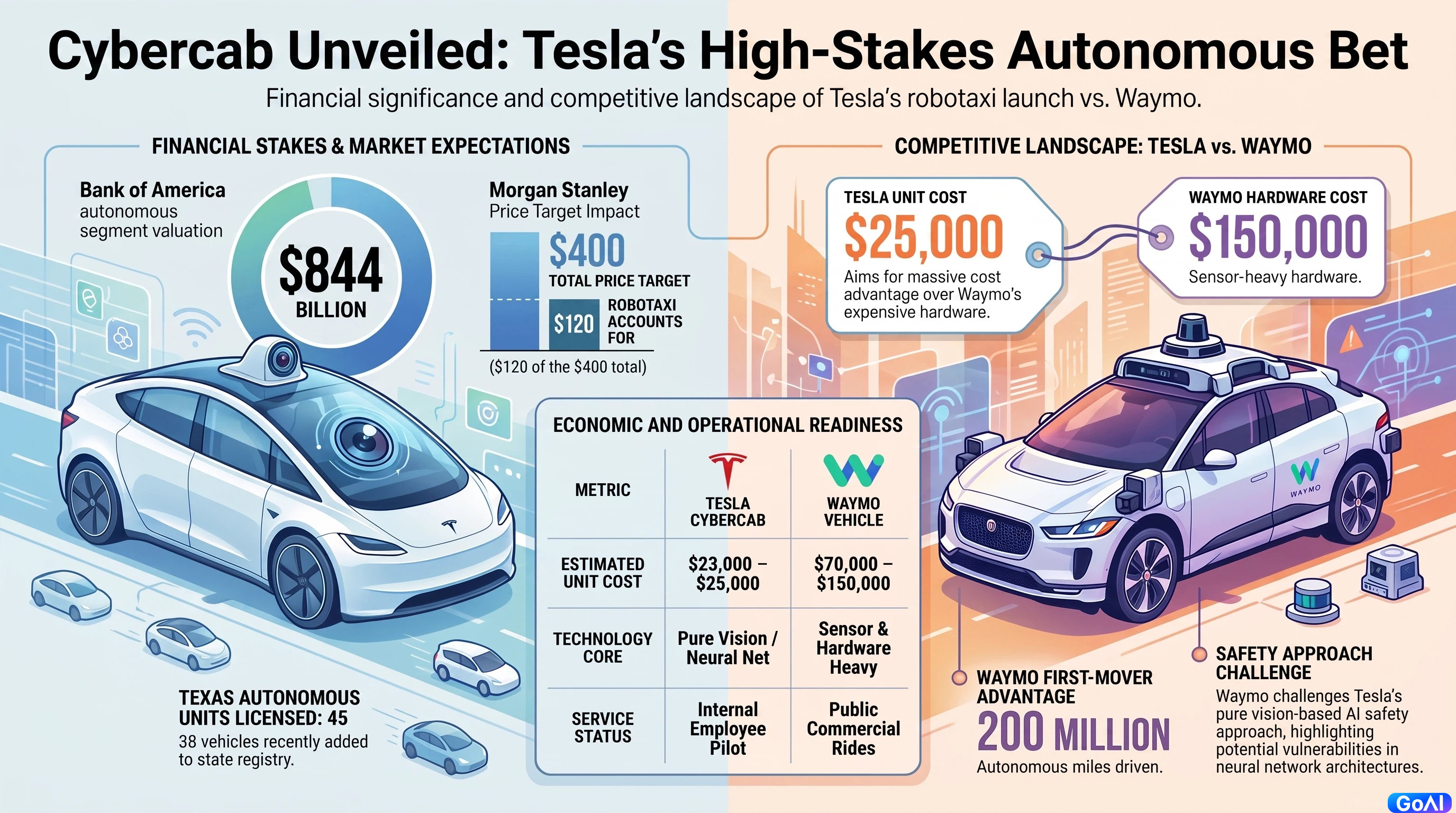
Tesla is scheduled to officially unveil its dedicated autonomous robotaxi, the Cybercab, on Thursday, marking a critical milestone in Elon Musk's push to challenge Alphabet's Waymo in commercial driverless ride-hailing.
The launch carries outsized significance for Tesla's equity valuation. Morgan Stanley analyst Andrew Percoco noted Wednesday that the Cybercab debut is far more consequential than past product showcases, pointing out that the robotaxi initiative accounts for $120 of the bank’s $400 price target on the stock.
In March, Bank of America valued Tesla’s autonomous taxi segment at $844 billion—roughly half of the company’s implied total value at the time.
However, Tesla shares have struggled year-to-date, sliding more than 18% as the company's market capitalization compressed to $1.12 trillion.
Percoco cautioned that if Thursday's showcase proves to be a static reveal with limited immediate operational deployment, the stock is likely to face downward pressure. Conversely, concrete evidence of near-term fleet scaling could spark a sharp rally.
Fleet Scale Under the Microscope
Investor scrutiny is elevated following Musk's commentary in late July signaling a "cautious rollout" for robotaxis, which sent Tesla shares tumbling 14.5% in a single session. As a result, Thursday's event serves as a pivotal litmus test for the commercial roadmap.
"Investors need to see more than just a handful of prototype vehicles on the road," Percoco noted, adding that deploying 25 to 50 operational Cybercabs across Texas within days or weeks following the event would be viewed favorably by the market.
Regulatory filings indicate that initial groundwork is underway. According to data from the Texas Department of Motor Vehicles, Tesla added 38 Cybercabs to its state autonomous fleet registry through Monday, bringing the licensed total to 45 units.
While internal employee pilot testing is active, commercial rides remain unavailable to the public.
Jamie Meyers, Senior Analyst at Laffer Tengler Investments, took a more measured view, cautioning that "in typical Musk fashion, Thursday’s event will likely generate substantial excitement while remaining light on execution specifics that move the needle for the stock."
Waymo’s Counteroffensive: Safety vs. Unit Economics
Sensing mounting competitive pressure, market incumbent Waymo published a pointed research brief last week titled "10 AI Lessons from Over 200 Million Fully Autonomous Miles."
The paper highlighted potential edge-case vulnerabilities inherent to pure vision-based, end-to-end neural network architectures—widely interpreted by analysts as an implicit challenge to Tesla's Full Self-Driving (FSD) safety approach.
Wall Street strategists view Waymo's preemptive warning as a tactical move to anchor the narrative on system safety, attempting to offset Tesla's massive cost advantage:
- Cybercab Estimated Unit Cost: $23,000 – $25,000
- Waymo Sensor & Hardware Cost: $70,000 – $150,000 per vehicle
If Tesla accompanies Thursday's debut with a credible, high-volume production schedule and aggressive regional deployment, Waymo's first-mover advantage in commercial autonomy could face structural disruption.
However, with Wall Street deeply divided on execution timelines, whether the Cybercab can immediately reshape the mobility landscape remains an open question.