
'Big Short' Investor Michael Burry Liquidates Nvidia and Palantir Puts Amid Portfolio-Wide De-Risking

Renowned contrarian investor and billionaire Michael Burry has pared back risk across his holdings, closing out headline put-option positions tied to artificial-intelligence bellwethers Nvidia and Palantir.
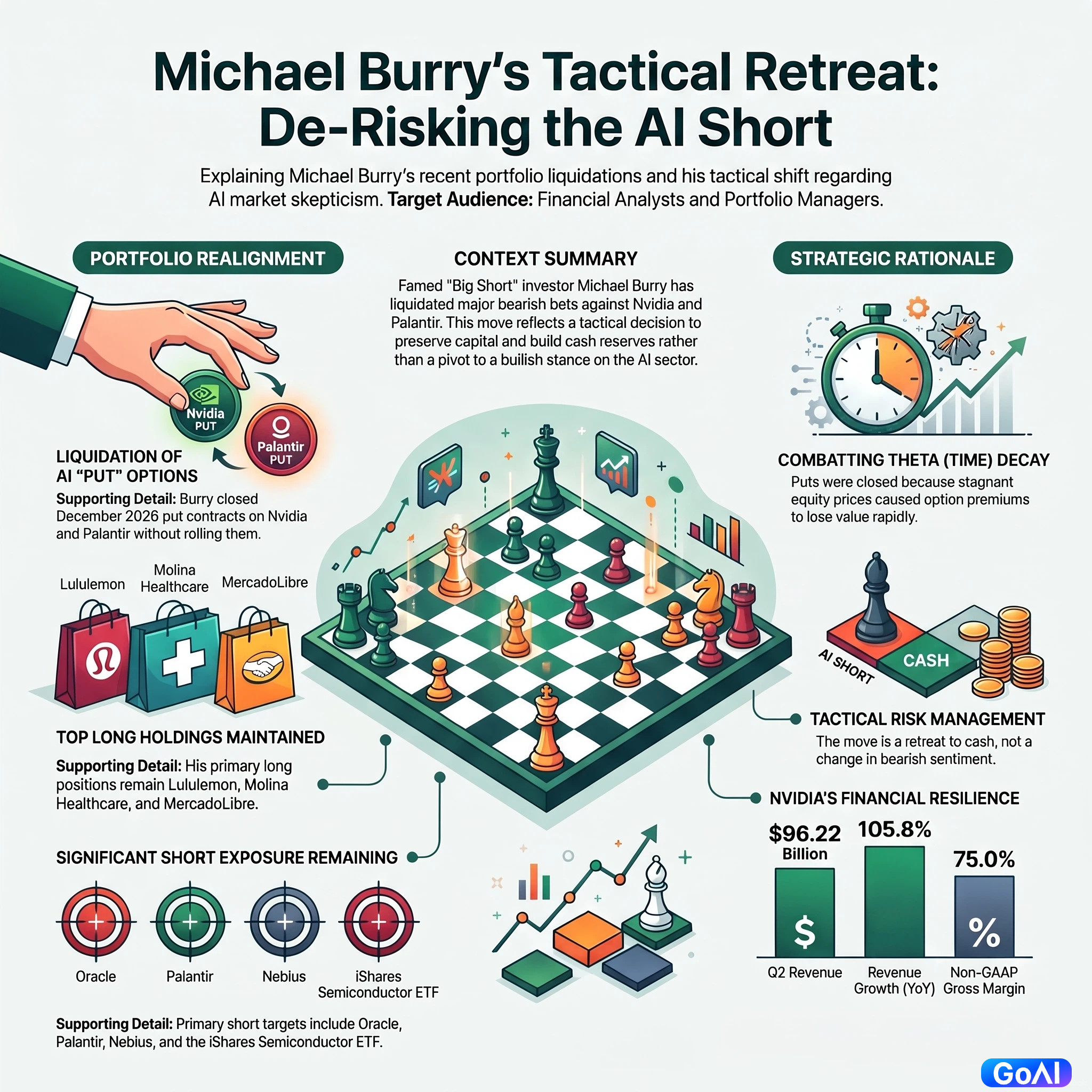
Burry disclosed that he liquidated December 2026 put contracts on both Nvidia and Palantir without rolling them forward, citing an intention to build cash reserves while assessing evolving market crosscurrents through the autumn.
The move marks a direct retreat from some of his most scrutinized bearish bets against the ongoing AI trade.
His three largest long holdings remain Lululemon, Molina Healthcare, and MercadoLibre, though he noted he has trimmed exposure across long books as well. Conversely, his primary short positions are led by Oracle, Palantir, and Nebius, followed by Nvidia and the iShares Semiconductor ETF.
Burry also noted that he is closely monitoring renewed softness across the Dollar Spot Index.
Core Investment Thesis Unchanged
Burry cemented Wall Street legend after successfully wagering against the subprime mortgage bubble ahead of the 2008 global financial crisis—a feat immortalized in the book and feature film The Big Short.
He had previously assembled massive options-based short exposures targeting the AI infrastructure ecosystem, including $187 million in notional value via Nvidia puts as part of an estimated $1 billion aggregate bearish bet against generative AI enthusiasm.
Crucially, the unwinding of these positions does not signal a pivot toward a bullish posture.
A primary factor driving the decision to close the puts was rapid time decay (theta decay): when an underlying equity fails to break down, shorter-dated put premiums bleed value at an accelerating pace.
Year-to-date, Nvidia shares have advanced over 15%, while Palantir has slipped 1.19%.
Broader market skepticism around the AI infrastructure trade continues to center on circular hyperscaler spending and towering debt issuance, leaving investors questioning whether end-market enterprise revenues can scale fast enough to support aggressive multi-year growth assumptions.
Nvidia’s late-August fiscal results temporarily alleviated some of those systemic concerns.
Second-quarter revenue surged 105.8% year-over-year to $96.22 billion, powered by a 117% jump in datacenter sales and non-GAAP gross margins reaching 75.0%, with management guiding third-quarter revenue to approximately $108 billion.
While Nvidia’s blowout print likely expedited Burry’s decision to prune downside hedges, his overarching thesis that AI valuations have outpaced fundamental monetization remains intact—the latest move reflects tactical risk management rather than a change of heart.