
Fed Rate Hike "Locked and Loaded" This Week: Wall Street Debates Whether the Bull Market Is in Jeopardy

Following Friday’s hotter-than-expected U.S. consumer price index report, traders broadly anticipate that the Federal Reserve will initiate an interest rate hike at this week’s policy meeting—marking its first tightening move in more than three years.
How equities will navigate this anticipated hike has become the central debate across dealing desks.
Historical tightening cycles provide a reference point—though past precedent offers no ironclad guarantee. Equities have historically stumbled out of the gate before regaining their footing.
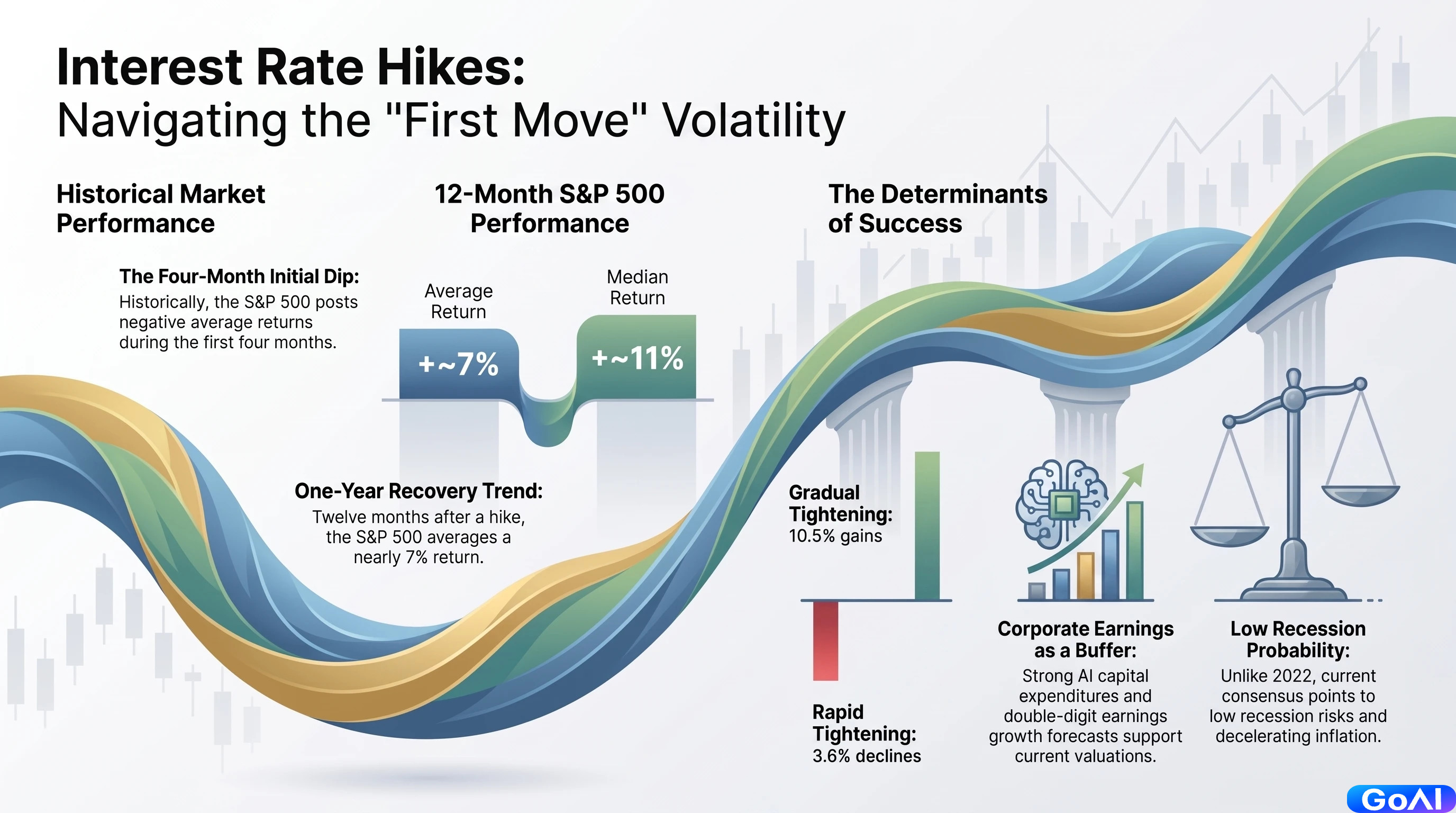
Jeff Buchbinder, Chief Equity Strategist at LPL Financial, pointed out in a recent research note that across the six rate-hiking cycles since 1994, the S&P 500 posted negative average returns over the first four months following an initial hike.
This historical trend implies that once the Fed delivers its decision, equity markets could face headwinds extending into early next year.
As of Friday's close, the benchmark S&P 500 had accumulated a year-to-date advance of nearly 12%, buoyed by resilient corporate profitability and steady macroeconomic growth.
Over a longer horizon, LPL’s data indicates equity performance tends to recover: 12 months after the onset of a tightening cycle, the S&P 500 has notched an average return of nearly 7%, with a median return of approximately 11%. (Using median figures strips out distortions from extreme outliers, such as the post-March 1997 rally when the index surged over 40%.)
"Rate hikes typically do not kill a bull market on their own. The dynamic shifts, however, when rate hikes coincide with mounting recession risks. At present, consensus assessments point to low recession probabilities," Buchbinder wrote.
Still, a positive 12-month trajectory following a first hike is not guaranteed. During the previous tightening cycle, which overlapped with the tail end of the pandemic, equities finished lower 12 months in.
With August core CPI coming in above consensus on Friday, market pricing shifted to reflect an approximate 90% implied probability of a September rate hike. In response, Goldman Sachs and JPMorgan both revised their interest-rate trajectories to incorporate a September move.
Should the Fed raise rates on Wednesday, it would mark its first rate hike since July 2023, when policymakers lifted the target federal funds range to 5.25%–5.50%.
The federal funds rate currently stands at 3.50%–3.75%. According to the CME Group FedWatch Tool, interest-rate futures imply an 86% probability of a 25-basis-point rate increase this week.
Wall Street Debates the Fallout
While equity investors are often skittish around rate hikes, several Wall Street strategists argue that a move this year should not trigger excessive alarm.
Jonathan Shugar, Head of Cross-Asset Sales across FICC and Equities at Goldman Sachs, remarked on a podcast Friday that higher rates will not necessarily halt the equity advance.
He noted that robust second-quarter earnings growth and valuations hovering near 10-year historical averages suggest the market is not overextended.
Whitney Stewart, Client Portfolio Manager at Sterling Capital Management, highlighted that hyperscaler capital expenditures across artificial intelligence continue to drive outsized corporate earnings gains.
Stewart noted that consensus forecasts point to double-digit earnings growth for S&P 500 constituent firms in 2027. If AI spending momentum remains intact, that earnings growth could offset any compression in multiples stemming from higher discount rates.
Another supporting factor is that while inflation remains sticky, the broader trajectory points toward deceleration from May’s peak of 4.2%.
That disinflationary trend should allow the Fed to proceed at a measured pace. Historical data suggests the cadence of tightening is a critical determinant of equity performance, as a gradual trajectory allows markets more breathing room to absorb policy adjustments.
Kevin Gordon, Director of Macro Research and Strategy at Charles Schwab, observed in a client note Thursday that during gradual tightening cycles, the S&P 500 gained an average of 10.5% over the subsequent 12 months.
In contrast, rapid tightening regimes saw the index decline by an average of 3.6% over the same timeframe.
The ultimate scale of rate hikes is equally decisive. In 2022, the Fed enacted aggressive, successive jumbo rate hikes to rein in inflation running above 9%, driving the policy rate from near-zero to over 5% in a matter of months and sending the S&P 500 down nearly 20% on the year.
This time around, policymakers are unlikely to require comparable tightening magnitude, meaning any market retrenchment should prove far less severe.
"The Fed is essentially dealing with the residual stubborn tail of inflation," said Mike Reynolds, Vice President of Investment Strategy at Glenmede. Reynolds noted that while a rate hike could trigger near-term asset repricing, "if the Fed does decide to move, my base case is that we will not see the type of sharp, sustained drawdown experienced in 2022."