
Gold Bull Run Far From Over? TD Securities Sees Next Leg Surpassing $5,000 Milestone

Gold prices have extended their pullback, breaching key technical support at $4,300 per ounce.
However, TD Securities argues the precious metal faces limited downside from here, maintaining that the macroeconomic backdrop remains structurally favorable for bullion to make another decisive run above $5,000 per ounce.
Ryan McKay, Senior Commodity Strategist at TD Securities, noted that while gold continues to absorb headwinds from rising interest rates, underlying institutional investment demand remains robust.
"Gold is gearing up for its next leg higher," McKay said. "Despite the Federal Reserve's rate hikes, gold has demonstrated remarkable resilience.
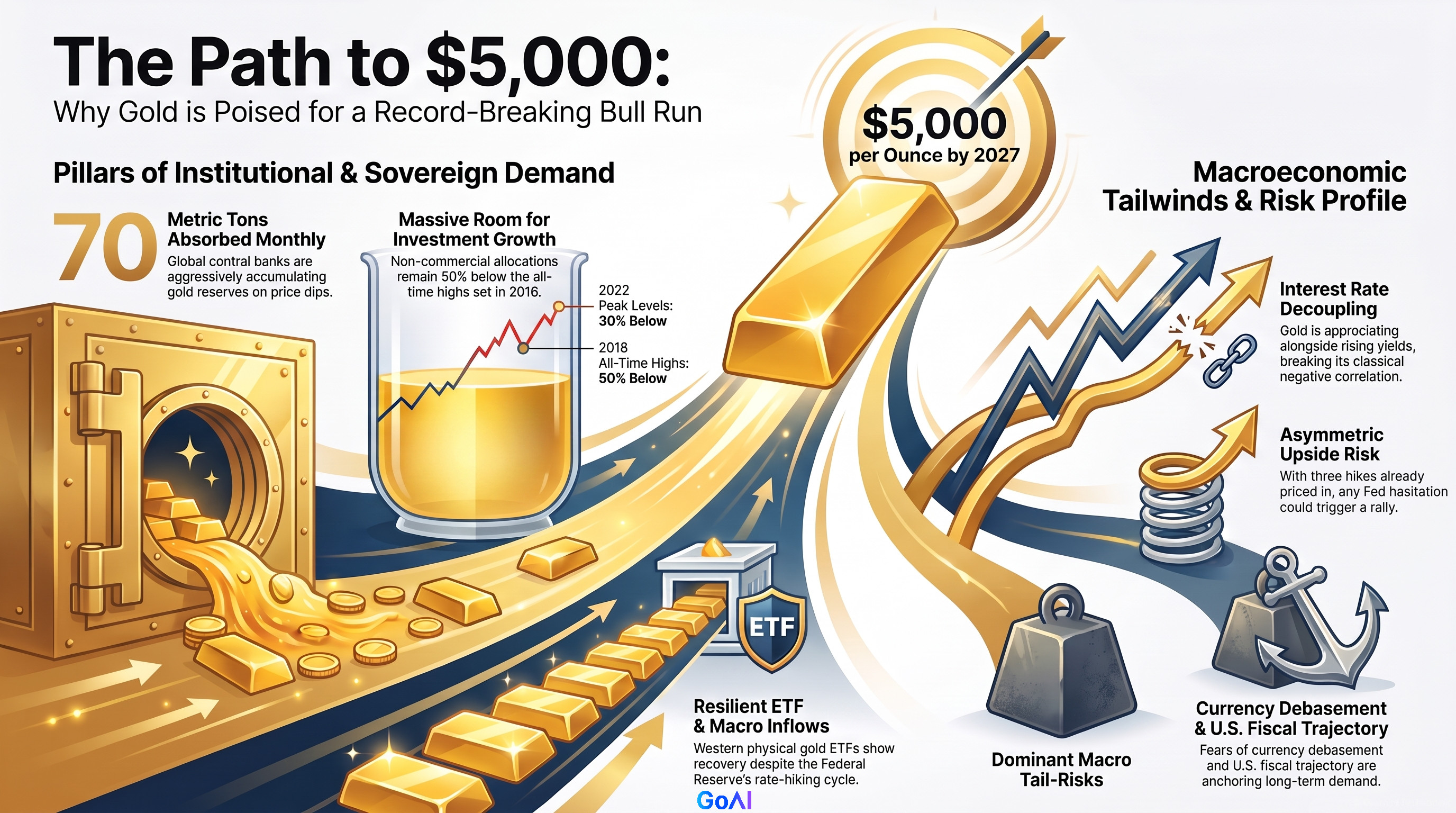
With demand from both institutional allocators and central banks accelerating once again, gold is poised to re-challenge and break above $5,000 per ounce in 2027."
While rising nominal interest rates and higher real yields traditionally pressure non-yielding bullion, McKay emphasized that this classical correlation has decoupled in the current cycle.
Historical precedents where gold appreciates alongside rising real yields are well-established, particularly when broader macroeconomic tail-risks dominate investor sentiment.
TD Securities maintains that intensifying geopolitical friction, mounting currency debasement fears, deteriorating sovereign fiscal balance sheets, and persistent inflation pressures will continue to anchor institutional demand.
Furthermore, McKay pointed out that swap markets have already fully priced in three rate hikes from the Federal Reserve.
This aggressive baseline creates an asymmetric risk profile skewed to the upside for gold, as any failure by the central bank to deliver on that hawkish terminal rate could trigger an accelerated rally.
Investment Inflows
TD Securities' constructive outlook does not rely solely on monetary policy. Beneath the surface, McKay highlighted a pivotal shift in underlying capital allocations.
Speculative positioning has steadily turned more constructive since June as macro funds began systematically rebuilding net long exposure.
This persistent bid supported bullion through the early summer, insulating prices even as expectations for central bank tightening gathered momentum.
Initial inflows were driven by renewed geopolitical friction, robust official sector purchases, and lingering skepticism over the Fed's capacity to restore price stability.
More recently, growing alarm over U.S. fiscal trajectory and a revival of dollar-debasement narratives have kept allocators engaged despite higher-for-longer policy rates.
Amid mounting fiscal uncertainty, TD Securities sees substantial headroom for discretionary investment demand to expand further.
The bank estimates that non-commercial allocations still sit roughly 30% below their 2022 peaks and remain approximately 50% below all-time highs set in 2016.
McKay noted that Western demand is steadily recovering through physical gold ETFs, showing minimal signs of deceleration even as the Fed resumed its rate-hiking cycle.
Central Bank Demand
Alongside resurgent private investor interest, structural reserve accumulation by central banks provides a formidable floor beneath bullion prices.
Drawing on customs declarations, cross-border trade flows, and inventory differentials, the World Bank estimates that global central banks are absorbing nearly 70 metric tons of gold per month on a three-month moving average basis.
McKay added that official sector reserve managers have grown increasingly opportunistic, actively accumulating bullion on dips at or below current trading levels.
For TD Securities, the confluence of heavy sovereign reserve buying, improving ETF flow dynamics, relatively clean speculative positioning, and persistent anxieties surrounding inflation, debt sustainability, and currency debasement suggests the current correction is cyclical rather than secular.
Even if the Federal Reserve sustains a hawkish posture, McKay concluded, these sticky long-term capital flows should allow gold to withstand higher borrowing costs and embark on a renewed multi-year bull cycle, taking prices comfortably above $5,000 per ounce by 2027.