
JPMorgan Doubles SpaceX Price Target to $500, Eyeing a $28 Trillion Addressable Market

SpaceX shares surged 10% on Wednesday following a blockbuster quarterly earnings print that showcased explosive revenue and profit growth fueled by its burgeoning artificial intelligence business.
The stellar performance triggered a wave of Wall Street upgrades, headlined by an exceptionally bullish note from JPMorgan Chase.
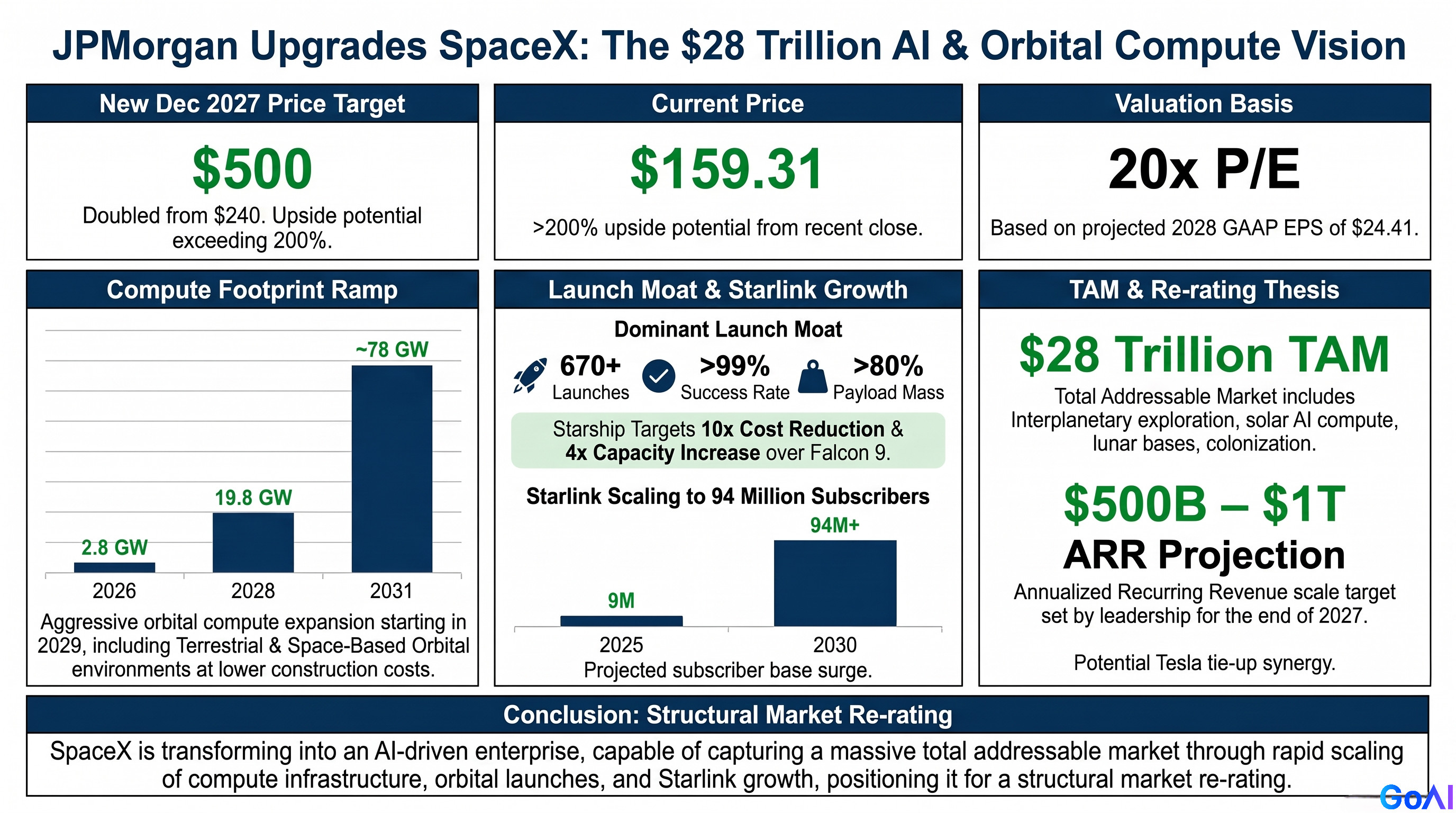
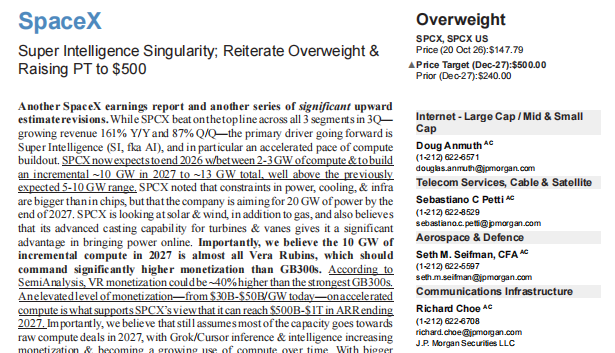
JPMorgan analyst Doug Anmuth dramatically doubled his December 2027 price target on SpaceX from $240 to $500, implying an upside potential of over 200% from Wednesday’s close of $159.31.
The revised target is based on a 20x price-to-earnings multiple applied to projected 2028 GAAP earnings per share of $24.41, reflecting higher intermediate earnings power alongside a conservative valuation multiple adjustment.
The core thesis rests on a sweeping premise: "In our view, no other company is as well-positioned as SpaceX to capture a massive total addressable market (TAM) estimated to exceed $28 trillion," Anmuth wrote.
The Macro Vision: From Launch to Orbital Compute
JPMorgan noted that SpaceX’s ambitions transcend traditional aerospace boundaries—spanning interplanetary exploration, space-based solar AI compute, lunar bases, and planetary colonization.
While Q3 results beat expectations across all three major operating segments, the long-term growth engine has decisively pivoted toward super-intelligence and accelerated infrastructure deployment:
Terrestrial & Orbital Compute: JPMorgan projects SpaceX’s ground-based compute footprint will expand from 2.8 gigawatts at the end of 2026 to 19.8 gigawatts by year-end 2028.
From 2029 onward, the firm expects SpaceX to aggressively scale space-based orbital compute, reaching approximately 78 gigawatts by 2031 at a fraction of terrestrial construction costs.
Launch Moat: Rocket manufacturing and launch remain the foundational baseline. Since 2023, SpaceX has completed over 670 orbital launches with a success rate exceeding 99%, capturing over 80% of total global payload mass.
The next-generation Starship is expected to achieve a tenfold cost reduction and a fourfold capacity increase over the Falcon 9, with launch cadence projected to scale from a handful of batches in 2026 to roughly 5,000 launches by 2031.
Connectivity: Starlink forms the bedrock of current telecom operations, with broadband subscribers projected to surge from 9 million in 2025 to over 94 million by 2030, while mobile virtual network operator (MVNO) models present longer-term upside optionality.
Constructing the Ultimate Technology Hegemony
SpaceX’s evolution has long surpassed rockets and satellites. By integrating custom silicon, hyperscale data centers, and the Grok AI model into a fully-verticalized ecosystem, AI services have rapidly eclipsed traditional operations to become its largest revenue pillar.
This expansive footprint also provides the strategic rationale behind the ongoing exploration of a potential merger with Tesla.
With special committees established across both boards to evaluate a tie-up, the combination could link Tesla’s cash-generative autonomous ride-hailing and humanoid robotics network with SpaceX’s orbital infrastructure and frontier AI planning layers.
During the earnings call, Elon Musk projected that SpaceX’s annualized recurring revenue could reach between $500 billion and $1 trillion by the end of 2027.
As this quarter's results demonstrate, SpaceX has effectively morphed into an AI-driven enterprise, setting the stage for a dramatic structural re-rating across global capital markets.