
From Hottest Market to Deep Value: South Korean Stocks’ Forward P/E Sinks to Near 20-Year Lows

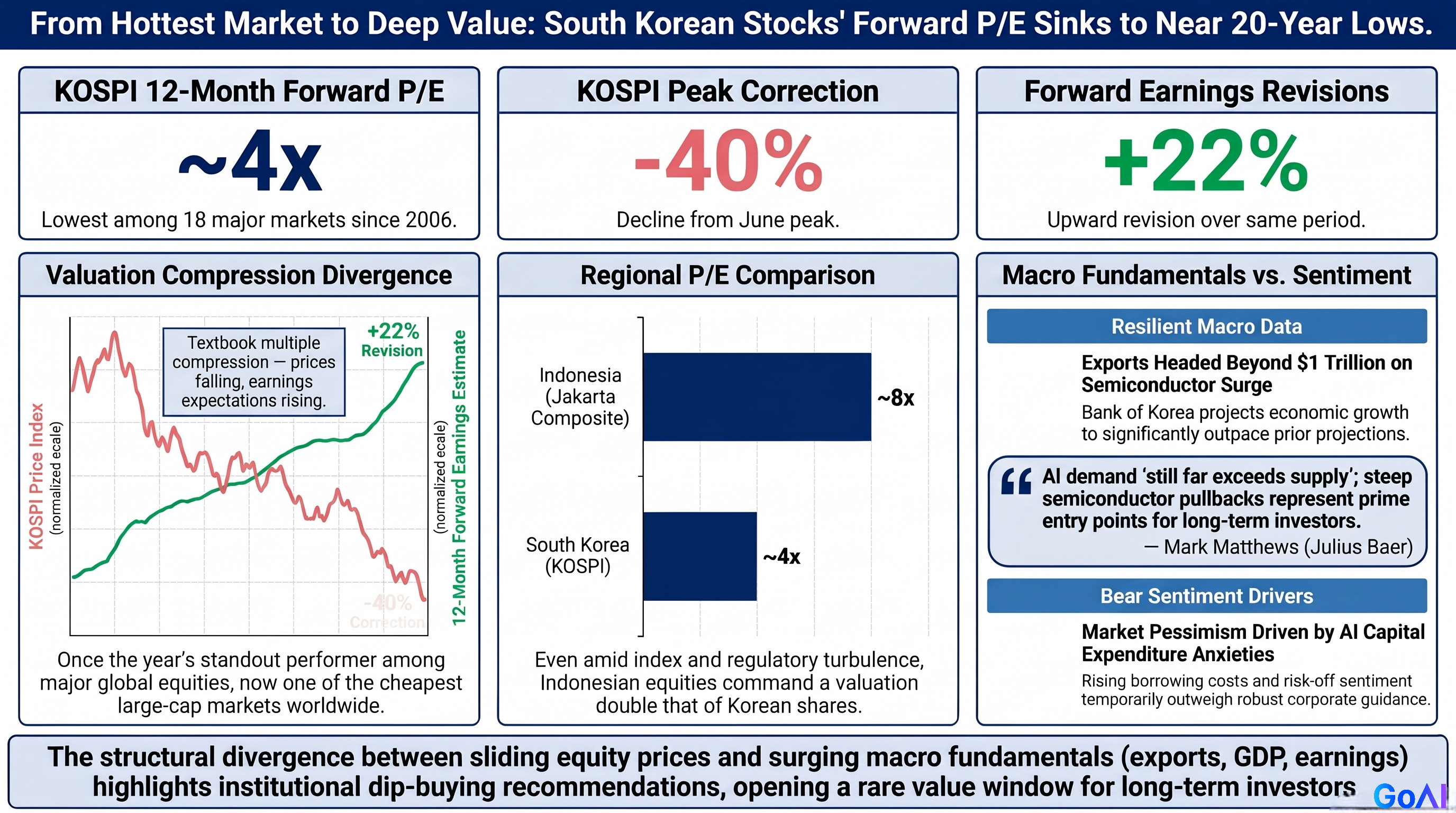
South Korea’s stock market, once the year’s standout performer among major global equities, has plunged to become one of the cheapest large-cap markets worldwide.
Driven by a vicious tech liquidation, a striking divergence has emerged between sliding equity prices and robust macroeconomic fundamentals—anchored by surging exports and upwardly revised economic forecasts—prompting select institutions to advocate for dip-buying strategies.
According to reports on October 23, the 12-month forward price-to-earnings ratio of South Korea’s KOSPI index has tumbled to roughly 4x. Among 18 major markets with a market capitalization exceeding $1 trillion at the start of the year, this valuation level is unprecedented since 2006.
Data shows the KOSPI has corrected roughly 40% from its June peak, even as its 12-month forward earnings estimates were revised upward by 22% over the same period—a textbook compression of valuation multiples driven by falling prices alongside rising earnings expectations.
By comparison, Indonesia’s Jakarta Composite Index trades at a forward P/E of roughly 8x, despite facing a potential downgrade threat by MSCI from emerging markets directly to standalone status over investability concerns.
In short, even amid index and regulatory turbulence, Indonesian equities command a valuation double that of Korean shares.
Commenting on the rout, Hui Ling Loh, managing director at Singapore-based ACG Management, noted that persistent investor anxieties over aggressive artificial intelligence investments have continued to outweigh strong corporate earnings and guidance.
She added that market participants are also weighing the impact of rising borrowing costs on AI-linked equities, which—compounded by intensifying risk-off sentiment—has severely weighed on overall risk appetite.
The selloff highlights how markets with heavy technology weightings can see sentiment flip violently amid technological paradigm shifts, straining traditional valuation benchmarks. This prevailing pessimism stands in stark contrast to South Korea’s resilient macroeconomic backdrop.
Fueled by booming chip demand, South Korea's annual exports are on track to surpass $1 trillion.
The Bank of Korea kept interest rates unchanged on October 22, noting that economic growth for this year and next will significantly outpace prior projections following two consecutive rate hikes.
Views remain split on when sentiment will definitively normalize, though some investors view the correction as a rare accumulation window.
Mark Matthews, Head of Asia Research at Julius Baer, told reporters that AI demand "still far exceeds supply." In his view, steep pullbacks in semiconductor equities—such as those observed over recent trading sessions—represent prime entry points for long-term investors.