
Why Is the AI Trade Selling Off So Hard?

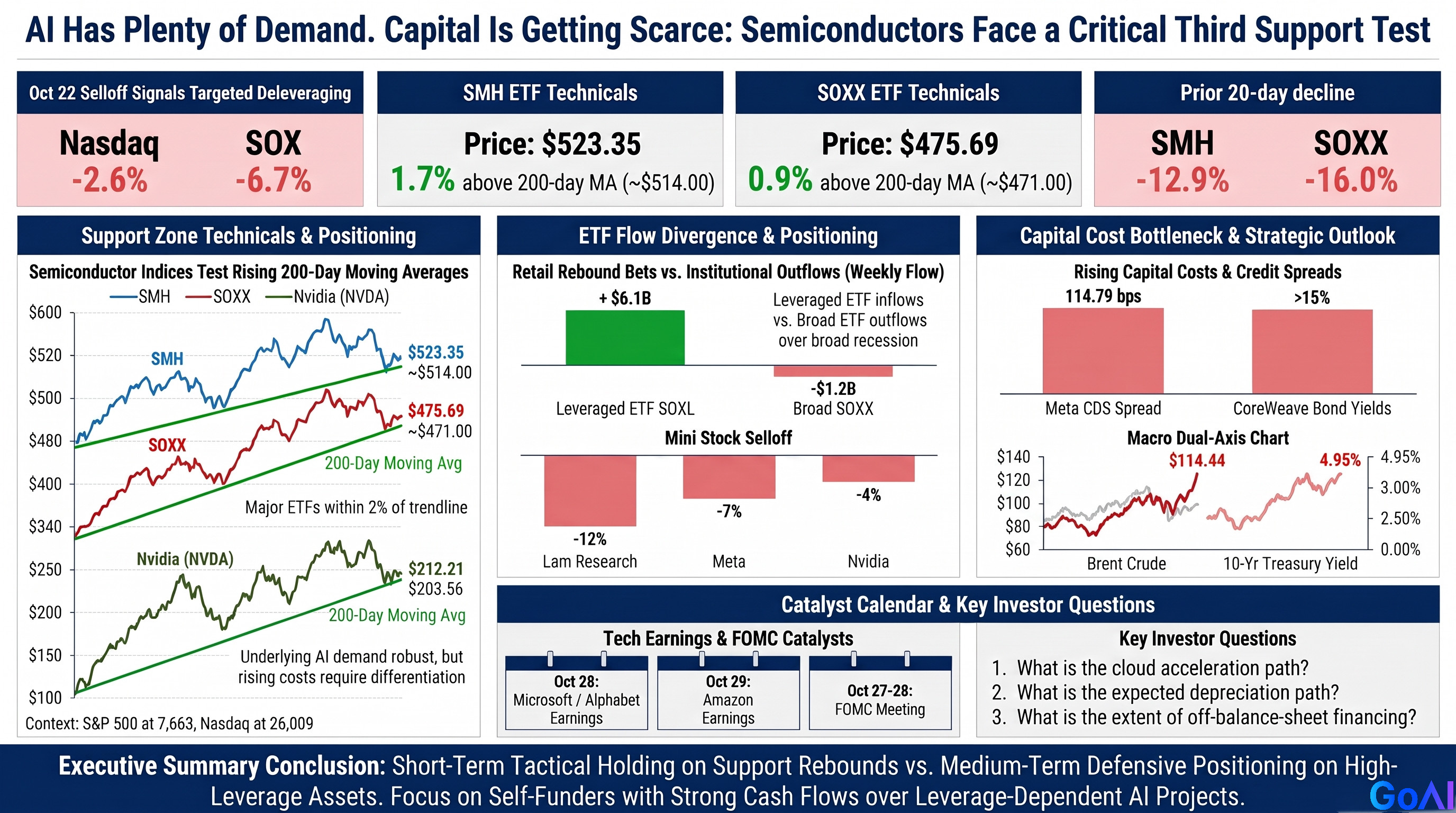
On October 22, the market washed through the AI trade. The Nasdaq Composite fell 2.6% and the Philadelphia Semiconductor Index lost 6.7%.
Meta fell 7% after reporting results and guidance above expectations; Nvidia fell 4%; Lam Research lost 12% despite record revenue and margins.
This was not an earnings-driven selloff. Investors were selling the bill: who will finance the next AI buildout, what will that capital cost, and who ultimately bears it?
More importantly, semiconductors have now reached the third support zone. By that we do not mean one magic price.
We mean the last area where a pullback can still be contained within an intact long-term trend: the rising 200-day moving averages, around $514 for SMH and $471 for SOXX. At the October 22 close, SMH stood at $523.35 and SOXX at $475.69—only 1.7% and 0.9% above those levels.
The market is already at the point where price action matters more than another headline.
Here is our call: the odds favor semiconductors holding this support zone in the near term. October 22 looked primarily like a violent deleveraging of a crowded trade, not a sudden collapse in AI demand. A rebound is possible.
That does not bring back the old market, where nearly every stock associated with AI moved higher. Over the next three to six months, AI assets will be sorted by their ability to fund themselves.
Companies with real cash flow, internal funding capacity, and durable customer relationships remain worth owning for the long run. Companies whose valuations depend on leverage, distant revenue promises, and repeated t…