
Samsung Electronics Delivers Blockbuster Q3: Operating Profit Tops 100 Trillion Won for First Time as Memory Crunch Persists

South Korean semiconductor bellwether Samsung Electronics Co. unveiled its third-quarter financial results on Thursday morning, posting historic highs in both revenue and profit fueled by relentless artificial intelligence chip demand.
Operating profit surged nearly eightfold, crossing the milestone 100 trillion won threshold for the first time in corporate history.
Despite the record-shattering print, both top- and bottom-line figures fell marginally short of consensus forecasts, triggering a "sell-the-news" reaction among market participants.
Samsung shares reversed early pre-market gains of nearly 3% to trade down approximately 5% at 230,250 won.
Key Q3 Metrics vs. LSEG SmartEstimates
- Revenue: 195.25 trillion won (+126.9% YoY, +13.85% QoQ) vs. 195.79 trillion won expected.
- Operating Profit: 107.44 trillion won (approx. $80.04 billion; +783.1% YoY) vs. 107.66 trillion won expected.
- Net Income: 75.13 trillion won (approx. $56.2 billion; +514.6% YoY) vs. 86.13 trillion won expected by FactSet consensus.
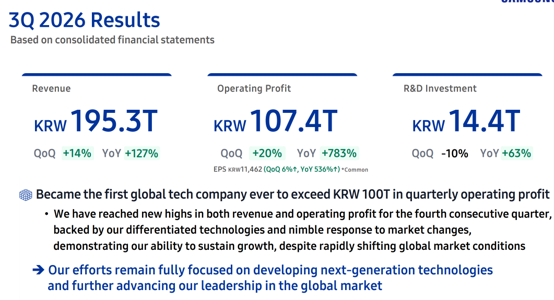
This marks the fourth consecutive quarter in which Samsung has established fresh all-time single-quarter records for revenue and operating profit, aligning closely with preliminary guidance issued earlier this month.
The milestone also establishes Samsung as the world's first technology firm to surpass 100 trillion won in quarterly operating profit.
On capital allocation, Samsung guided full-year 2026 capex to 84.4 trillion won, a substantial step-up from 52.7 trillion won deployed in 2025.
Semiconductor Division Drives Virtually All Profits
The Device Solutions (DS) division, which oversees Samsung's semiconductor operations, served as the primary earnings engine, generating nearly the entirety of consolidated operating income.
DS Division Performance: Revenue reached 147.1 trillion won (+15% QoQ), generating 106.5 trillion won in operating profit. Memory operations registered all-time record revenue and operating income.
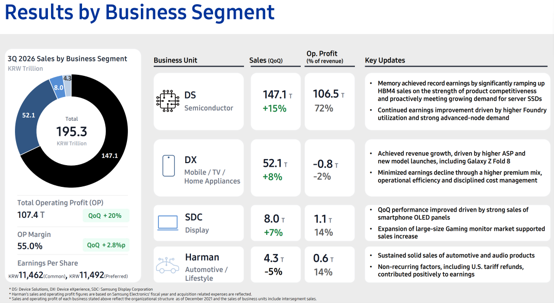
Product Mix & Advanced Nodes: Management attributed the record profitability to accelerating shipments of next-generation HBM4 memory alongside soaring enterprise server SSD demand. Q3 HBM4 revenue more than doubled sequentially.
Forward Roadmaps: Samsung projects Q4 DRAM bit shipment growth of 15% to 20% and reiterated plans to commence mass production of HBM4E in the first half of 2027.
Foundry Progress: Foundry operations saw sequential margin improvement driven by higher fab utilization and resilient demand for advanced lithography nodes, with Q4 foundry revenue guided to double-digit percentage growth.
Conversely, elevated silicon and component costs squeezed margins across Samsung's consumer-facing units.
The Device Experience (DX) division—encompassing smartphones, consumer electronics, and home appliances—recorded an 8% QoQ revenue increase but posted a small operating loss of 0.8 trillion won.
Capital Return & Shareholder Distributions
Samsung outlined an aggressive shareholder return framework:
- Quarterly Dividend: Declared a Q3 cash dividend of 4,601 won per share, totaling 30 trillion won.
- Annual Return Framework: Management reaffirmed its 2026 shareholder return target of 90 trillion to 110 trillion won. With 35 trillion won already deployed or committed, an estimated 55 trillion to 75 trillion won remains to be executed.
- Capital Return Channels: Residual funds will be directed toward sizable share repurchases, share cancellations, and supplementary cash payouts. Detailed allocation parameters will be formally disclosed in late January 2027.
Structural "Memory Crunch" Set to Extend
Echoing the bullish demand commentary delivered yesterday by peer SK Hynix—which posted its own record Q3 revenue of over 100 trillion won and a 632.1% surge in operating profit—Samsung emphasized that structural supply deficits will persist.
Management noted that memory shortages will intensify heading into next year, projecting that tight supply conditions will endure over the multi-year planning horizon.
Notably, Samsung confirmed that its entire HBM production allocation through 2027 is already fully committed and sold out.