
AI Spending Is Still Accelerating. Why Is the Market Selling Tech?

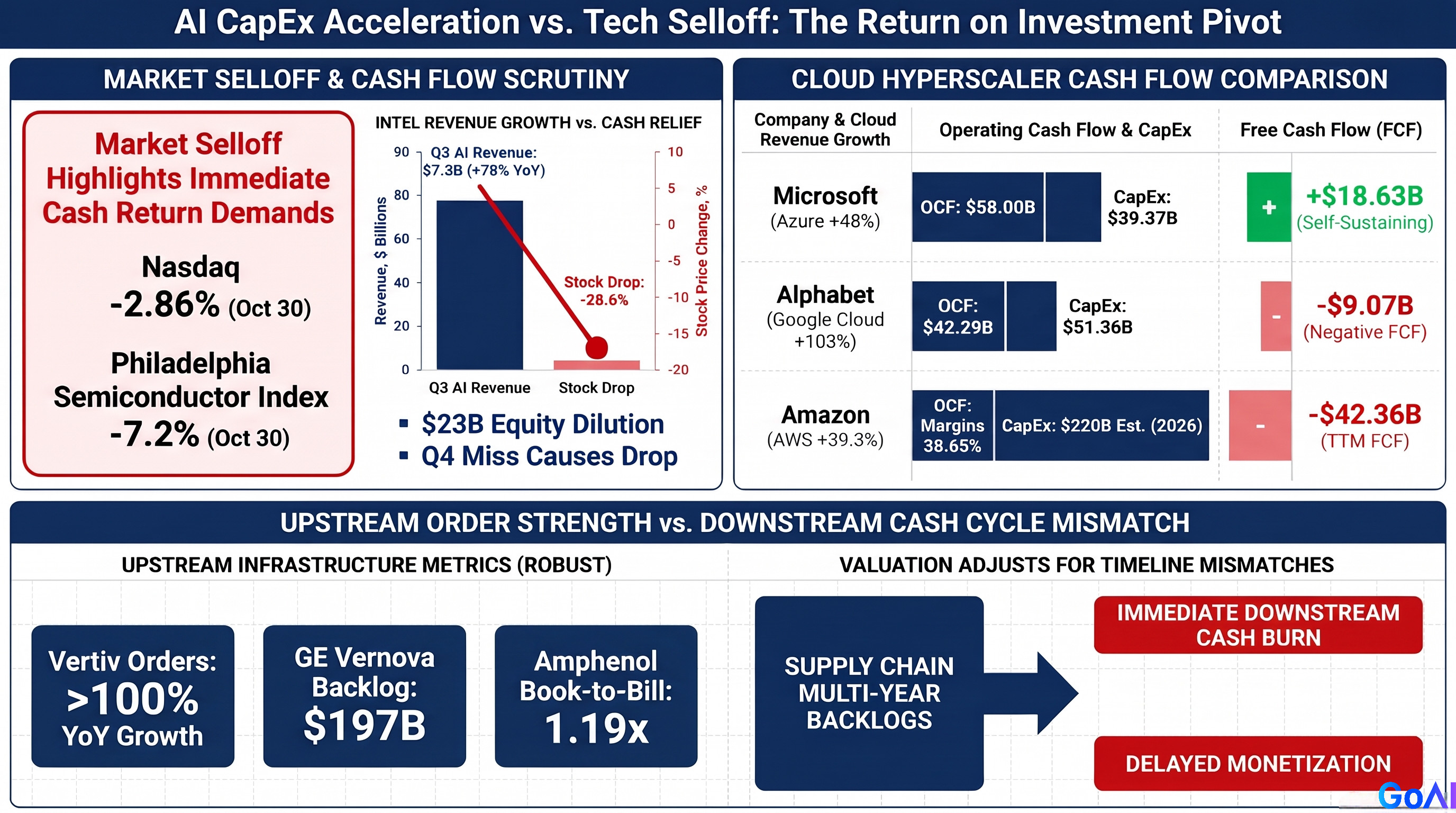
The last two days of earnings season have made the AI trade harder to explain.
Microsoft, Alphabet, and Amazon have not announced cuts to data-center buildouts. Cloud growth is still accelerating. Their capital-spending plans are getting bigger, not smaller. Under the old market playbook, that should have been bullish.
Yet the stocks most exposed to AI spending were the ones investors sold. On October 30, the Nasdaq fell 2.86% and the Philadelphia Semiconductor Index dropped 7.2%.
What is being repriced is not AI demand itself. It is the speed of cash payback—and whether the companies making these investments can keep funding them from their own cash generation.
Intel Made the Question Impossible to Avoid
Intel's third quarter did not look bad on the surface. Revenue reached $16.5 billion, up 21% year over year. Adjusted EPS was $0.52. Its Data Center and AI unit generated $7.3 billion in revenue, up 78%.
If that were the whole story, it would be difficult to connect the report with Friday's selloff.
But investors were looking ahead—and at the cost of that growth. Intel guided fourth-quarter revenue to $15 billion to $16 billion, below the $17.07 billion LSEG consensus.
Its adjusted EPS outlook of $0.25 also came in below the $0.43 estimate. Management expects PC-chip revenue to fall by roughly a quarter in the fourth quarter, with weakness lasting at least through the first half of 2027.
The more difficult issue is that AI growth has not removed Intel's funding pressure.
The company generated $5.082 billion of operating cash flow and $1.639 billion…