
As Hacks and Outages Pile Up, Could Gold’s Bear Market Turn? Wall Street Weighs a New Allocation Thesis

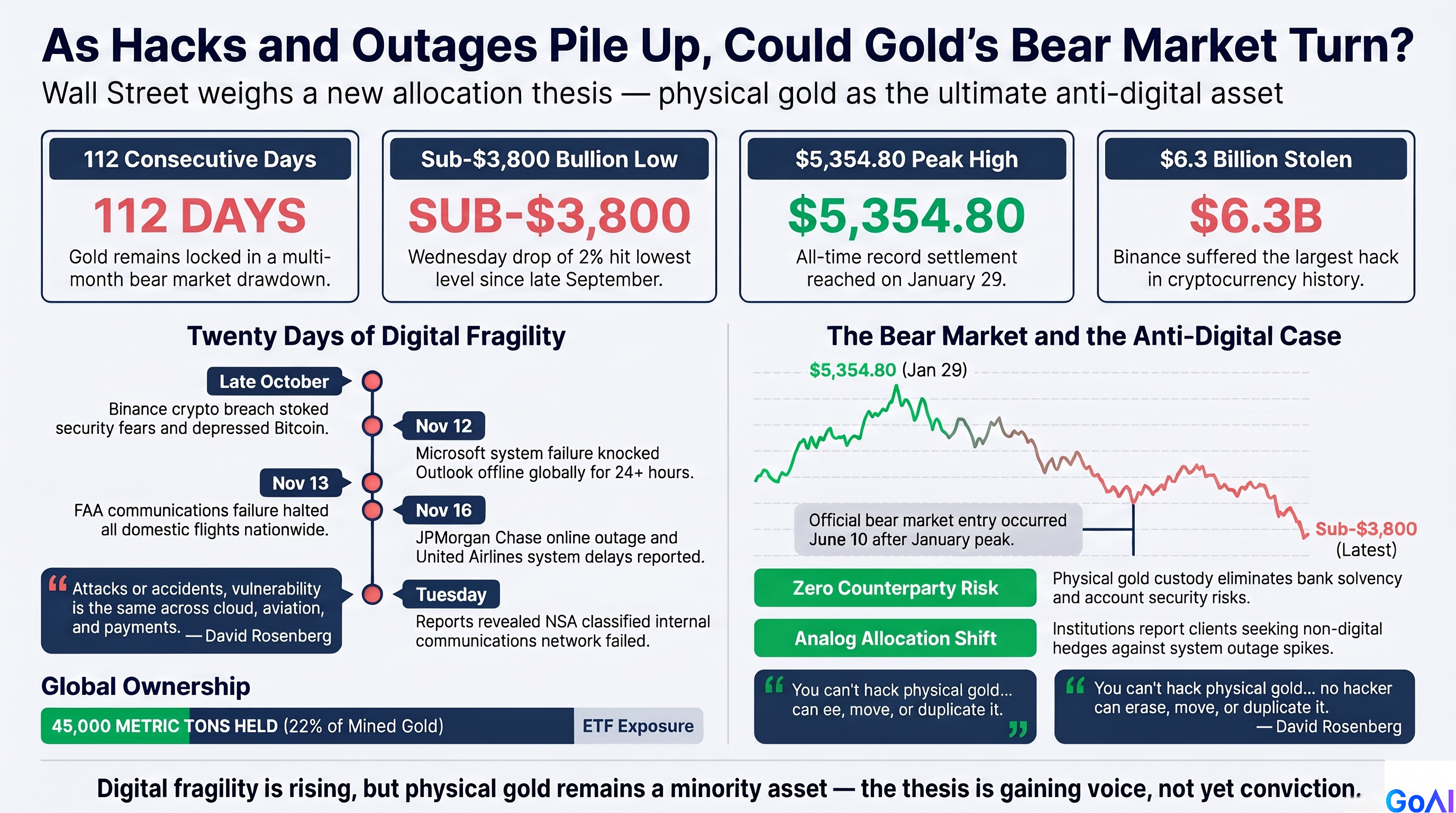
In less than 20 days, investors have witnessed the largest cryptocurrency hack in history alongside a string of high-profile digital outages.
This week brings another watershed moment: the first-ever IPO of an artificial intelligence lab, with Anthropic set to debut on the Nasdaq on Thursday.
While the digital realm steadily encroaches on the physical world, everyday life has grown increasingly vulnerable to disruptions caused by electronic system failures.
Email blackouts, banking glitches, and last Friday’s rare nationwide ground stop for U.S. flights have heightened investor anxiety over the fragility of digital infrastructure.
At the same time, gold has spent 112 consecutive days in a bear market. Bullion slid again on Wednesday, dropping as much as 2% to break below $3,800 an ounce—its lowest level since late September of last year.
Against that backdrop, a new allocation thesis is taking shape on Wall Street: physical gold, as the ultimate "anti-digital" asset, could gain fresh appeal as a portfolio diversifier.
“Physically held gold and silver do not rely on anyone’s promise to pay or perform,” said Stefan Gleason, president and chief executive officer of Money Metals Exchange. “They are money in and of themselves.”
Gleason noted that investors turn to physical precious metals held in personal custody to “eliminate counterparty risk.”
That includes exposure to bank solvency, account security, and access restrictions—as well as the counterparty risk inherent in holding U.S. dollars, whose purchasing power faces steady erosion as living costs climb.
Sameer Samana, head of global equities and real assets at Wells Fargo Investment Institute, said Tuesday that the apparent spike in digital disruptions makes this dynamic particularly relevant.
As a result, some clients have begun looking for “anti-digital or analog hedges,” he said.
“I think everyone is openly questioning right now whether they can meaningfully unplug from AI and the digital world,” Samana added.
In late October, crypto exchange Binance suffered a $6.3 billion hack—the largest theft in cryptocurrency history—stoking fresh security fears and sending Bitcoin sliding to a nearly three-month low.
Crypto is hardly the only source of concern. On November 12, a Microsoft system outage knocked services including Outlook offline globally for at least 24 hours.
The very next day, the Federal Aviation Administration issued a nationwide ground stop citing a communications failure, halting flights across all U.S. airports.
Then on Monday, November 16, JPMorgan Chase blamed an online banking disruption on a “software glitch,” while United Airlines reported flight delays stemming from an internal system outage.
By Tuesday, media reports indicated that even the National Security Agency’s classified internal communications network had experienced a failure.
“Whether these are attacks or accidents, the vulnerability is the same: single points of failure across cloud services, aviation communications, and payment networks,” said David Rosenberg, former chief North American economist at Merrill Lynch.
“Cyberterrorism could also be playing a role here. The takeaway is that there is no longer a completely safe way to store money digitally.”
Rosenberg believes gold could step into that void. As of Tuesday, bullion had remained in a bear market for 112 days.
According to Dow Jones Market Data, gold officially entered bear-market territory on June 10 after falling more than 20% from its record settlement high of $5,354.80 an ounce set on January 29.
“You can’t hack physical gold—whether it’s bars or coins—and no hacker can erase, move, or duplicate it,”
Rosenberg said, adding that his firm is considering boosting its exposure to precious metals, particularly now that the bear market has “shaken out weak hands,” leaving nervous investors selling at a loss.
Still, Gleason pointed out that outside of jewelry, people who own physical gold or silver in any form remain a distinct minority.
According to the World Gold Council, private investors globally hold roughly 45,000 metric tons of gold in bars and coins, accounting for about 22% of all the gold ever mined.
For now, Samana noted, individual investors hold most of their gold exposure through commodity exchange-traded funds. For the majority of buyers, he said, ETFs remain a practical way to own gold without taking physical delivery.