
Major Wall Street Banks Stay Bullish on the Dollar, Citing Durable AI Boom

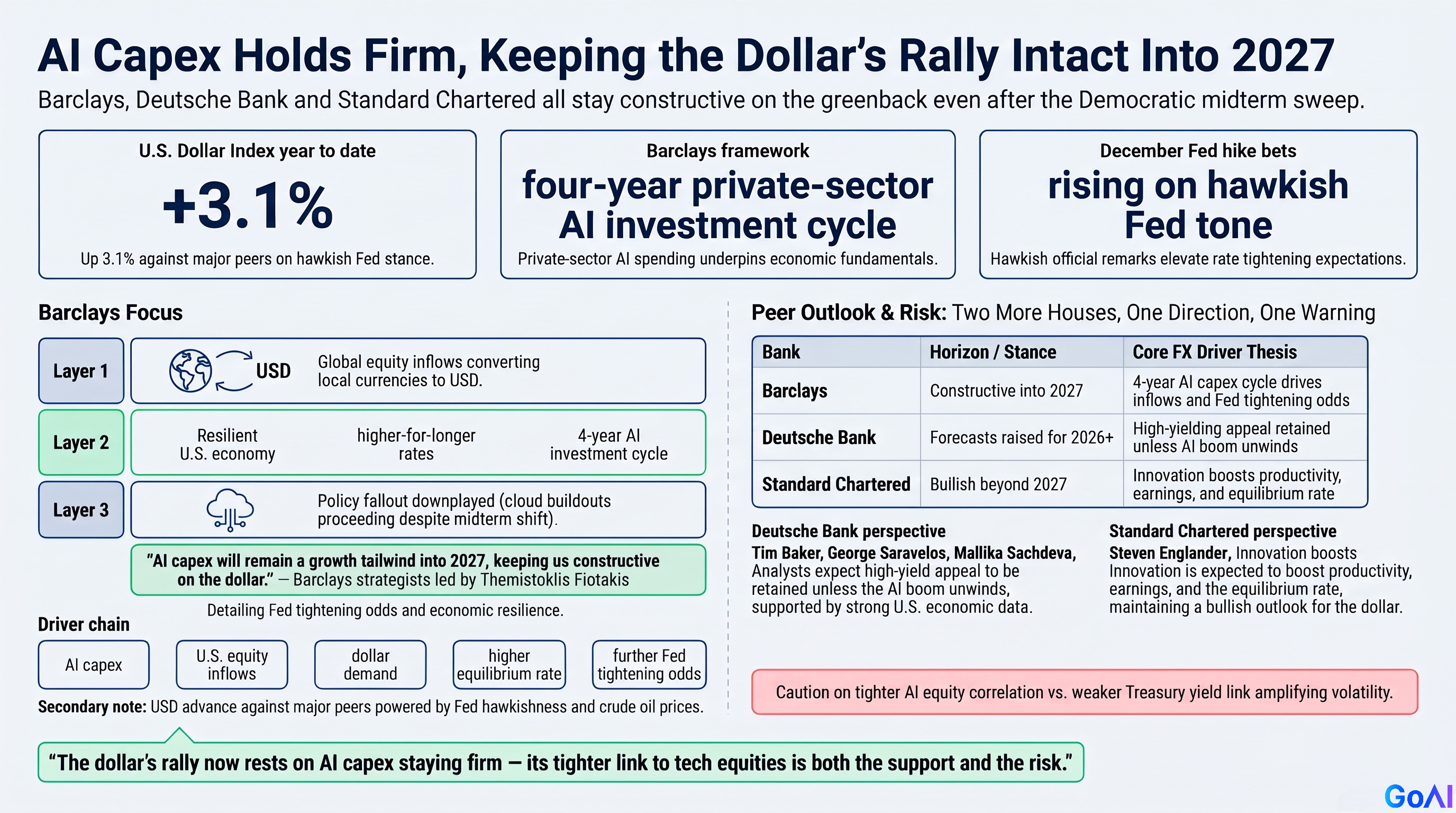
Despite growing concerns following the U.S. midterm elections that tech giants could rein in artificial intelligence spending—and potentially drag down the greenback—at least three major banks see AI capital expenditure holding firm, keeping the dollar’s rally intact into 2027.
Barclays Sees Dollar Strength Extending Into Next Year
Global inflows into U.S. equities, fueled by the AI boom, have been a key tailwind for the currency as overseas investors convert local funds into dollars to buy American tech shares.
Barclays noted that a resilient U.S. economy, higher-for-longer interest rates, and a four-year private-sector AI investment cycle provide solid fundamental backing for the greenback.
“AI capex will remain a growth tailwind into 2027, keeping us constructive on the dollar,” Barclays strategists led by Themistoklis Fiotakis wrote in a note Tuesday.
The bank also downplayed the fallout from the Democratic “blue wave” in the midterms.
While markets worry a Democratic-controlled Congress could slow AI infrastructure buildouts in the near term, Barclays expects existing projects to move forward, seeing no signs yet that major cloud providers are pulling back on spending.
Barclays added that the AI investment wave increases the odds of further Federal Reserve tightening.
Several Fed officials have struck a hawkish tone recently, prompting traders to step up bets on a December rate hike. Even if U.S. growth moderates, the bank said, the dollar is likely to remain resilient.
AI Momentum Continues to Underpin the Greenback
Year-to-date, the U.S. Dollar Index has gained roughly 3.1%, advancing against most major peers on the back of a hawkish Fed and rising crude oil prices.
Alongside Barclays, both Deutsche Bank and Standard Chartered expect AI demand to remain a key pillar of support for the currency.
On Wednesday, Deutsche Bank strategists including Tim Baker, George Saravelos, and Mallika Sachdeva raised their dollar forecasts for next year.
“Unless the AI boom unwinds, the dollar is likely to retain its high-yielding appeal and remain well supported,” they wrote.
Earlier this week, however, the bank cautioned that the dollar’s tighter correlation with U.S. AI equities—and weaker link to Treasury yields—could amplify currency volatility.
Standard Chartered strategist Steven Englander echoed the bullish view.
“If U.S. innovation continues to lift productivity, corporate earnings, and the equilibrium interest rate, U.S. markets will remain a magnet for global capital—and that is the core driver supporting the dollar,” he said, projecting that sustained AI inflows will carry the currency higher beyond 2027.