
US Equities 2027: Down Before Up

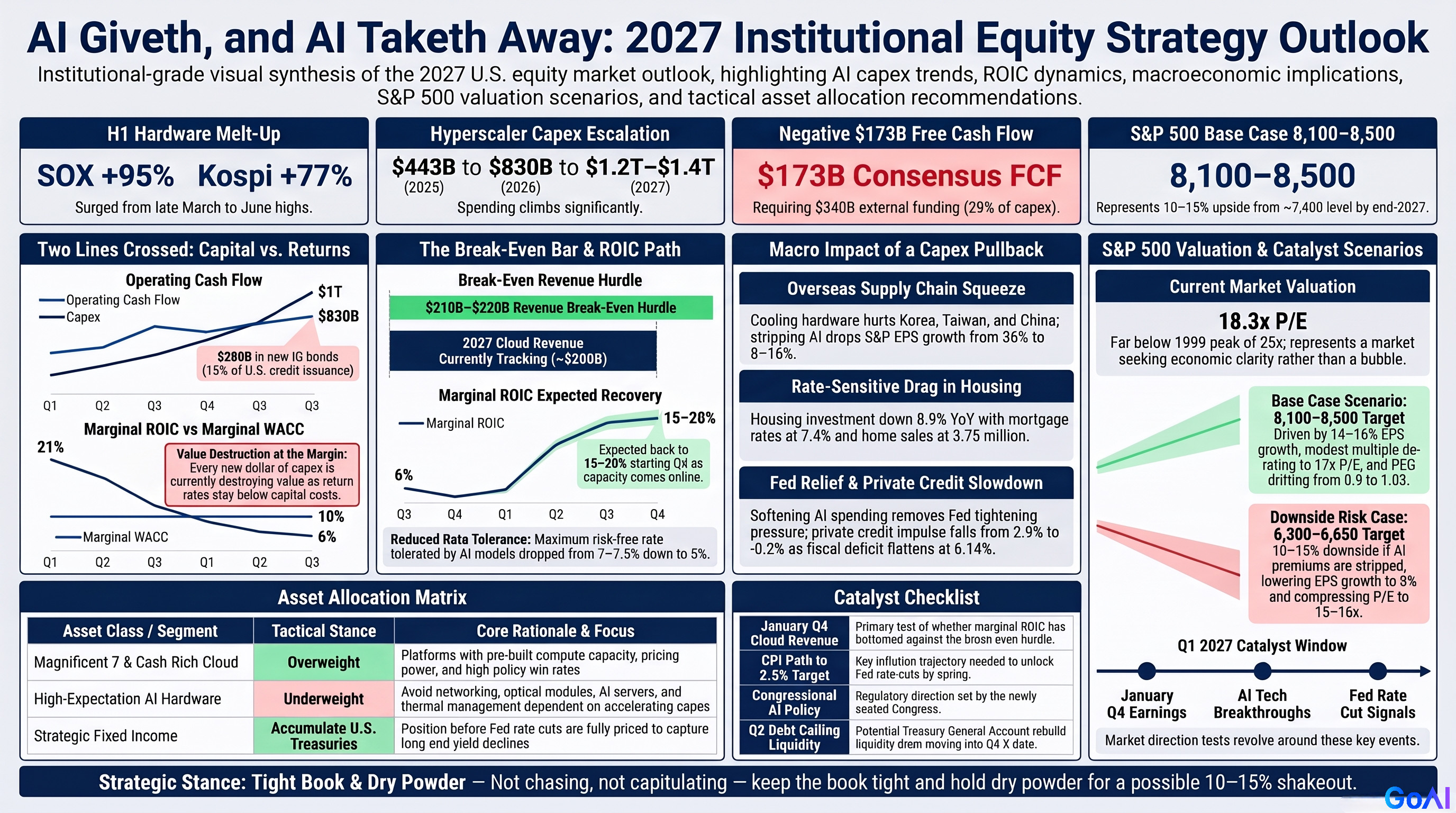
This year comes down to one line: AI giveth, and AI taketh away.
AI drove the hardware melt-up in the first half.
From late March to the June highs, the SOX ran as much as 95% and the Kospi 77%.
AI also drove the chaos in the second half: a crowded deleveraging, a 10-year yield that touched 5.3%, a Fed under Warsh that started hiking in September, and, once the midterm sweep came into view, the S&P's worst single day since the reciprocal-tariff shock.
A year on, we're right back where we were last December, asking the same question. Can AI earn back the money it's borrowing?
What's different now is that it isn't just AI's problem anymore. Growth, profits, rates and Fed policy all hang on that one answer. Our view for 2027 is simple: narrow the front, wait for the catalyst, and be ready for the market to go down before it goes up.
AI Has Hit Its Darkest Hour
After the frenzy in the first half, AI has crossed two lines.
First, revenue is now smaller than investment. US hyperscaler capex goes from $443 billion in 2025 to about $830 billion this year, up 87%.
Consensus has it at $1.2 trillion next year, closer to $1.4 trillion once you add SpaceX's "superintelligence" push.
Operating cash flow rises 35% to roughly $1 trillion, but it can't keep up. Consensus free cash flow for the group is negative $173 billion in 2027.
That gap needs outside money. We put the 2027 external funding need at about $340 billion, close to 29% of capex.
Roughly 80% of it comes from the IG market, which means about $280 billion of new bonds versus $250 billion this year, or aro…